History
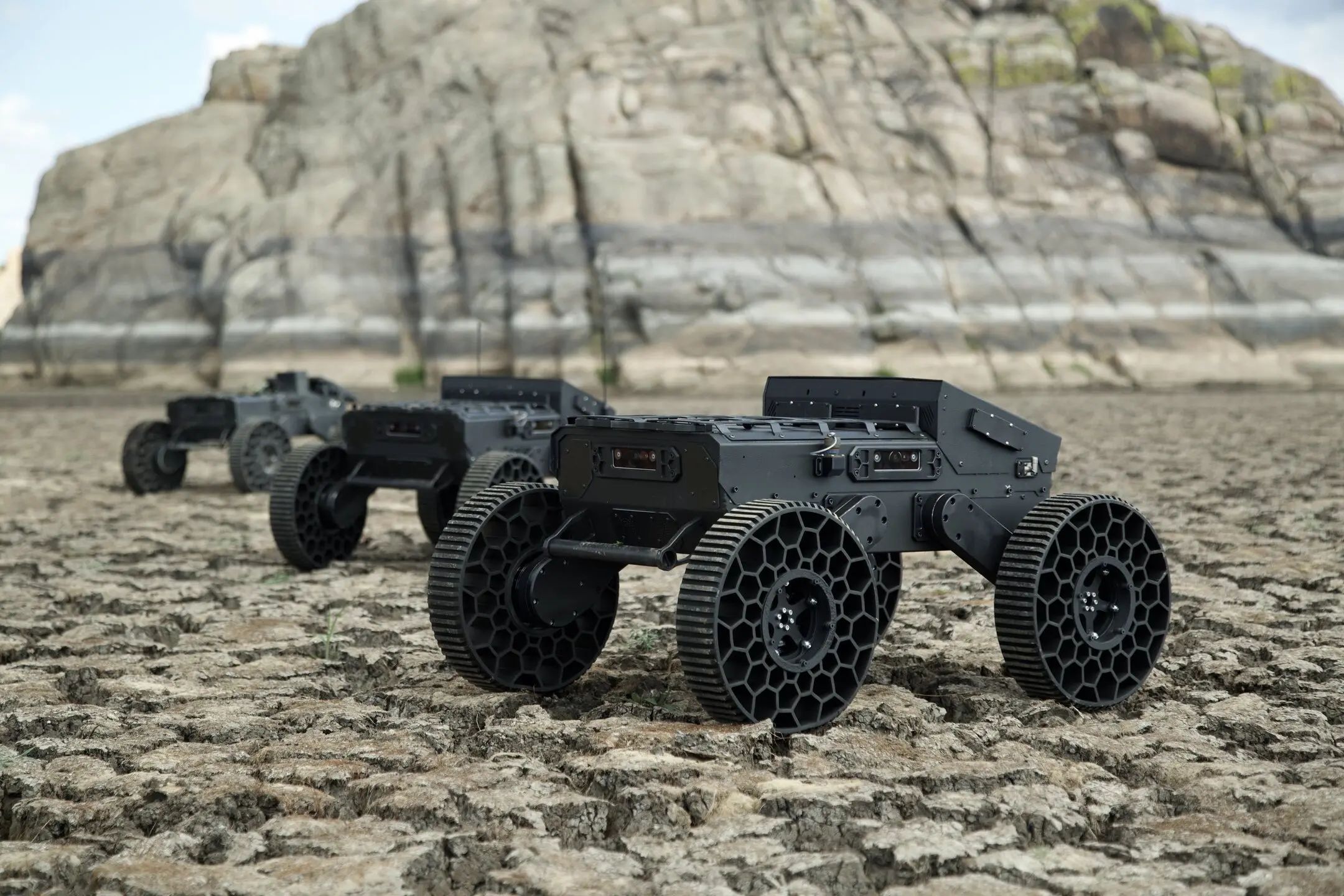
The Swarmbotics AI FireAnt is a compact unmanned ground vehicle developed as a modular and attritable platform for coordinated swarm operations. The tracked robot is intended to support military formations with reconnaissance, sensing, electronic warfare, counter-UAS, anti-armor and other mission-specific payloads.
The FireAnt has been demonstrated in U.S. Army experimentation, including an anti-armor field trial in 2025 and the Pegasus Charge 3 experiment in 2026. During Pegasus Charge 3, multiple FireAnt vehicles were carried externally by an M2A4 Bradley infantry fighting vehicle, illustrating one approach to integrating small ground robots directly into existing armored formations.
The program emphasizes groups of relatively small robots operating under limited human supervision rather than relying on a single large unmanned vehicle. Swarmbotics AI describes modular payloads and coordinated autonomous behavior as central elements of the system.
2025 anti-armor testing
From October 27 to 29, 2025, the U.S. Army conducted a multi-day FireAnt field test during the xTechOverwatch for Unmanned Systems event at the Innovation Proving Ground in Bryan, Texas. According to an Army Recognition report, the test examined swarm-enabled behavior, target tracking and the potential use of autonomous ground robots against armored threats.
The 2025 reporting described an anti-armor FireAnt configuration intended to locate, track and engage armored vehicles. Demonstrated or proposed payload concepts included loitering munitions, explosively formed penetrator devices and a lightweight recoilless weapon comparable in role to the M72 LAW. These armament descriptions apply to mission configurations and should not be interpreted as a fixed weapon fit for every FireAnt.
Swarmbotics AI also presented the FireAnt as part of a wider family of modular ground-robot missions. A Defence Blog report described rapid field-interchangeable payloads, swarm autonomy and compatibility with common robotic middleware including ROS 2 and JAUS.
2026 Bradley integration
On August 25, 2026, Swarmbotics AI released footage from the U.S. Army's Pegasus Charge 3 experimentation with the 1st Cavalry Division. The footage showed an M2A4 Bradley infantry fighting vehicle transporting multiple FireAnt UGVs as part of experimentation associated with the Army's Transformation in Contact initiative.
At least five FireAnt vehicles were visible on the Bradley's left-side external storage area. The imagery did not establish whether another group was carried on the opposite side, and it did not show the complete deployment procedure. The experiment nevertheless demonstrated physical integration of several compact UGVs with an existing frontline armored vehicle.
The FireAnts visible during Pegasus Charge 3 did not appear to carry the prominent anti-armor warhead configuration shown in earlier material. This supported the broader presentation of FireAnt as a modular platform that can carry different payloads for different missions rather than functioning only as an anti-tank robot.
Design
FireAnt uses a compact tracked chassis intended for movement over varied terrain. Reporting from the 2025 Army trial described the vehicle as weighing less than 90 kg and measuring slightly more than 1 m in length. Its size was described as allowing transport and deployment by a two-person fire team, while the same reporting also discussed potential air deployment by rotary-wing aircraft or unmanned aerial vehicles.
The vehicle uses a hybrid-electric drive. The configuration is intended to provide mobility while limiting thermal signature. Swarmbotics AI material reported through Defence Blog also described IP67 environmental sealing and resistance to dust, heat, vibration and shock.
Autonomy and swarm operation
Swarm operation is a central element of the FireAnt concept. Reporting from the 2025 Army testing stated that a single operator could command a group of six to eight FireAnts through a touchscreen interface. The robots were described as using peer-to-peer communications and coordinated behaviors for movement, positioning and mission execution.
The architecture is intended to support real-time tasking and data sharing among multiple robots. Swarmbotics AI has also described mixed teams performing different missions, allowing individual vehicles to carry different payloads while operating as part of a coordinated group.
Sensors and navigation
The anti-armor configuration described during 2025 testing carried a multispectral sensor package including infrared and electro-optical sensors together with laser rangefinding equipment. The reported system used onboard neural processing for computer-vision functions associated with detecting and classifying vehicles.
Reporting on the trials also described inertial navigation combined with GPS redundancy. These systems were intended to maintain positioning capability when satellite navigation was degraded, although the available material does not establish the complete performance of the navigation system under electronic attack.
Payloads
FireAnt is designed around a modular payload bay. Swarmbotics AI has presented reconnaissance, mapping, data-relay, electronic-warfare and counter-UAS roles in addition to anti-armor missions. Public material has also shown configurations intended for one-way attack missions.
For anti-armor use, reported payload concepts include loitering munitions, explosively formed penetrators and a lightweight recoilless weapon. Because the platform is modular, these should be treated as mission-specific configurations rather than standard equipment carried simultaneously by every vehicle.
Program status
FireAnt has reached field experimentation with the U.S. Army but the supplied evidence does not establish operational service or an Army-wide procurement decision. The 2025 xTechOverwatch event evaluated the platform in an anti-armor context, while the 2026 Pegasus Charge 3 activity examined how FireAnt robots could accompany an armored formation.
The Bradley experiment also addressed a practical integration issue. Instead of requiring a dedicated carrier, several FireAnt robots were transported by an existing M2A4 Bradley. This arrangement allows the Army to explore how robotic systems could be distributed within conventional mechanized formations while retaining their existing armored vehicles.
Important questions remain under experimentation, including communications resilience, survivability, maintenance, payload effectiveness, autonomy authorities and operator workload. Available evidence therefore supports describing FireAnt as a developing and experimentally evaluated UGV rather than an operational standard system.
Variants
- Anti-armor configuration: FireAnt configuration presented for detecting, tracking and attacking armored targets with interchangeable anti-armor payloads.
- Reconnaissance and sensing configurations: Modular configurations intended to carry sensors for intelligence, surveillance, reconnaissance and mapping missions.
- Electronic-warfare and counter-UAS configurations: Mission configurations identified by Swarmbotics AI for electronic effects and counter-unmanned-aircraft tasks.
- Data-relay configuration: A configuration described for communications and information relay within mixed robotic teams.
- One-way attack configuration: A publicly shown mission concept intended to deliver an expendable strike effect.
Specifications (FireAnt UGV)
General characteristics
- Type: Compact modular unmanned ground vehicle
- Mobility: Tracked chassis
- Length: Slightly more than 1 m
- Weight: Less than 90 kg (198 lb)
- Drive: Hybrid-electric
- Environmental protection: IP67 sealing reported by Swarmbotics AI
- Payload arrangement: Modular, field-interchangeable payload bay
Sensors and control
- Electro-optical sensing: Electro-optical and infrared sensors reported for the anti-armor configuration
- Rangefinding: Laser rangefinder reported for the anti-armor configuration
- Processing: Onboard neural processing for computer-vision functions
- Navigation: Inertial navigation with GPS redundancy reported during 2025 testing
- Swarm control: One operator reported as capable of controlling six to eight FireAnts
- Robotic middleware compatibility: ROS 2 and JAUS integration reported by Swarmbotics AI
Mission payloads
- Anti-armor concepts: Loitering munitions, explosively formed penetrator devices and a lightweight recoilless weapon have been reported as interchangeable options
- Other supported roles: Reconnaissance, mapping, data relay, electronic warfare and counter-UAS missions
 Argentina
 Armenia
 Australia
 Austria
 Austria-Hungary
 Belgium
 Brazil
 United Kingdom
 United States
 Brunei
 Bulgaria
 Canada
 Chile
Chile China
China Colonial America
 Colombia
 Confederate States
 Croatia
 Czech
Czech Denmark
 Egypt
Egypt Finland
 France
 Georgia
 Germany
 German Imperial
 Greece
 Holland
 Hungary
 India
India Indonesia
 Iran
Iran Iraq
Iraq Ireland
 Israel
 Italy
Italy Japan
Japan Japan (1940)
 Jordan
 Kingdom of Italy
 Malaysia
 Mexico
 Myanmar
 Nazi Germany
 Netherlands
 New Zealand
 North Korea
 Norway
 Pakistan
 Peru
Peru Philippines
 Poland
 Portugal
 Prussia
 Romania
 Russia
 Saudi Arabia
 Serbia
 Singapore
 Slovakia
 Slovenia
 South Africa
 South Korea
 Soviet Union
 Spain
Spain Sweden
 Switzerland
 Syria
Syria Taiwan
 Thailand
 Turkey
 UAE
UAE Ukraine
 Vietnam
 Yugoslavia