History
The MIM-104 Patriot and Terminal High Altitude Area Defense (THAAD) are distinct ground-based missile-defense systems used by U.S. forces to counter ballistic missile threats. Patriot also provides defense against aircraft, cruise missiles, loitering munitions, and other aerial targets. The two systems became closely linked in U.S. force-planning discussions in 2026 because combat operations against Iran consumed substantial numbers of both Patriot and THAAD interceptors.
Patriot originated in a U.S. Army effort for a mobile replacement for the Hawk and Nike Hercules air-defense systems. The program evolved through AADS-70 and Surface-to-Air Missile, Development (SAM-D), eventually becoming Patriot. Continuous modernization transformed Patriot from an aircraft-oriented surface-to-air missile system into a major component of ballistic missile defense.
THAAD serves a separate missile-defense role, but the available 2026 inventory analysis treated Patriot and THAAD together because both interceptor stocks were heavily used against Iranian missile attacks. Estimates indicated that restoring both inventories to their pre-war levels could require slightly more than three years under favorable production assumptions and potentially longer if combat expenditure continued.
Patriot development
The U.S. Army Missile Command began work on the concept that became Patriot in 1961. The effort was renamed SAM-D in 1964, and a prime contractor was selected in 1967. According to the CSIS Missile Threat profile, SAM-D conducted its first flight test in November 1969. Another account records the first unguided XMIM-104 test launch in February 1970. The revised SAM-D entered engineering development in 1976 and was renamed PATRIOT on May 21 of that year.
Patriot entered full-rate production in September 1980, and the U.S. Army activated its first Patriot missile battalion in May 1982. The system was initially oriented toward aircraft. During the 1980s, upgrades added tactical ballistic missile defense. PAC-1 introduced software changes for ballistic missile engagements and was deployed in July 1988 after a successful interception of a Lance missile in 1986.
PAC-2 introduced changes to the missile fuze, warhead, and guidance for improved performance against ballistic missiles. In the 1990s, additional upgrades included remote-launch capability and the Guidance Enhanced Missile family. The later PAC-3 program represented a much more substantial change because it introduced a smaller hit-to-kill interceptor derived from the ERINT program.
PAC-3 and PAC-3 MSE
PAC-3 flight testing began in 1997. PAC-3 Configuration 3 entered low-rate initial production in 2000, achieved initial operating capability in 2001, and was declared combat-ready in August 2002. PAC-3 units were used during Operation Iraqi Freedom in 2003.
The PAC-3 Missile Segment Enhancement, or PAC-3 MSE, added an enlarged dual-pulse motor and improvements to guidance, structure, and software. Its first guided intercept attempt in March 2009 failed when the motor's second pulse did not ignite. A February 2010 test successfully intercepted a tactical ballistic missile. PAC-3 MSE was approved for low-rate initial production in 2014, achieved initial operational capability in late 2016, and received approval for full-rate production in 2018.
Testing also demonstrated increasing integration between Patriot and THAAD sensors. In February 2020, PAC-3 MSE interceptors received remote track data from THAAD during an unsuccessful test affected by a software error. In October 2020, another test using THAAD remote track data successfully supported a PAC-3 MSE engagement.
2026 Iran war and interceptor replenishment
U.S. forces in the Middle East used large numbers of Patriot and THAAD interceptors after the war with Iran began in February 2026. A Center for Strategic and International Studies analysis estimated that the U.S. military may have expended as much as 67 percent of its Patriot missile inventory and as much as 48 percent of its THAAD interceptor inventory.
The estimated Patriot inventory fell from about 2,330 missiles before the war to between 759 and 827. The estimated THAAD inventory fell from 452 interceptors to between 234 and 278. These estimates indicated that continued combat expenditure could reduce the number of interceptors available for other contingencies or for transfers to allies and partners.
Analysts estimated that rebuilding both inventories to pre-war levels could take a little more than three years if new production were directed primarily to U.S. requirements. The timeline could become longer if substantial combat expenditure continued or if production remained committed to foreign customers. One defense-policy analyst cited typical contract completion periods of about 42 months for Patriot interceptors and 53 months for THAAD interceptors.
In 2026, the U.S. Army awarded Lockheed Martin a contract modification valued at nearly $54 billion as part of a seven-year agreement for Patriot missiles, in addition to a roughly $5 billion contract awarded in April. Lockheed Martin expected the additional funding to support a tripling of advanced Patriot missile production capacity by the end of 2030. The company also received a nearly $35 billion contract in June to support a fourfold increase in THAAD production over seven years.
Design
Patriot system architecture
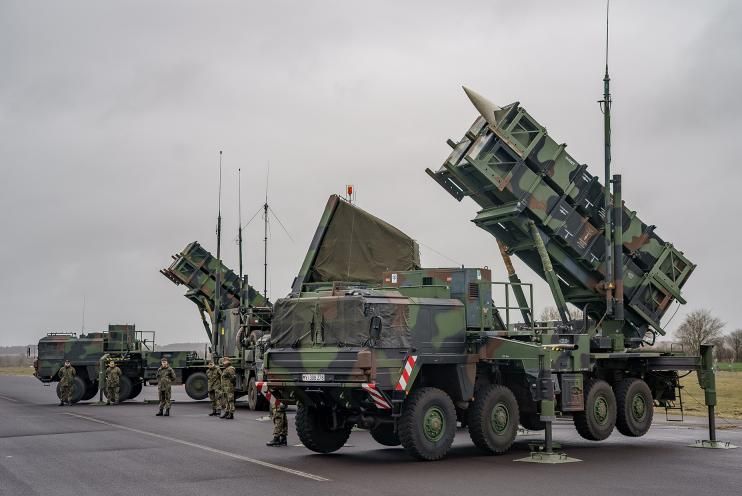
A Patriot firing battery combines interceptor missiles, launching stations, a radar set, an engagement control station, electrical power equipment, and communications equipment. The radar performs surveillance, tracking, and engagement functions. The engagement control station provides command and fire-control functions, while launchers can be positioned separately and controlled through data links.
Patriot has used the AN/MPQ-53, AN/MPQ-65, and AN/MPQ-65A radar families. The AN/MPQ-53 and AN/MPQ-65 are phased-array radars that combine detection, identification, tracking, and engagement functions. The AN/MPQ-65A is a further digitized version with increased range. Later modernization plans introduced the Lower Tier Air and Missile Defense Sensor, an active electronically scanned array radar intended to provide 360-degree coverage.
A typical Patriot battery has six to eight launching stations. The M901 launcher is associated with the PAC-2 family and carries up to four interceptors. The M902 can carry four PAC-2 missiles or sixteen PAC-3 CRI interceptors. The M903 can carry four PAC-2 GEM missiles, sixteen PAC-3 CRI interceptors, twelve PAC-3 MSE interceptors, or selected mixed loads.
Patriot interceptors
The PAC-2 family evolved from the original Patriot missile. PAC-2 interceptors use a blast-fragmentation warhead and Track-Via-Missile guidance in the terminal phase. The later GEM variants improved propulsion, guidance, and fuzing for engagements against ballistic missiles, aircraft, and cruise missiles.
PAC-3 is a different interceptor design. It has a smaller diameter than PAC-2 and uses hit-to-kill technology to destroy the target through direct impact. The missile uses an active Ka-band radar seeker during the endgame and incorporates 180 solid-fueled attitude-control motors in its forward section for rapid maneuvering. After PAC-3 MSE entered service, earlier PAC-3 missiles were redesignated PAC-3 CRI.
PAC-3 MSE retains the PAC-3 hit-to-kill concept but uses an enlarged dual-pulse motor and revised guidance, structure, and software. The second propulsion pulse can provide additional energy later in the engagement, increasing the defended area compared with the earlier PAC-3 interceptor.
Patriot and THAAD networking
Patriot modernization has increasingly emphasized networked engagements. The AN/MPQ-65A and newer fire-control architecture can exchange data with other sensors, while PAC-3 MSE testing demonstrated engagements based on remote THAAD track data. This allows a Patriot interceptor to be supported by information originating outside its own radar set.
Operational history
Patriot first saw combat during the 1991 Gulf War, when batteries defended locations in Saudi Arabia, Kuwait, and Israel against Iraqi ballistic missiles. Early claims of very high interception success were later disputed, and subsequent studies did not establish the initially publicized success rates. A February 1991 attack on a U.S. Army barracks at Dhahran exposed a software timing error that caused the Patriot radar to search in the wrong location and prevented an interceptor from being fired.
During the 2003 invasion of Iraq, upgraded Patriot systems were used against tactical ballistic missiles. PAC-3 interceptors were credited with successful engagements, while Patriot units were also involved in fatal friendly-fire incidents against a British Tornado and a U.S. F/A-18 Hornet.
Foreign operators subsequently used Patriot against aircraft, drones, and missiles. Israel employed Patriot against drones and Syrian aircraft. Saudi Arabia and the United Arab Emirates used Patriot against missile and drone attacks associated with the conflict in Yemen.
Ukraine began operating U.S.- and German-supplied Patriot systems in 2023 during the Russia-Ukraine war. Reported early engagements included the interception of a Russian Kh-47 Kinzhal missile over Kyiv on May 4, 2023. On May 16, Ukrainian authorities said Patriot had been used against a salvo of six Kinzhal missiles.
During the Iran war beginning in February 2026, U.S. forces used both Patriot and THAAD interceptors to defend bases and partner countries in the Middle East from Iranian missile attacks. This sustained use created a major replenishment requirement and increased attention on production capacity for both interceptor families.
Variants
- PAC-1: A software-centered Patriot upgrade deployed in 1988 that added a limited capability against tactical ballistic missiles.
- PAC-2: An upgraded Patriot missile with changes to guidance, fuze, and warhead for improved ballistic missile defense.
- PAC-2 GEM: Guidance Enhanced Missile development of PAC-2 with improved structures, propulsion, guidance, and fuzing.
- PAC-2 GEM-T: Later GEM variant optimized for tactical ballistic missile engagements.
- PAC-2 GEM-C: Later GEM variant optimized for cruise missile and aircraft engagements.
- PAC-3 CRI: Hit-to-kill PAC-3 interceptor family using an active Ka-band radar seeker and high-agility attitude-control motors.
- PAC-3 MSE: Missile Segment Enhancement variant with an enlarged dual-pulse motor and improvements to guidance, structure, and software.
2026 interceptor inventories and production
- Patriot pre-war inventory: Approximately 2,330 missiles in the CSIS estimate.
- Patriot estimated remaining inventory: Between 759 and 827 missiles after extensive use in the 2026 Iran war.
- Estimated Patriot expenditure: Up to 67 percent of the pre-war inventory.
- THAAD pre-war inventory: Approximately 452 interceptors in the CSIS estimate.
- THAAD estimated remaining inventory: Between 234 and 278 interceptors.
- Estimated THAAD expenditure: Up to 48 percent of the pre-war inventory.
- Estimated replenishment period: Slightly more than three years for Patriot and THAAD combined under favorable assumptions, with a longer period possible if heavy expenditure continues.
- Typical contract completion period cited for Patriot: About 42 months.
- Typical contract completion period cited for THAAD: About 53 months.
Specifications (Patriot PAC-3 MSE)
General characteristics
- Length: Approximately 5.20 m.
- Launch weight: Approximately 373 kg.
- Diameter: 304 mm.
- Span: Approximately 920 mm.
- Propulsion: Solid-fuel dual-pulse rocket motor.
- Guidance: Inertial navigation and data-link updates during midcourse flight, with an active radar seeker for terminal engagement.
- Kill mechanism: Hit-to-kill direct impact with a lethality-enhancer device.
Performance
- Ballistic missile engagement distance: Approximately 35 km in the cited configuration.
- Ballistic missile engagement altitude: Up to approximately 34.1 km.
- Aircraft engagement distance: More than 70 km.
- Aircraft engagement altitude: Up to approximately 24.6 km.
Specifications (Patriot PAC-3 CRI)
General characteristics
- Weight: Approximately 312 kg.
- Terminal seeker: Active Ka-band radar.
- Attitude control: 180 solid-fueled attitude-control motors in the forward section.
- Kill mechanism: Hit-to-kill direct impact.
- Launcher capacity: Up to sixteen PAC-3 CRI missiles on an M902 or M903 launcher.
Related equipment
Patriot and THAAD occupy different layers of ballistic missile defense rather than being variants of one system. Their increasingly networked operation is illustrated by PAC-3 MSE tests using THAAD remote track data. Additional background on Patriot development, architecture, and combat use is available from the MIM-104 Patriot reference article and the CSIS Missile Defense Project.
 Argentina
 Armenia
 Australia
 Austria
 Austria-Hungary
 Belgium
 Brazil
 United Kingdom
 United States
 Brunei
 Bulgaria
 Canada
 Chile
Chile China
China Colonial America
 Colombia
 Confederate States
 Croatia
 Czech
Czech Denmark
 Egypt
Egypt Finland
 France
 Georgia
 Germany
 German Imperial
 Greece
 Holland
 Hungary
 India
India Indonesia
 Iran
Iran Iraq
Iraq Ireland
 Israel
 Italy
Italy Japan
Japan Japan (1940)
 Jordan
 Kingdom of Italy
 Malaysia
 Mexico
 Myanmar
 Nazi Germany
 Netherlands
 New Zealand
 North Korea
 Norway
 Pakistan
 Peru
Peru Philippines
 Poland
 Portugal
 Prussia
 Romania
 Russia
 Saudi Arabia
 Serbia
 Singapore
 Slovakia
 Slovenia
 South Africa
 South Korea
 Soviet Union
 Spain
Spain Sweden
 Switzerland
 Syria
Syria Taiwan
 Thailand
 Turkey
 UAE
UAE Ukraine
 Vietnam
 Yugoslavia