
History
The Tactical Intelligence Targeting Access Node, or TITAN, is a U.S. Army crewed mobile intelligence ground station designed to combine data from multiple sensor domains and turn it into actionable targeting information. The system uses artificial intelligence and machine learning to assist analysts with processing sensor data, identifying potential targets, and supporting mission command and long-range precision fires.
TITAN is designed as an expeditionary and maneuverable ground system rather than a fixed intelligence-processing facility. It can receive information from space, high-altitude, aerial, terrestrial, geospatial, and signals-intelligence sources, then fuse and process that information near the battlefield. The Army describes TITAN as a system intended to reduce sensor-to-shooter timelines through automated target nominations while maintaining human authority over target approval.
The program progressed through competitive prototyping before entering production in 2026. According to the U.S. Army announcement, two delivery orders totaling $192 million were awarded for eight initial production systems, consisting of four TITAN Advanced and four TITAN Basic variants.
Development and prototyping
Palantir and RTX were selected for initial TITAN software and system design work in 2021 and subsequently developed competing prototypes. Army experimentation included pre-prototype systems sent to the Pacific and Europe in 2022. These deployments and later prototype activities allowed soldiers to use TITAN configurations in different environments and provide feedback to the development teams.
In 2024, Palantir received a contract valued at approximately $178 million to deliver ten TITAN prototypes after being selected over RTX. The prototype fleet consisted of five Advanced and five Basic systems. The Army used these systems to refine the platform through operational feedback, environmental testing, and experimentation with different vehicle installations.
Prototype deployments revealed practical environmental and integration issues. Reporting on the program described humidity-related problems encountered during an early deployment in the Philippines. Army officials later stated that environmental engineering work had addressed the climate concerns. The service also continued to investigate ways of making TITAN less dependent on a specific vehicle type.
Testing
TITAN participated in Project Convergence Capstone 6, where the Army evaluated the system within a broader prototype command-and-control architecture. During the exercise, TITAN systems fused geospatial and signals intelligence and exchanged information through a data mesh associated with the Next Generation Command and Control prototype.
Different TITAN variants were dispersed around the training area and connected through Anduril's Lattice software. Army officials reported that target information could move through the network for consideration, nomination, and execution by participating units. The testing also continued to identify technical and procedural changes needed for integrating automated targeting tools into Army workflows.
Production
On August 31, 2026, the Army moved TITAN into its production phase through delivery orders totaling $192 million. Palantir received a $127 million award and leads overall production, while Anduril received $65 million for critical hardware components and shelter integration. The initial production order covers eight systems scheduled for delivery over the following 18 months.
Palantir is responsible for overall system production and provides the software that powers TITAN. Its program partners include L3Harris Technologies, Sierra Nevada Corporation, Strategic Technology Consulting, and World Wide Technology. Anduril serves as a major hardware partner, manufacturing ruggedized vehicle-mounted systems and integrating power, thermal-management, control, operator, and shelter subsystems.
The eight production systems comprise four Advanced and four Basic variants. They are intended to join nine prototype units retained by the Army for operational use. The Army stated that another production order for additional TITAN systems is anticipated in fiscal year 2027. Palantir also said it would continue sustaining prototype platforms already fielded with operational forces while supporting production and development of future capabilities. The production arrangement is also described in Palantir's production announcement.
Design
TITAN is a mobile intelligence-processing and targeting system built around a crewed ground station. Its primary function is to collect or access intelligence from distributed sensors, process that information locally, and provide targeting data to commanders and long-range fires units. The architecture is intended to support operations even when access to centralized cloud services or wider intelligence networks is degraded.
The system is designed to process information from space, high-altitude, aerial, and terrestrial sensors. Reported inputs include geospatial intelligence and signals intelligence collected by ground sensors, unmanned aircraft, crewed aircraft, and satellites. TITAN can combine these inputs into a common intelligence picture and use artificial intelligence and machine-learning tools to help analysts identify information that matches specified target characteristics.
Artificial intelligence and targeting workflow
TITAN's artificial-intelligence software is intended to reduce the volume of sensor information that human analysts must examine manually. The system can filter incoming data, identify items with characteristics relevant to an analyst's search, and present higher-probability recommendations for review.
The automated process does not remove the analyst from target approval. Army officials stated that a human remains involved in the targeting workflow and serves as the approving authority before a target nomination is passed to fires elements. TITAN therefore uses automation to accelerate recognition, geolocation, data fusion, and nomination while preserving human review of the resulting recommendations.
Mobility and vehicle integration
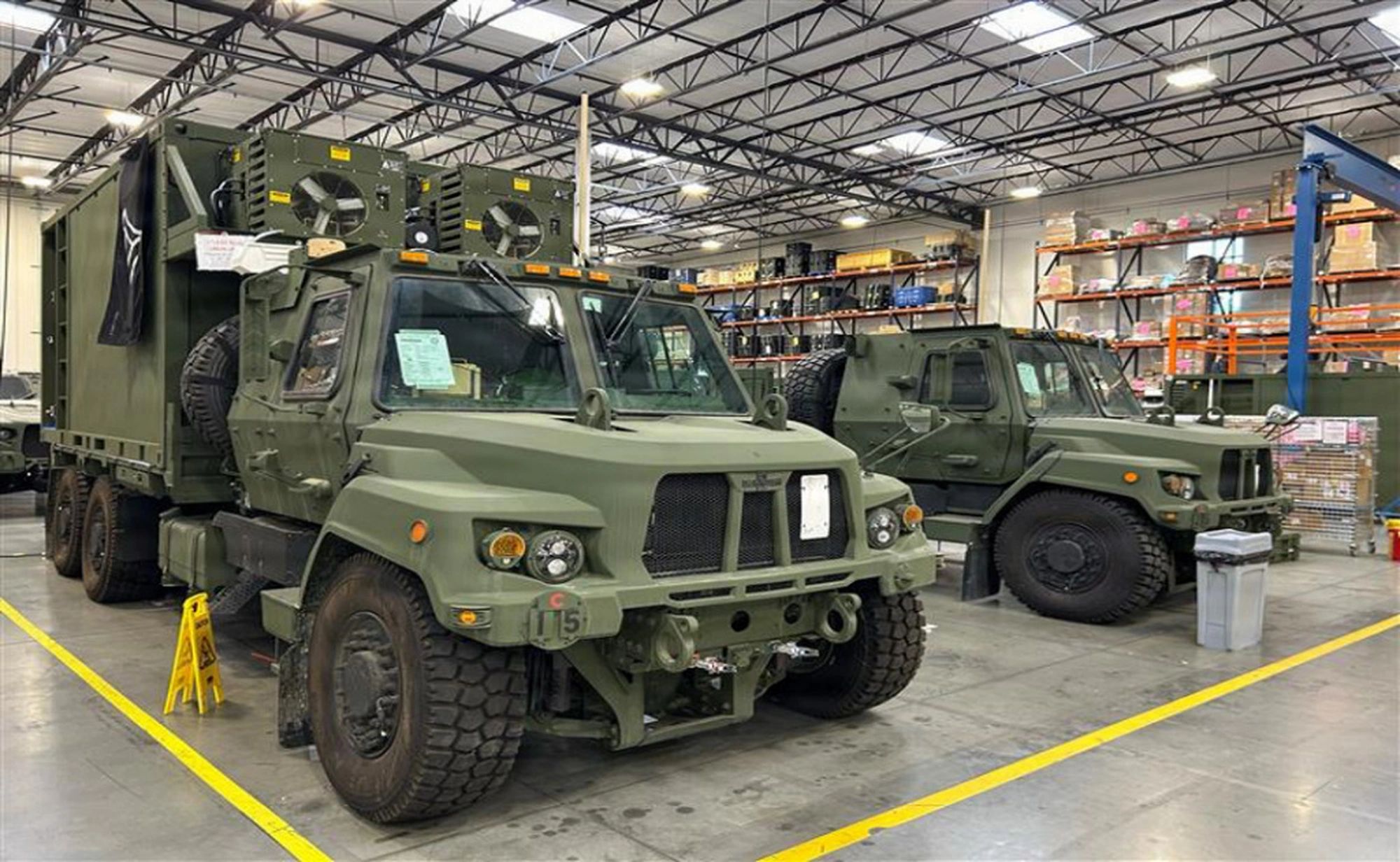
The TITAN Advanced prototype is installed on a medium-sized Army tactical vehicle. The Advanced version provides greater processing and integration capability than the Basic configuration and is intended for higher-level formations and intelligence organizations.
TITAN Basic emphasizes mobility and rapid deployment. Prototype Basic systems have been integrated onto the Joint Light Tactical Vehicle and the Infantry Squad Vehicle-Utility. Army officials have also described an objective of making the system vehicle-agnostic so that commanders can install TITAN equipment on a broader selection of platforms rather than depending on a single vehicle chassis.
A further vehicle-agnostic concept under consideration would package TITAN equipment so it could be carried in a vehicle or removed and connected inside another location such as a building. The Army continued rapid prototyping work in 2026 to explore alternative configurations and transport methods. These concepts were still developmental rather than established production variants.
Hardware integration
Anduril is responsible for major portions of TITAN's ruggedized hardware and shelter integration. Its work includes the power, thermal, control, and operator subsystems required for the equipment to function as a vehicle-mounted field system. The hardware is intended to support operation in demanding environments while hosting the computing and communications equipment needed for TITAN's intelligence-processing mission.
The broader production team combines this hardware with Palantir's software and additional subsystems and technologies supplied by other program partners. This modular arrangement supports continued integration of new technologies as the Army develops the system beyond the initial production configuration.
Program status
TITAN entered the production phase in 2026 after several years of competitive prototyping and soldier evaluation. The first production order covers eight systems, divided equally between Advanced and Basic variants, with delivery planned over an 18-month period.
The Army retained nine prototype TITAN systems for operational use while production began. According to Breaking Defense, the service also planned continued prototyping and integration work involving the JLTV and ISV-U, as well as development of a more vehicle-agnostic configuration.
The production transition followed approximately five years of program development beginning with competitive design work in 2021. A contemporary overview from Tectonic Defense likewise reported the transition from prototype to production and the division of the initial order between four Advanced and four Basic systems.
Variants
- TITAN Advanced: Higher-capability version providing greater processing and integration capacity. Prototype systems are mounted on medium-sized Army tactical vehicles. Four Advanced systems are included in the initial 2026 production order.
- TITAN Basic: More mobile version designed for rapid deployment. Prototype installations include the Joint Light Tactical Vehicle and Infantry Squad Vehicle-Utility. Four Basic systems are included in the initial 2026 production order.
- Vehicle-agnostic configuration: Developmental concept intended to allow TITAN equipment to operate independently of a particular vehicle type and potentially be removed from a vehicle for operation from another location. The Army was exploring this configuration through additional prototyping in 2026.
Operators
- United States Army: Development and production customer. The Army retained nine prototype systems for operational use in 2026 and ordered eight initial production systems, comprising four Advanced and four Basic variants.
Specifications (TITAN production system)
General characteristics
- Type: Crewed mobile intelligence, sensing, processing, and targeting ground station.
- Primary user: United States Army.
- Production variants: TITAN Advanced and TITAN Basic.
- Initial production quantity: Eight systems, including four Advanced and four Basic variants.
- Prototype fleet retained in 2026: Nine systems.
Sensor and data integration
- Sensor domains: Space, high-altitude, aerial, and terrestrial sources.
- Reported intelligence inputs: Geospatial intelligence and signals intelligence.
- Processing: Artificial intelligence and machine-learning-assisted sensor fusion, analysis, target recognition, geolocation, and target nomination.
- Mission outputs: Actionable targeting information supporting mission command and long-range precision fires.
- Human control: Target recommendations are reviewed by human analysts before being passed to fires elements.
Mobility
- TITAN Advanced platform: Medium-sized Army tactical vehicle.
- TITAN Basic prototype platforms: Joint Light Tactical Vehicle and Infantry Squad Vehicle-Utility.
- Future integration objective: Vehicle-agnostic installation allowing the system to operate from a broader range of vehicles or locations.
 Argentina
 Armenia
 Australia
 Austria
 Austria-Hungary
 Belgium
 Brazil
 United Kingdom
 Brunei
 Bulgaria
 Canada
 Chile
Chile China
China Colonial America
 Colombia
 Confederate States
 Croatia
 Czech
Czech Denmark
 Egypt
Egypt Finland
 France
 Georgia
 Germany
 German Imperial
 Greece
 Holland
 Hungary
 India
India Indonesia
 Iran
Iran Iraq
Iraq Ireland
 Israel
 Italy
Italy Japan
Japan Japan (1940)
 Jordan
 Kingdom of Italy
 Malaysia
 Mexico
 Myanmar
 Nazi Germany
 Netherlands
 New Zealand
 North Korea
 Norway
 Pakistan
 Peru
Peru Philippines
 Poland
 Portugal
 Prussia
 Romania
 Russia
 Saudi Arabia
 Serbia
 Singapore
 Slovakia
 Slovenia
 South Africa
 South Korea
 Soviet Union
 Spain
Spain Sweden
 Switzerland
 Syria
Syria Taiwan
 Thailand
 Turkey
 UAE
UAE Ukraine
 Vietnam
 Yugoslavia