
History
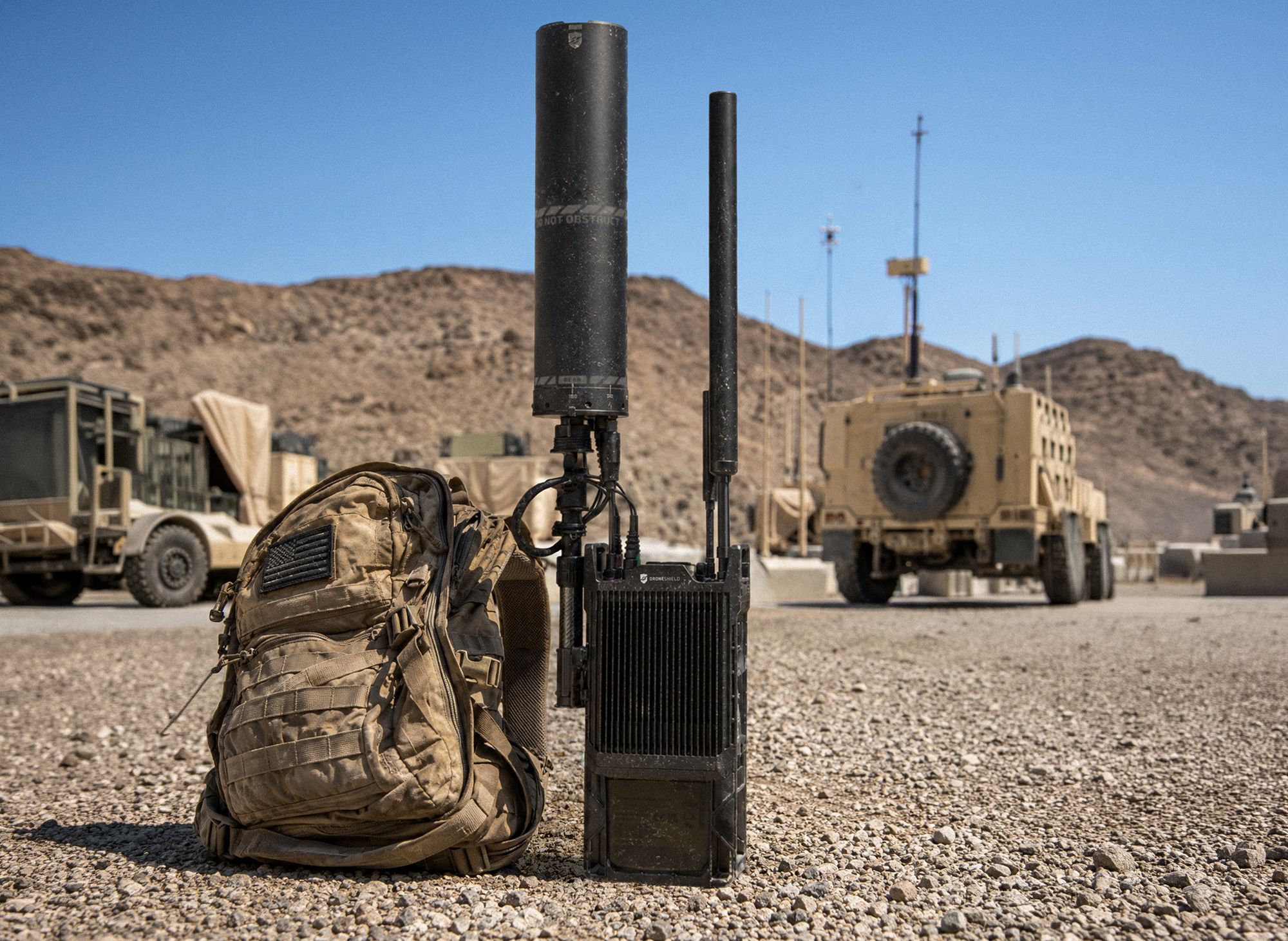
DroneShield RfRecon is a portable radio-frequency intelligence system developed for defence, government and security users. It combines RF spectrum awareness, direction finding and signal analysis to help operators detect, identify, locate and assess electromagnetic activity.
The system is intended for counter-UAS, electronic-warfare and broader spectrum-awareness missions. It can operate as a standalone sensor or provide RF intelligence to a layered defence architecture and command-and-control network.
DroneShield launched RfRecon on 10 August 2026. Contemporary reports from EDR Magazine and European Security & Defence described it as the company's latest portable RF intelligence product and as an evolution from basic RF detection toward interpretation of electromagnetic activity at the tactical edge.
RfRecon was developed around DroneShield's RfAI-3 intelligence architecture. According to UASweekly, the architecture combines wideband spectrum awareness, direction finding and AI-powered signal intelligence within one device. The objective is to reduce dependence on several separate systems and lessen the amount of specialist analysis required to interpret collected RF data in the field.
A 13 August 2026 report by Military Aerospace described RfRecon as bringing sensing, processing and analysis closer to deployed personnel. DroneShield stated that this approach is intended to shorten the interval between detecting RF activity and understanding its operational significance.
Design
RF sensing and analysis
RfRecon combines ultra-wideband spectrum awareness with precision direction finding and RfAI-3-powered signal intelligence. Spectrum awareness allows the system to detect activity across the electromagnetic environment, while direction finding adds information about the direction from which a detected signal originates. Processing within the portable system is intended to provide operators with context about detected activity rather than only presenting raw spectrum data.
DroneShield states that RfRecon provides approximately six times more RF spectrum coverage than previous industry-adopted solutions. The company also claims four times greater processing and AI compute capability, 31 times more storage and eight times more memory. These figures are comparative manufacturer claims rather than absolute published hardware specifications.
Signal support
RfRecon supports Bluetooth and Wi-Fi activity, Remote ID, Automatic Identification System signals and Automatic Dependent Surveillance-Broadcast detection. It also incorporates integrated GNSS and hardware-based security. This combination allows the platform to collect information from several types of emitters rather than focusing only on drone-control links.
Deployment and integration
The system is designed for dismounted, vehicle-mounted, expeditionary and fixed-site use. Its open architecture and support for industry-standard data transfer are intended to allow integration with existing defence and security systems.
RfRecon can interoperate with ATAK, third-party command-and-control platforms and complementary sensors. Within a layered counter-UAS architecture, its role is to provide RF intelligence that can be shared with other sensors or effectors. Those other elements may perform functions such as additional tracking, cyber takeover or kinetic defeat; RfRecon itself is described as the sensing and intelligence component rather than a complete defeat system.
Program status
RfRecon was introduced in August 2026 and was reported as immediately available to qualified defence, government and security customers worldwide. DroneShield also stated that the system would receive continuing capability enhancements through its software development roadmap.
At launch, no confirmed operators, procurement quantities or fielded military units were identified in the supplied sources. The Motley Fool Australia reported that initial engagement with qualified customers had begun and that possible orders and revenue contribution were anticipated during the second half of 2026, subject to procurement schedules. These statements described commercial expectations rather than confirmed contracts or operational deployment.
Specifications (DroneShield RfRecon)
General characteristics
- Type: Portable RF intelligence and electronic-warfare sensing system
- Core architecture: DroneShield RfAI-3
- Primary functions: RF spectrum awareness, signal identification and analysis, and precision direction finding
- Deployment modes: Dismounted, vehicle-mounted, expeditionary and fixed-site
- Navigation support: Integrated GNSS
- Security: Hardware-based security
Detected and supported signal types
- Wireless signals: Bluetooth and Wi-Fi
- Drone identification: Remote ID
- Maritime signals: Automatic Identification System (AIS)
- Aviation signals: Automatic Dependent Surveillance-Broadcast (ADS-B)
Integration
- Command-and-control compatibility: ATAK and third-party command-and-control platforms
- Architecture: Open architecture with support for industry-standard data transfer
- Counter-UAS role: RF intelligence component for standalone or layered counter-UAS systems
Manufacturer-stated comparative capability
- RF spectrum coverage: Approximately six times greater than previous industry-adopted solutions
- Processing and AI compute: Four times greater
- Storage: 31 times greater
- Memory: Eight times greater
 Argentina
 Armenia
 Austria
 Austria-Hungary
 Belgium
 Brazil
 United Kingdom
 United States
 Brunei
 Bulgaria
 Canada
 Chile
Chile China
China Colonial America
 Colombia
 Confederate States
 Croatia
 Czech
Czech Denmark
 Egypt
Egypt Finland
 France
 Georgia
 Germany
 German Imperial
 Greece
 Holland
 Hungary
 India
India Indonesia
 Iran
Iran Iraq
Iraq Ireland
 Israel
 Italy
Italy Japan
Japan Japan (1940)
 Jordan
 Kingdom of Italy
 Malaysia
 Mexico
 Myanmar
 Nazi Germany
 Netherlands
 New Zealand
 North Korea
 Norway
 Pakistan
 Peru
Peru Philippines
 Poland
 Portugal
 Prussia
 Romania
 Russia
 Saudi Arabia
 Serbia
 Singapore
 Slovakia
 Slovenia
 South Africa
 South Korea
 Soviet Union
 Spain
Spain Sweden
 Switzerland
 Syria
Syria Taiwan
 Thailand
 Turkey
 UAE
UAE Ukraine
 Vietnam
 Yugoslavia