
History
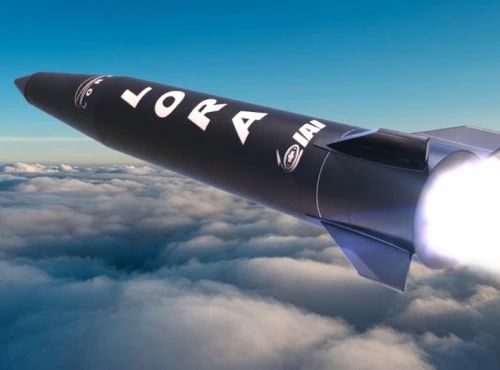
LORA, short for Long Range Artillery, is an Israeli solid-propellant quasi-ballistic missile developed by Israel Aerospace Industries for precision attacks against fixed targets at extended range. The system can be deployed from road-mobile launchers and maritime platforms using sealed launch canisters.
LORA has been tested from land and ships and has been exported to Azerbaijan. The missile has also been demonstrated in maritime configurations, including a German Navy live-fire trial from the F125-class frigate Sachsen-Anhalt in September 2026.
Published specifications differ significantly on maximum range and some guidance details. Figures from approximately 280 km to more than 400 km have been reported, while commonly cited physical dimensions remain around 5.2 m in length, 0.624 m in diameter, and 1,600 kg launch weight.
Development and early testing
Development of LORA began in 2002. According to the LORA overview, the program was intended to produce a theater-level quasi-ballistic precision weapon. The CSIS Missile Threat profile reports test firings in November 2003, March 2004, and 2006. LORA was publicly shown at the Eurosatory exhibition in 2006 and subsequently displayed at the Paris Air Show.
Sources disagree on when LORA entered operational service. CSIS describes an Israeli service-entry date of 2007 as unconfirmed, while another technical reference gives 2018. Because the available evidence does not establish a single confirmed introduction date, the earlier physical test milestone is more reliable for dating the system.
Maritime testing
IAI demonstrated a maritime launch in June 2017 by firing LORA from a containerized launcher carried on the deck of a cargo ship. The missile struck a land target. The launcher concept allows the weapon to be transported and fired from sealed containers without requiring a purpose-built missile ship.
In 2020, IAI conducted another maritime demonstration in which two LORA missiles were fired from a ship against separate floating targets at reported distances of approximately 60 miles and 250 miles. The test demonstrated that the missile could be employed from a moving maritime platform, although the ability of the basic missile to engage a maneuvering warship remains less certain. The 2026 source describes the basic LORA as lacking an autonomous terminal seeker, while other references report TV terminal guidance. These descriptions may represent different configurations or published interpretations, and the available material does not resolve the difference.
Exports and combat use
Azerbaijan publicly revealed in June 2018 that it had acquired LORA. The missile was subsequently used during the 2020 Nagorno-Karabakh war against a bridge in the Lachin corridor. Initial reports described the bridge as destroyed, but later imagery indicated that the strike caused limited damage.
In 2023, India's Bharat Electronics signed a memorandum of understanding with IAI concerning licensed production of LORA in India. This agreement does not by itself establish India as an operational user. In December 2025, Greece reportedly decided to acquire LORA, with initial deliveries expected in 2026 according to available reporting.
German Navy trial
On September 2, 2026, the German Navy conducted a live-fire trial of LORA as part of its operational experimentation program. At least two missiles were fired from launch canisters placed on the flight deck of the F125-class frigate Sachsen-Anhalt during testing in the North Atlantic. Video released by the German Ministry of Defense showed individual missiles launching from two separate canisters.
IAI stated that both missiles followed their planned trajectories and hit their targets with high precision. The exact targets, engagement distances, flight profiles, and missile configurations were not disclosed. A Naval News report described the trial as part of the German Navy's Marine 2035 OPEX initiative and identified the naval configuration as NAVAL LORA.
The trial did not establish LORA as an operational German Navy weapon. The temporary launch installation occupied the F125 flight deck and prevented normal aviation use, so any permanent installation would require a different integration arrangement. It also remained unclear whether the demonstration would lead to a procurement program.
Design
Missile and launcher
LORA is a surface-to-surface quasi-ballistic missile powered by a solid-propellant rocket motor. Published specifications cited by CSIS give a length of 5.2 m, a diameter of 0.624 m, and a launch weight of approximately 1,600 kg. The missile is stored and transported in a hermetically sealed launch canister.
The system can be deployed on road-mobile vehicles or ships. CSIS describes maritime launchers carrying missiles in four-round packs and land systems using 6x6 vehicles. A Missile Defense Advocacy Alliance description states that a standard container can house four missiles and that one command and fire-control section can control multiple launcher containers. The same source states that sealed missiles can be stored for up to seven years without maintenance.
IAI has described LORA as capable of being prepared for launch within minutes, including from unprepared positions. The 2026 source states that a target within range can be attacked in less than ten minutes after a launch decision.
Guidance and trajectory
LORA uses inertial navigation combined with satellite navigation. Published sources commonly cite accuracy of approximately 10 m circular error probable. CSIS and some other references also describe TV-based terminal guidance, while the 2026 account of the basic missile states that it has no terminal seeker. The available material therefore supports inertial and satellite navigation as established features but does not establish that all LORA configurations use terminal imaging guidance.
The missile follows a quasi-ballistic trajectory rather than the low-altitude flight path typical of many cruise missiles. This allows rapid transit to the target and creates a different interception problem for air and missile defenses. Its high terminal velocity also gives the weapon substantial kinetic energy when striking hardened targets.
Warhead
CSIS reports a payload of up to 600 kg and lists high-explosive and submunition warhead options. Other published references give slightly different warhead masses. The available evidence therefore supports a heavy conventional payload but does not establish one universal warhead weight for every configuration.
Range
Published maximum-range figures for LORA are inconsistent. CSIS gives approximately 280 km, while other sources report approximately 400 km or 430 km. The 2026 account describes an official range envelope of roughly 60 to 270 miles, equivalent to approximately 100 to 435 km. These differences may reflect changes in configuration, payload, or manufacturer data released at different times, so a single maximum range should not be treated as universally applicable.
Maritime employment
NAVAL LORA combines the missile with a dedicated naval launcher and command-and-control system. IAI describes the configuration as providing precision maritime strike for sea-to-shore and sea-to-sea missions. The German Navy trial demonstrated that LORA could be fired from an operational frigate using temporary deck-mounted launch canisters.
Its suitability against moving ships is less clearly established. Earlier maritime tests included floating targets, but the 2026 account notes that striking a fixed or stationary target is different from engaging a maneuvering warship using electronic warfare and defensive systems. Without a confirmed autonomous terminal seeker in the tested configuration, the basic missile is more clearly suited to targets with accurately known coordinates.
Operational history
Azerbaijan is the best-documented foreign operational user. Its forces employed LORA during the 2020 Nagorno-Karabakh conflict against infrastructure in the Lachin corridor. Israel is also identified as an operator by the CSIS profile, although the exact date at which the weapon entered Israeli service remains uncertain.
Germany had not adopted LORA operationally as of the September 2026 test. The firing from Sachsen-Anhalt was an experimentation event intended to evaluate emerging technologies and operational concepts before any broader procurement decision.
Variants
- LORA: Baseline ground- and sea-launchable quasi-ballistic missile deployed in sealed launch canisters.
- NAVAL LORA: Maritime configuration combining LORA with a naval launcher and command-and-control system for precision strike from ships.
- Air LORA: Air-launched derivative unveiled in June 2024. The available material confirms its existence but does not provide enough verified technical data for a separate specification set.
Operators
- Israel: Identified by CSIS as an operator of LORA, although the reported 2007 service-entry date is unconfirmed.
- Azerbaijan: Publicly revealed acquisition of LORA in 2018 and used the missile during the 2020 Nagorno-Karabakh conflict.
Specifications (LORA)
General characteristics
- Type: Quasi-ballistic surface-to-surface missile
- Length: Approximately 5.2 m
- Diameter: Approximately 0.624 m
- Launch weight: Approximately 1,600 kg
- Propulsion: Solid-propellant rocket motor
- Payload: Up to approximately 600 kg according to CSIS
- Warhead options: High explosive or submunitions according to CSIS
- Launch platforms: Road-mobile vehicle and maritime launcher
Performance
- Range: Published figures vary from approximately 280 km to more than 400 km depending on source and configuration
- Accuracy: Approximately 10 m CEP in commonly published data
Guidance
- Navigation: Inertial navigation combined with satellite navigation
- Terminal guidance: Some references report TV terminal guidance, while the 2026 description of the basic missile states that it lacks a terminal seeker
 Argentina
 Armenia
 Australia
 Austria
 Austria-Hungary
 Belgium
 Brazil
 United Kingdom
 United States
 Brunei
 Bulgaria
 Canada
 Chile
Chile China
China Colonial America
 Colombia
 Confederate States
 Croatia
 Czech
Czech Denmark
 Egypt
Egypt Finland
 France
 Georgia
 Germany
 German Imperial
 Greece
 Holland
 Hungary
 India
India Indonesia
 Iran
Iran Iraq
Iraq Ireland
 Italy
Italy Japan
Japan Japan (1940)
 Jordan
 Kingdom of Italy
 Malaysia
 Mexico
 Myanmar
 Nazi Germany
 Netherlands
 New Zealand
 North Korea
 Norway
 Pakistan
 Peru
Peru Philippines
 Poland
 Portugal
 Prussia
 Romania
 Russia
 Saudi Arabia
 Serbia
 Singapore
 Slovakia
 Slovenia
 South Africa
 South Korea
 Soviet Union
 Spain
Spain Sweden
 Switzerland
 Syria
Syria Taiwan
 Thailand
 Turkey
 UAE
UAE Ukraine
 Vietnam
 Yugoslavia