History
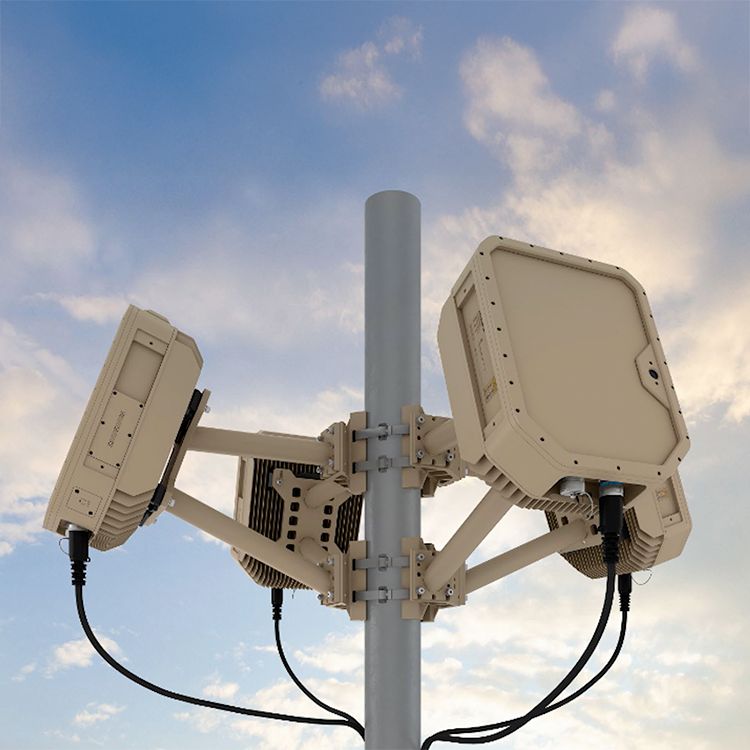
Echodyne EchoShield is a medium-range electronically scanned radar developed for counter-UAS, security, and multi-domain surveillance missions. It is designed to detect, classify, and continuously track aerial and ground objects while providing high-rate position data to command systems, optical sensors, and effectors.
EchoShield uses Echodyne's Metamaterials Electronically Steerable Array, or MESA, technology. The radar electronically directs its beam rather than relying on a mechanically rotating antenna, allowing the system to combine compact size and relatively low power demand with rapid target updates.
The radar has been integrated into counter-UAS architectures intended for fixed-site, rapidly deployable, and expeditionary use. Echodyne also describes EchoShield as suitable for mobile and on-the-move operation and for networking multiple radar units into a coordinated sensor system.
In August 2025, EchoShield was identified by Echodyne as a primary radar system for Trust Automation's Small-Unmanned Air Defense System program for the U.S. Air Force. Under a $490 million indefinite-delivery, indefinite-quantity contract, Trust Automation planned RD-SUADS, FS-SUADS, and EX-SUADS configurations. Echodyne stated that EchoShield was the first fully integrated Sensor Open Systems Architecture radar solution in these platforms. The manufacturer's SUADS announcement described the radar as a commercial-off-the-shelf sensor intended to provide tracking data for other sensors and counter-UAS effectors.
In September 2026, the U.S. Air Force's 31st Contracting Squadron issued a request for quotes covering four EchoShield radars for the 57th Rescue Squadron at Aviano Air Base, Italy. The requirement also included a Rapid Deployment Kit capable of connecting as many as four radars and three years of software updates and technical support for each radar. According to the published solicitation information, funding was not yet available and no award could be made until funds became available. The request therefore represented a proposed procurement rather than a completed purchase. Solicitation reporting stated that quotes were due on September 11, 2026.
Design
Radar architecture
EchoShield is based on Echodyne's MESA electronically steerable radar architecture. According to the manufacturer, the system provides angular accuracy of less than 0.5 degrees in azimuth and less than 0.5 degrees in elevation. Range accuracy is stated as 0.75 to 6 m depending on the waveform being used. Track data is delivered at a 10 Hz update rate.
The radar is designed to maintain stable tracks rather than provide detection-only alerts. Echodyne states that it can track hundreds of objects while maintaining high-rate position and velocity updates. Its radar data can be used to cue optical sensors, command-and-control systems, and other elements of a defensive system. Additional manufacturer information is available on the EchoShield product page.
Classification
EchoShield incorporates machine-learning-based object classification. Echodyne states that its models can classify detected objects into categories that include humans, vehicles, fixed-wing aircraft, and multi-rotor aircraft. Classification begins at detection range and can be refined as a target continues to be tracked.
Mobility and networking
The radar is intended for both stationary and on-the-move operation. Echodyne states that each EchoShield unit includes a dedicated kinematics interface for integration with an inertial navigation system, allowing the radar to compensate for movement of the host platform.
Multiple EchoShield radars can be connected through Echodyne's EchoWare software. The manufacturer describes this configuration as a cooperative radar network in which targets can be handed from one sensor to another while retaining track continuity and the same track identifier.
For the 2026 U.S. Air Force requirement, the associated Rapid Deployment Kit was required to allow one operator to assemble a network of up to four radars without tools in less than one hour. The complete kit, including tripod and cabling, was required to fit into no more than three transport cases.
Integration
EchoShield is offered as a commercial-off-the-shelf radar and uses interfaces intended for integration into larger surveillance and counter-UAS systems. In the Trust Automation SUADS architecture, EchoShield provides radar data for systems intended to protect permanent installations, support rapid deployment, or provide expeditionary drone detection. Echodyne states that EchoShield systems are commercially exportable under ECCN 6A008.e.
Program status
EchoShield has been selected for integration into several U.S. defense counter-UAS programs. In the Trust Automation SUADS program announced in 2025, it serves as the primary radar sensor across rapidly deployable, fixed-site, and expeditionary configurations planned for delivery to the U.S. Air Force.
The separate 2026 Aviano Air Base requirement called for four EchoShield radars for the 57th Rescue Squadron. At the time of the solicitation, however, the Air Force stated that funds were not available, so the notice did not constitute a completed purchase or confirmed delivery.
Specifications (EchoShield)
General characteristics
- Radar type: Medium-range electronically steerable radar
- Technology: Echodyne MESA electronically steerable array
- Track update rate: 10 Hz
- Angular accuracy: Less than 0.5 degrees in azimuth and less than 0.5 degrees in elevation
- Range accuracy: 0.75 to 6 m, depending on waveform
- Operating mode: Fixed or on-the-move operation
- Networking: Multiple radars can be connected through EchoWare
- Classification classes stated by manufacturer: Human, vehicle, fixed-wing, and multi-rotor
U.S. Air Force solicitation requirements
- Group 1 small-UAS detection requirement: 2.7 to 3 km for a DJI Phantom-class target
- Group 2 UAS detection requirement: 4.8 to 6 km for a DJI Matrice 600-class target
- Dismounted-person tracking requirement: 8 km
- Vehicle tracking requirement: 11 km
- High-priority target capacity: More than 40 targets
- Lower-priority target capacity: More than 1,000 targets
- Radar panel weight requirement: No more than 17.8 kg
- Power requirement: Less than 250 W at full operation
 Argentina
 Armenia
 Australia
 Austria
 Austria-Hungary
 Belgium
 Brazil
 United Kingdom
 United States
 Brunei
 Bulgaria
 Canada
 Chile
Chile China
China Colonial America
 Colombia
 Confederate States
 Croatia
 Czech
Czech Denmark
 Egypt
Egypt Finland
 France
 Georgia
 Germany
 German Imperial
 Greece
 Holland
 Hungary
 India
India Indonesia
 Iran
Iran Iraq
Iraq Ireland
 Israel
 Italy
Italy Japan
Japan Japan (1940)
 Jordan
 Kingdom of Italy
 Malaysia
 Mexico
 Myanmar
 Nazi Germany
 Netherlands
 New Zealand
 North Korea
 Norway
 Pakistan
 Peru
Peru Philippines
 Poland
 Portugal
 Prussia
 Romania
 Russia
 Saudi Arabia
 Serbia
 Singapore
 Slovakia
 Slovenia
 South Africa
 South Korea
 Soviet Union
 Spain
Spain Sweden
 Switzerland
 Syria
Syria Taiwan
 Thailand
 Turkey
 UAE
UAE Ukraine
 Vietnam
 Yugoslavia