
History
The V-2, developed under the German Army designation Aggregat-4 or A-4, was a liquid-propellant long-range ballistic missile developed in Nazi Germany during World War II. It combined a large liquid-fuel rocket engine, gyroscopic guidance, aerodynamic controls, and a roughly one-ton warhead.
The first flight vehicles were completed in 1942, and the first successful A-4 test flight took place at Peenemünde on 3 October 1942. Operational V-2 attacks began in September 1944 and continued until March 1945. After the war, captured missiles, components, documents, and German specialists contributed to missile and launch-vehicle programs in the United States, Soviet Union, Britain, and France.
The V-2 also became an important experimental vehicle after World War II. Captured missiles were used for high-altitude research, missile development, multistage rocket experiments, and a U.S. Navy shipboard launch from USS Midway during Operation Sandy in 1947.
Development
The V-2 evolved from German Army experiments with smaller liquid-fuel rockets. The A-1 and A-2 were tested during the early 1930s, and two A-2 rockets were successfully flown from Borkum Island in December 1934. They were followed by the A-3, developed in 1935-1937, and the A-5 test vehicle, which was used to develop guidance technology after the unsuccessful A-3 flight program.
The larger A-4 was proposed in 1936 as a rocket with approximately 25 metric tons of thrust. Detailed design work followed during 1939-1941. Wernher von Braun served as technical director of the Peenemünde Army rocket center, while Walter Dornberger directed the Army rocket program. The development group moved to Peenemünde in 1937, where facilities were established for research, testing, and later production preparations.
The first non-flight A-4 vehicles were completed and tested in 1940-1941. Flight vehicles followed in 1942. After unsuccessful launches in June and August 1942, the fourth test vehicle completed the first successful A-4 flight on 3 October 1942. According to the Smithsonian National Air and Space Museum, the missile reached an altitude of about 60 miles and a range of about 125 miles during the successful test.
Production
Mass production was authorized in late 1942. Production preparations involved Peenemünde, the Zeppelin Works at Friedrichshafen, and Raxwerke near Wiener Neustadt. After the Royal Air Force bombing of Peenemünde on the night of 17-18 August 1943, large-scale production was shifted to the underground Mittelwerk complex near Nordhausen.
V-2 production was closely associated with forced labor and the Mittelbau-Dora concentration camp system. Thousands of prisoners were compelled to work on the missile program in extremely harsh conditions. The Smithsonian states that approximately half of the roughly 20,000 deaths at Mittelbau-Dora can be attributed to the V-2 program.
Combat introduction
The first two operational rockets were fired toward Paris on 7 September 1944 but failed because of premature engine cutoff. On 8 September, a V-2 struck near Porte d'Italie in Paris. Later that day another missile hit Chiswick in London. The missile was subsequently publicly identified as the V-2, from Vergeltungswaffe 2, or Vengeance Weapon 2.
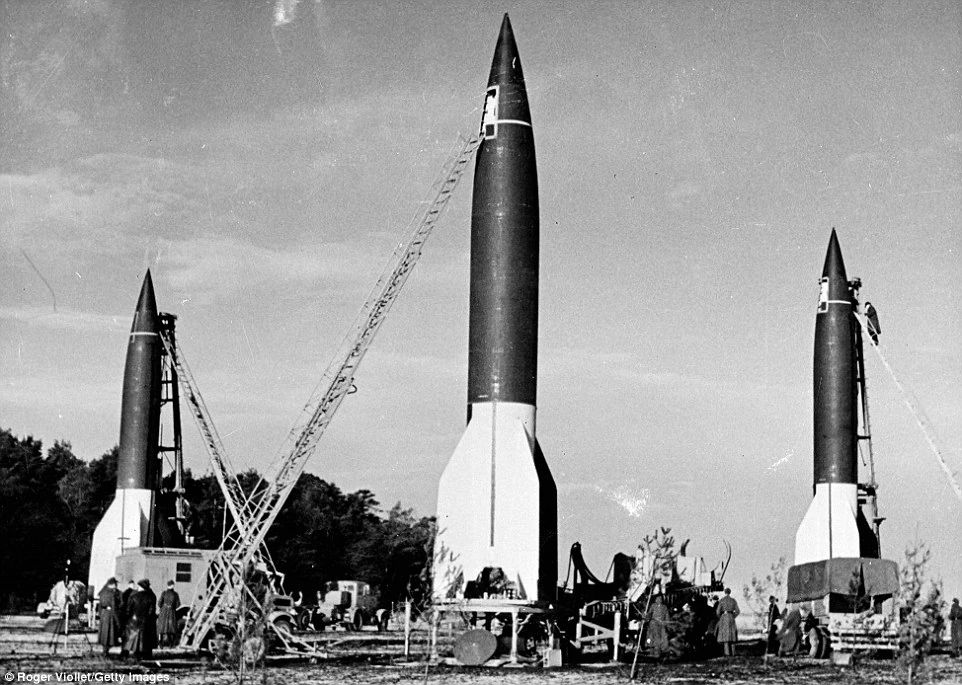
V-2 units used mobile launch equipment rather than relying exclusively on fixed sites. This mobility made the system difficult to suppress after the missiles and support vehicles had dispersed. Launch crews transported the rocket to a prepared location, erected it vertically, fueled it with alcohol mixture and liquid oxygen, aligned it toward the target, and conducted the firing sequence.
Design
The V-2 had a cylindrical central body, an ogival upper section, and four clipped fins around the tail. Its shape was developed for supersonic flight using wind-tunnel testing. The fins were also designed with transportation requirements in mind, including movement through European railway tunnels.
Structure
The missile was built primarily from thin sheet steel that was welded, riveted, and internally braced. Some sections incorporated wooden structural elements. The central body contained aluminum-magnesium alloy propellant tanks. The liquid-oxygen tank was insulated with glass wool. The forward section contained the warhead and instrumentation, while the tail housed the rocket engine, turbopump, steam generator, and associated plumbing.
Powerplant
The A-4 used liquid oxygen as oxidizer and a mixture of approximately 75 percent ethanol and 25 percent water as fuel. The water reduced combustion temperature and thermal stress. A turbopump supplied propellants to the combustion chamber. Concentrated hydrogen peroxide decomposed with a catalyst to generate steam for driving the turbine.
The engine developed approximately 25 metric tons of thrust after the turbopump reached operating conditions. The available source material states that thrust increased to about 29 tons as external atmospheric pressure decreased with altitude. Powered flight lasted for up to about 65 seconds before engine cutoff and the subsequent ballistic portion of the trajectory.
Guidance and control
The V-2 combined aerodynamic rudders on its four fins with graphite vanes positioned in the rocket exhaust. The graphite vanes provided control while aerodynamic surfaces had limited effectiveness at low speed immediately after launch. Electrical-hydraulic servomotors moved the control surfaces in response to guidance commands.
The guidance system used gyroscopes for stabilization and an analog control computer. Range was primarily controlled by terminating engine thrust after the missile reached the required velocity. Some V-2 launches also used ground-based radio signals as guidance or engine-cutoff inputs. Before launch, crews surveyed the firing position and aligned the missile with the required target azimuth.
Warhead
The V-2 was designed to carry a warhead of approximately one metric ton. The Smithsonian describes the missile as a weapon intended primarily for attacks on cities. Its very high terminal speed meant that the missile could arrive without the audible warning associated with slower aircraft or the V-1 flying bomb.
Operational history
From September 1944 until March 1945, V-2 missiles were launched against targets including London, Antwerp, Paris, Liège, Brussels, Southampton, and Bristol. Published totals vary. The Smithsonian gives a wartime figure of approximately 3,200 to 3,600 missiles sent toward Allied targets, while other historical summaries give slightly different totals.
Antwerp and London were among the principal targets. The missile's accuracy was limited, so it was more suitable for attacks against large urban areas than precise military targets. In March 1945, 11 V-2 missiles were fired in an attempt to strike the Ludendorff Bridge at Remagen, but none hit the bridge. The last combat V-2 launch occurred on 29 March 1945.
Casualty estimates differ between historical sources, but V-2 attacks killed and injured thousands of people. The weapon also imposed a severe human cost during production because of the use of concentration-camp prisoners and forced labor.
Postwar testing and development
After Germany's defeat, the Allied powers competed to obtain V-2 hardware, documents, facilities, and specialists. Britain conducted Operation Backfire, in which three V-2 rockets were experimentally launched near Cuxhaven on 2, 3, and 15 October 1945 with assistance from German technicians.
The United States shipped components for approximately 100 V-2 missiles from Germany and used captured rockets under Project Hermes. A static firing took place at White Sands Proving Ground on 15 March 1946, followed by the first U.S. launch of a captured V-2 there on 16 April. V-2 flights supported missile engineering and upper-atmosphere research.
On 6 September 1947, a V-2 was launched from the flight deck of the aircraft carrier USS Midway during Operation Sandy. The launch was the U.S. Navy's first sea launch of a V-2 and was conducted as a ballistic missile test. The rocket veered from its intended path and did not complete a normal flight, but the experiment demonstrated that a large ballistic missile could be launched from a ship.
The Soviet Union also reconstructed and tested captured V-2 technology. Its first reconstructed V-2 was launched from Kapustin Yar on 30 October 1947. The experience contributed to later Soviet derivatives including the R-1. The first successful R-1 launch occurred on 17 September 1948.
In the American Project Bumper program, a V-2 served as the first stage beneath a smaller WAC-Corporal second stage. On 24 February 1949, one of these vehicles reached an altitude of about 244 miles. On 24 July 1950, Bumper No. 8 became the first rocket successfully launched from Cape Canaveral. Captured V-2 operations at White Sands continued until 28 June 1951.
The V-2 influenced later ballistic missiles and liquid-fuel launch vehicles in several countries. Its postwar importance resulted from both its technical design and the experience gained by engineers and military organizations in handling, launching, and modifying a large liquid-propellant rocket.
Specifications (V-2/A-4)
General characteristics
- Type: Long-range guided ballistic missile
- Propellant system: Liquid propellant
- Fuel: Approximately 75 percent ethanol and 25 percent water
- Oxidizer: Liquid oxygen
- Launch mass: Approximately 13.5 metric tons
- Fuel load: Approximately 4,173 kg of alcohol mixture
- Liquid oxygen load: Approximately 5,553 kg
Performance
- Maximum range: About 320 km
- Powered flight duration: Up to approximately 65 seconds
- Engine thrust: Approximately 25 metric tons under full pump-fed operation, increasing to about 29 tons as atmospheric pressure decreased
Guidance and control
- Stabilization: Gyroscopic
- Control: Four aerodynamic tail rudders and four graphite exhaust vanes
- Range control: Engine cutoff after a predetermined velocity was reached
- Additional guidance: Some missiles used ground-based radio guidance or radio-assisted engine cutoff
Armament
- Warhead: Approximately one metric ton
Related equipment
- A-1 and A-2: Early German Army liquid-fuel experimental rockets that preceded the larger A-series designs.
- A-3: Experimental predecessor developed before the A-4 program.
- A-5: Test vehicle used to develop guidance and aerodynamic technology for the A-4.
- R-1: Early Soviet missile derived from reconstructed and studied V-2 technology.
- V-2/WAC-Corporal Bumper: American two-stage experimental vehicle that used the V-2 as its first stage.
 Argentina
 Armenia
 Australia
 Austria
 Austria-Hungary
 Belgium
 Brazil
 United Kingdom
 United States
 Brunei
 Bulgaria
 Canada
 Chile
Chile China
China Colonial America
 Colombia
 Confederate States
 Croatia
 Czech
Czech Denmark
 Egypt
Egypt Finland
 France
 Georgia
 Germany
 German Imperial
 Greece
 Holland
 Hungary
 India
India Indonesia
 Iran
Iran Iraq
Iraq Ireland
 Israel
 Italy
Italy Japan
Japan Japan (1940)
 Jordan
 Kingdom of Italy
 Malaysia
 Mexico
 Myanmar
 Netherlands
 New Zealand
 North Korea
 Norway
 Pakistan
 Peru
Peru Philippines
 Poland
 Portugal
 Prussia
 Romania
 Russia
 Saudi Arabia
 Serbia
 Singapore
 Slovakia
 Slovenia
 South Africa
 South Korea
 Soviet Union
 Spain
Spain Sweden
 Switzerland
 Syria
Syria Taiwan
 Thailand
 Turkey
 UAE
UAE Ukraine
 Vietnam
 Yugoslavia