
History
The Perseus Defense Harpe is a compact guided interceptor developed in the United States for counter-unmanned aircraft system missions. It is intended primarily to defeat Group 1 and Group 2 drones while offering a smaller and lower-cost kinetic effector than conventional surface-to-air missiles.
Harpe is designed around a portable, network-compatible launcher that can receive targeting information from external sensors and command-and-control systems. The system has been demonstrated in U.S. Army and USNORTHCOM experimentation, including live-fire counter-drone events during 2026.
Public information indicates that Perseus Defense developed the interceptor rapidly from experimental guided rockets into a military-tested counter-UAS system. Important characteristics such as the seeker type, propulsion system, warhead configuration and data link used by the tested configuration have not been publicly disclosed.
Development
According to an account of the Harpe development program published by Defence Blog, Perseus Defense built its first two spin-stabilized rockets, designated Mk-I and Mk-II guided missiles, in June 2025. Testing of a Mk-III surface-to-air interceptor followed in July 2025. The company subsequently relocated to the Austin, Texas area and leased a headquarters facility in Buda, Texas, in December 2025.
In January 2026, the program reportedly achieved fully guided flight culminating in a direct hit-to-kill intercept. By April 2026, the Harpe system had progressed to a U.S. Army military-hosted live-fire demonstration.
Golden Shield testing
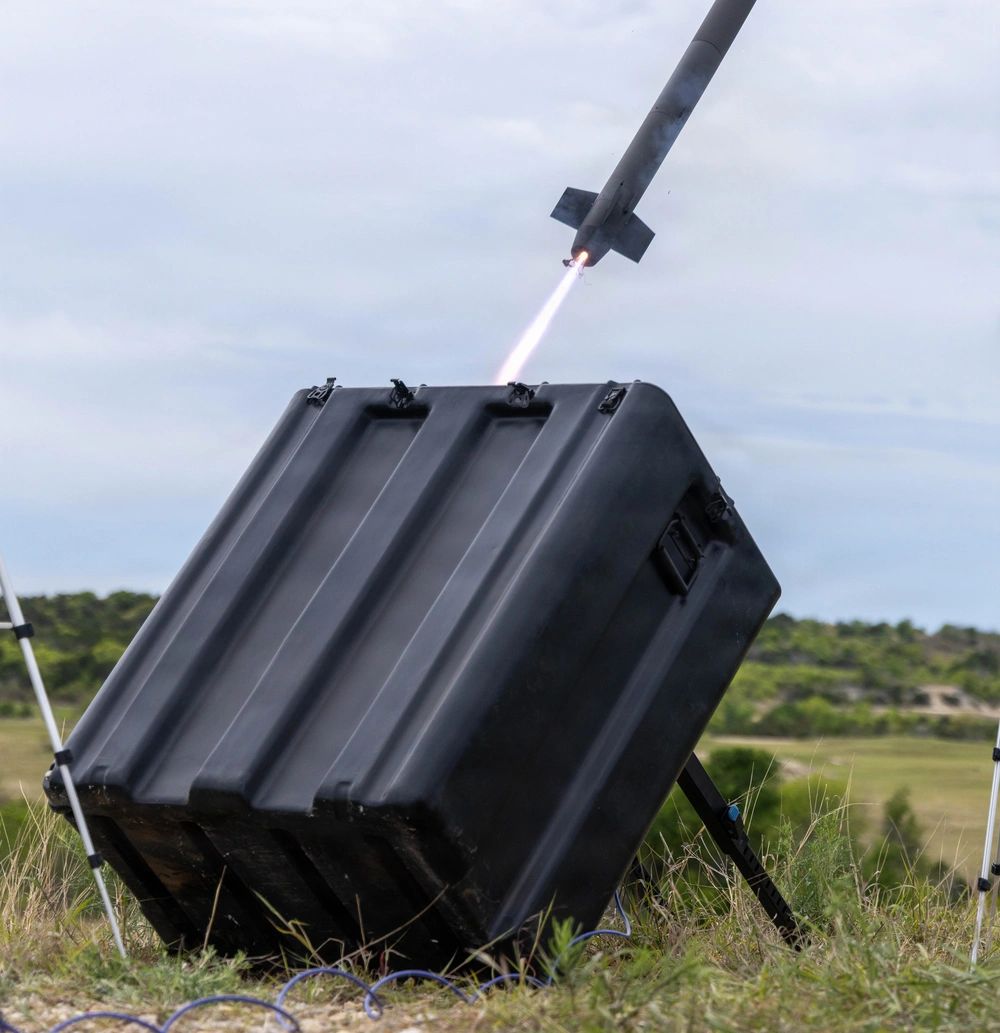
From April 7 to 9, 2026, the U.S. Army's 1st Cavalry Division conducted Exercise Golden Shield at Fort Hood, Texas. Harpe was among the counter-drone systems evaluated. During the event, external radar cues were passed through military command-and-control software to the Harpe system, which demonstrated multiple launches and active guidance against drone targets. The exercise was described by The Defense Post as an early live exercise integrating micro-missile interceptors into the Army's counter-drone concept.
Contemporary reporting described an eight-interceptor launcher and an engagement range exceeding 1,000 m. TURDEF separately reported a range of about 1 km and noted that Harpe could be launched from ground boxes, vehicles and Group 2 unmanned aircraft.
Falcon Peak 26.2
In September 2026, USNORTHCOM included Perseus Defense's Portable Kinetic Missile Interceptor system in Falcon Peak 26.2 experimentation at Yuma Proving Ground in Arizona. The event placed the system in a homeland-defense test environment focused on counter-small-UAS technologies and the protection of military installations and critical infrastructure.
The configuration shown during Falcon Peak combined a portable launcher with Harpe interceptors. The September source described each interceptor as approximately 61 cm long and stated a 2 km engagement range, while the launcher weighed less than 36 kg. These figures differ from the approximately 1 km range reported during the April 2026 Golden Shield period, indicating either an updated configuration, an expanded company claim, or differences in how the engagement range was reported. The available sources do not establish the reason for the change.
Design
Harpe is a compact guided kinetic interceptor intended for short-range defense against small unmanned aircraft. Perseus Defense identifies Group 1 and Group 2 drones as its primary targets. The interceptor is designed to provide a relatively low-cost kinetic option where the use of larger air-defense missiles would be economically inefficient or where reducing collateral effects is important.
Launcher and integration
During the April 2026 Golden Shield exercise, Harpe was shown operating from a pod reported to contain eight micro-missiles. The system received targeting cues from external radar through military command-and-control software rather than relying solely on an organic sensor at the firing position.
By September 2026, the system was described as a portable launcher weighing less than 36 kg. Perseus Defense stated that several launchers could be networked and supplied with targeting information from external sensors or command-and-control systems. This architecture is intended to permit dispersed firing positions and overlapping defensive coverage.
Available reporting also describes Harpe as adaptable to different launch platforms. Ground boxes and vehicles have been demonstrated or described, while launch from Group 2 unmanned aircraft and potential integration on boats have also been reported as supported configurations. The available sources do not establish that every proposed platform integration has completed military qualification.
Guidance and terminal effect
During Golden Shield, Harpe demonstrated externally cued engagements and fully active guidance against drone targets. The program had previously reported a fully guided direct hit-to-kill intercept in January 2026.
Public information does not identify the seeker technology, propulsion system, warhead configuration or data link employed by the configuration evaluated at Yuma. It is therefore not possible to confirm whether the interceptor relies exclusively on direct impact or whether some versions incorporate an additional terminal-effect mechanism.
Cost and employment concept
Perseus Defense has stated an interceptor cost below $10,000 per shot. The concept is intended to reduce the cost imbalance created when inexpensive drones are engaged with substantially larger and more expensive conventional surface-to-air missiles.
A short-range guided interceptor of this type is intended to operate as one layer within a broader counter-UAS architecture. Its effectiveness depends on timely detection, reliable target tracking and sufficient interceptor availability during attacks involving several drones or saturation tactics.
Program status
As of September 2026, Harpe had progressed through guided-flight development, a U.S. Army live-fire exercise and USNORTHCOM field experimentation. The available sources describe testing and evaluation rather than operational service or a completed procurement program.
The Golden Shield and Falcon Peak events evaluated Harpe alongside other counter-UAS technologies and provided military organizations with data on factors including mobility, engagement range, cost, magazine depth, networking and terminal effects. No confirmed production order, fielding quantity or operational unit assignment is provided by the available sources.
Specifications (Harpe interceptor and portable launcher)
General characteristics
- Type: Compact guided counter-UAS interceptor
- Primary targets: Group 1 and Group 2 unmanned aircraft
- Interceptor length: Approximately 61 cm
- Portable launcher weight: Less than 36 kg
- Launcher capacity: Eight interceptors in the configuration reported during the April 2026 Golden Shield exercise
Performance
- Reported engagement range: More than 1,000 m during April 2026 reporting; a September 2026 source stated 2 km
- Reported interceptor cost: Less than $10,000 per shot
Guidance and integration
- Targeting: Can receive cues from external sensors and command-and-control systems
- Guidance: Fully active guidance demonstrated during Golden Shield testing
- Network operation: Multiple launchers can be interconnected for coordinated engagements
- Launch platforms: Portable ground launcher, with vehicle, boat and Group 2 UAV integration described in public reporting
 Argentina
 Armenia
 Australia
 Austria
 Austria-Hungary
 Belgium
 Brazil
 United Kingdom
 Brunei
 Bulgaria
 Canada
 Chile
Chile China
China Colonial America
 Colombia
 Confederate States
 Croatia
 Czech
Czech Denmark
 Egypt
Egypt Finland
 France
 Georgia
 Germany
 German Imperial
 Greece
 Holland
 Hungary
 India
India Indonesia
 Iran
Iran Iraq
Iraq Ireland
 Israel
 Italy
Italy Japan
Japan Japan (1940)
 Jordan
 Kingdom of Italy
 Malaysia
 Mexico
 Myanmar
 Nazi Germany
 Netherlands
 New Zealand
 North Korea
 Norway
 Pakistan
 Peru
Peru Philippines
 Poland
 Portugal
 Prussia
 Romania
 Russia
 Saudi Arabia
 Serbia
 Singapore
 Slovakia
 Slovenia
 South Africa
 South Korea
 Soviet Union
 Spain
Spain Sweden
 Switzerland
 Syria
Syria Taiwan
 Thailand
 Turkey
 UAE
UAE Ukraine
 Vietnam
 Yugoslavia