
History
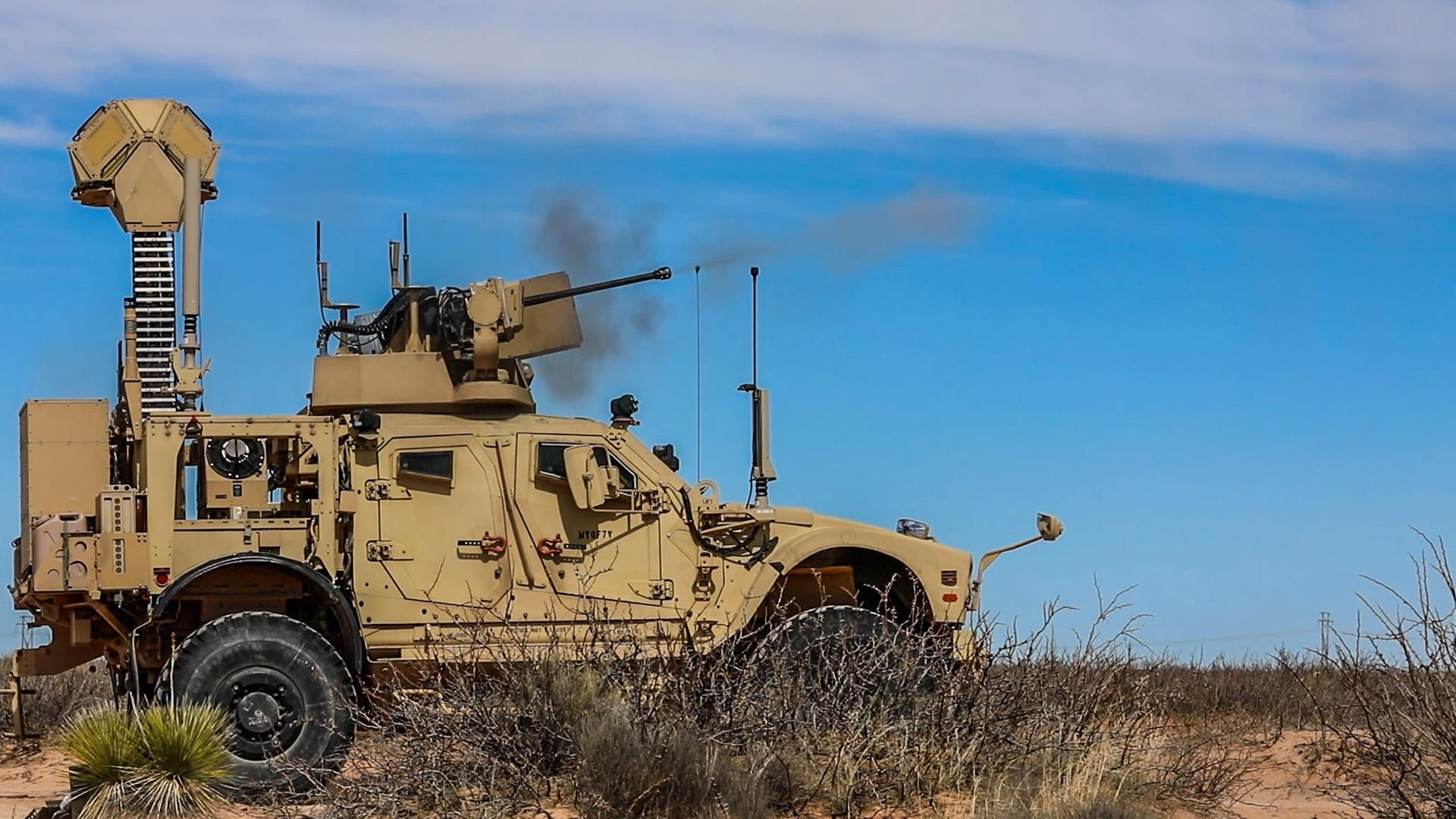
The Mobile-Low, Slow, Small Integrated Defeat System, or M-LIDS, is a mobile counter-unmanned aircraft system developed for the U.S. Army. It combines detection, command-and-control, electronic warfare and kinetic effectors on mobile tactical vehicles to detect, track and defeat small unmanned aircraft.
M-LIDS is the mobile configuration of the Army's broader Low, slow, small unmanned aircraft Integrated Defeat System architecture. The system uses a layered approach in which radar and other sensors provide target information to command-and-control equipment, while electronic warfare, a 30 mm cannon and Coyote interceptors provide different defeat options.
Leonardo DRS serves as lead system integrator for M-LIDS. The mobile system is based on Oshkosh M-ATV vehicles and integrates equipment supplied by several companies, including Raytheon's Ku-band Radio Frequency Sensor and Coyote interceptor, Northrop Grumman's Forward Area Air Defense Command and Control system, and electronic warfare equipment from Syracuse Research Corporation.
Development and procurement
The U.S. Army developed LIDS as a system-of-systems response to the growing threat from small unmanned aircraft. According to Raytheon, a contract awarded in October 2022 was intended to equip two Army divisions with KuRFS radars and Coyote effectors. Additional fixed-site and mobile LIDS systems were awarded in 2023 to support U.S. Central Command operations, followed by another contract intended to equip a third Army division.
Testing continued alongside procurement. During a summer 2023 test at Yuma Proving Ground in Arizona, KuRFS detected and tracked a swarm of more than 30 unmanned aircraft, while Coyote interceptors engaged individual and multiple targets. The tests were used to validate hardware and software improvements to the LIDS architecture.
By 2024, M-LIDS was operationally deployed. An April 2024 report by Defense Express described M-LIDS deployed in Romania with elements of the U.S. 101st Airborne Division and reported firing activity at the Capu Midia Training Range. The same source stated that the system had previously been observed outside the United States in Kuwait.
In September 2026, the U.S. Army deployed M-LIDS to India for the first time during Yudh Abhyas 2026. The system accompanied the 3rd Multi-Domain Task Force and was incorporated into training involving counter-UAS defense, digital command and control, and long-range precision fires. The deployment was a U.S. operational training deployment and did not represent an announced transfer or Indian procurement of M-LIDS.
The 2026 exercise was intended to culminate in combined live-fire activity involving U.S. and Indian long-range and precision fires. M-LIDS provided a mobile defensive layer around the networked force while the participating units practiced coordination of sensors, command systems and firing elements. The number of M-LIDS systems deployed to India and the exact configuration used there were not publicly specified.
Design
M-LIDS is arranged as a paired mobile system based on two Oshkosh M-ATV vehicles. Army Technology identifies Leonardo DRS as the lead system integrator and describes the system as a counter-UAS platform intended to detect and neutralize moving aerial targets.
Vehicle arrangement
In the configuration described during the 2026 deployment to India, one M-ATV carries a Moog Reconfigurable Integrated Weapons Platform with an XM914 30 mm automatic cannon. The second vehicle carries surveillance, electronic warfare and associated detection equipment. The paired arrangement allows the sensing and engagement functions to remain mobile with the units being protected.
Sensors and command and control
The system uses the Ku-band Radio Frequency Sensor, or KuRFS, for aerial surveillance. KuRFS is an active electronically scanned array radar providing 360-degree coverage and is used to detect and track small aerial targets. Depending on configuration, M-LIDS can also include electro-optical and infrared sensors, direction-finding equipment and networked IP radios.
Track data and engagement functions are integrated through the Forward Area Air Defense Command and Control system, commonly abbreviated FAAD C2 or FAADC2. This command-and-control layer fuses air tracks and connects sensors with available effectors, helping reduce the time between detection and engagement.
The broader LIDS architecture is described by the M-LIDS overview as combining radar and electronic warfare capabilities with kinetic systems to detect, track and neutralize small drones.
Electronic warfare
Electronic warfare provides a non-kinetic defeat option when an unmanned aircraft remains dependent on a vulnerable control or communications link. Syracuse Research Corporation electronic warfare equipment forms part of the integrated Army LIDS architecture described by Raytheon. Public descriptions of the M-LIDS configuration deployed to India also identify electronic warfare as part of the second vehicle's equipment.
Kinetic effectors
The XM914 30 mm automatic cannon provides a direct-fire option against aerial targets. It is mounted on the weapon vehicle through the Moog Reconfigurable Integrated Weapons Platform.
M-LIDS can also use the Coyote Block 2 interceptor. The Coyote is rail-launched and uses an initial rocket boost followed by turbine propulsion for interception. In the integrated architecture, KuRFS provides detection and tracking information that can support Coyote engagements against unmanned aircraft.
The combination of electronic warfare, cannon fire and an interceptor gives the system multiple methods for responding to different unmanned-aircraft threats. No confirmed engagement range for the M-LIDS configuration deployed in India was provided in the available sources.
Operational history
M-LIDS has been deployed outside the continental United States as part of U.S. Army operations and training. By April 2024, the system was reported in Romania, where U.S. forces conducted firing activity at Capu Midia Training Range. A 2024 report also stated that M-LIDS had previously been observed in Kuwait.
In September 2026, the U.S. Army brought M-LIDS to India during Yudh Abhyas 2026. The deployment accompanied the 3rd Multi-Domain Task Force and placed the counter-UAS system within an exercise architecture that also included long-range precision fires and digital command-and-control training. The activity focused on U.S.-Indian interoperability rather than transfer of the equipment to the Indian armed forces.
Specifications (M-LIDS mobile configuration)
General characteristics
- Type: Mobile counter-unmanned aircraft system
- Lead system integrator: Leonardo DRS
- Vehicle platform: Oshkosh M-ATV
- Vehicle arrangement: Two-vehicle paired configuration
- Primary surveillance radar: Ku-band Radio Frequency Sensor, or KuRFS, with 360-degree coverage
- Command and control: Forward Area Air Defense Command and Control system, FAAD C2 or FAADC2
- Additional supported sensors: Electro-optical and infrared sensors and direction-finding equipment, depending on configuration
- Communications: Networked IP radios, depending on configuration
Defeat systems
- Gun: XM914 30 mm automatic cannon on a Moog Reconfigurable Integrated Weapons Platform
- Interceptor: Coyote Block 2 kinetic interceptor
- Non-kinetic capability: Electronic warfare for disruption of susceptible unmanned-aircraft control or communications links
 Argentina
 Armenia
 Australia
 Austria
 Austria-Hungary
 Belgium
 Brazil
 United Kingdom
 Brunei
 Bulgaria
 Canada
 Chile
Chile China
China Colonial America
 Colombia
 Confederate States
 Croatia
 Czech
Czech Denmark
 Egypt
Egypt Finland
 France
 Georgia
 Germany
 German Imperial
 Greece
 Holland
 Hungary
 India
India Indonesia
 Iran
Iran Iraq
Iraq Ireland
 Israel
 Italy
Italy Japan
Japan Japan (1940)
 Jordan
 Kingdom of Italy
 Malaysia
 Mexico
 Myanmar
 Nazi Germany
 Netherlands
 New Zealand
 North Korea
 Norway
 Pakistan
 Peru
Peru Philippines
 Poland
 Portugal
 Prussia
 Romania
 Russia
 Saudi Arabia
 Serbia
 Singapore
 Slovakia
 Slovenia
 South Africa
 South Korea
 Soviet Union
 Spain
Spain Sweden
 Switzerland
 Syria
Syria Taiwan
 Thailand
 Turkey
 UAE
UAE Ukraine
 Vietnam
 Yugoslavia