
History
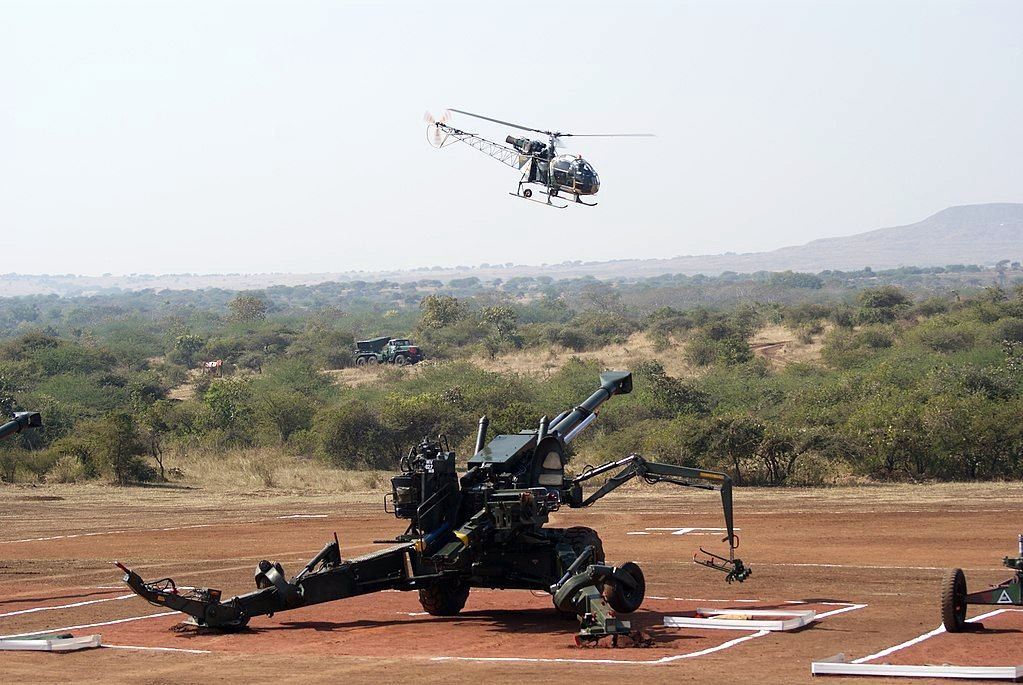
Dhanush is an Indian 155 mm 45-calibre towed howitzer developed from the Bofors FH-77B technical lineage. It was created as a longer-range and more automated artillery system for the Indian Army, combining a lengthened barrel with modern navigation, laying, ballistic-computation, and day-and-night sighting equipment.
The weapon was developed by the former Ordnance Factory Board using technical documentation transferred with India's acquisition of FH-77B howitzers. Production is associated with Gun Carriage Factory at Jabalpur, now part of Advanced Weapons and Equipment India.
Dhanush reached live-fire development testing by 2013, completed its final development trials in 2018, received bulk production clearance in February 2019, and began formal induction into the Indian Army in April 2019. The system remained in active Indian Army use during bilateral artillery training with the U.S. Army in 2026.
Development and trials
India's acquisition of 155 mm 39-calibre FH-77B howitzers in the 1980s included a technology-transfer package containing extensive technical documentation. The Dhanush program used this material as the basis for an Indian-developed weapon with a barrel lengthened from 39 to 45 calibres and extensive changes to its fire-control and sighting systems.
An Indian Army requirement covered 114 guns, with additional weapons planned. The program had reached live-fire testing by August 2013, when a barrel burst interrupted trials. The incident was later attributed to ammunition rather than a defect in the barrel design or metallurgy.
Summer trials were conducted at the Pokhran Field Firing Range from 6 to 30 June 2014 after winter testing in Sikkim at an altitude of about 3,500 m. Three Dhanush guns were delivered to the Indian Army for user trials in July 2016. Six-gun battery trials followed in 2017.
During 2017 testing, projectiles struck the muzzle brake on several occasions. Investigation subsequently identified defective ammunition as the cause. Development testing continued in desert and Himalayan conditions. Final development trials were completed in June 2018, when six guns fired 50 rounds each. Twelve prototypes had been built during the development program and had fired about 4,200 rounds.
The Ministry of Defence granted bulk production clearance for Dhanush on 18 February 2019. The first production batch of six guns was handed over to the Indian Army on 8 April 2019, marking the formal start of induction. The approved production requirement covered 114 guns.
Design
Dhanush is a 155 mm towed howitzer with a 45-calibre barrel. The longer barrel distinguishes it from the 39-calibre FH-77B and contributes to its greater firing range. The gun weighs less than 13 tonnes and incorporates an auxiliary self-propulsion system that allows limited movement and positioning without continuous assistance from a towing vehicle.
Fire control and sighting
The howitzer incorporates an inertial-navigation-based sighting system with GPS-supported gun recording and automatic laying. An onboard tactical computer performs ballistic calculations, while a muzzle-velocity recording system supplies data used for firing solutions.
For direct fire and day-and-night operation, Dhanush is equipped with an automated sighting system incorporating a camera, thermal imaging equipment, and a laser rangefinder. These systems allow the crew to lay the gun electronically and engage visible targets directly when required.
Range and ammunition
The Dhanush has a stated firing range of about 36 km with its normal long-range configuration. Firing to approximately 38 km has been demonstrated with specialized ammunition. The weapon is designed around the 155 mm ammunition family and is compatible with NATO-pattern 155 mm ammunition.
Operational history
The Indian Army began formal induction of Dhanush in April 2019 after completion of development trials and approval for bulk production. The first handover consisted of six guns, with the procurement program covering 114 weapons.
In September 2026, Indian artillery crews operated Dhanush alongside the lightweight M777A2 during Exercise Yudh Abhyas at the Mahajan Field Firing Range in Rajasthan. Personnel from the U.S. Army's 2nd Battalion, 8th Field Artillery Regiment trained with Indian crews on firing procedures, emplacement methods, maintenance, crew routines, and movement between firing positions. The activity was intended to improve artillery interoperability despite the two armies using different weapon, sensor, and command-system architectures.
Variants
- Dhanush 155 mm 45-calibre: Standard towed version developed for the Indian Army and approved for series production in 2019.
- Dhanush MGS: Vehicle-mounted derivative displayed in 2018 with the Dhanush gun installed on an 8x8 Tatra truck manufactured under licence by BEML. The configuration was described with a cross-country speed of about 30 km/h and road speed of about 80 km/h.
Operators
- India: Indian Army operator. Formal induction began in April 2019 under an approved requirement for 114 guns.
Specifications (Dhanush 155 mm 45-calibre)
General characteristics
- Type: Towed long-range howitzer
- Calibre: 155 mm
- Barrel length: 45 calibres
- Weight: Less than 13 tonnes
- Mobility: Auxiliary self-propulsion unit for local movement and emplacement
Performance
- Stated range: About 36 km
- Demonstrated extended range: Approximately 38 km with specialized ammunition
- Firing capacity: Up to 42 rounds in one hour
Fire control and equipment
- Navigation and gun recording: Inertial navigation with GPS support
- Laying: Automatic laying system
- Ballistic computation: Onboard tactical computer
- Muzzle-velocity measurement: Onboard recording system
- Direct-fire sighting: Camera, thermal imaging, and laser rangefinder
Related equipment
The Dhanush is derived from the Bofors FH-77B technical lineage but replaces the earlier 39-calibre barrel with a 45-calibre weapon and incorporates updated navigation, fire-control, sighting, and mobility systems.
 Argentina
 Armenia
 Australia
 Austria
 Austria-Hungary
 Belgium
 Brazil
 United Kingdom
 United States
 Brunei
 Bulgaria
 Canada
 Chile
Chile China
China Colonial America
 Colombia
 Confederate States
 Croatia
 Czech
Czech Denmark
 Egypt
Egypt Finland
 France
 Georgia
 Germany
 German Imperial
 Greece
 Holland
 Hungary
 Indonesia
 Iran
Iran Iraq
Iraq Ireland
 Israel
 Italy
Italy Japan
Japan Japan (1940)
 Jordan
 Kingdom of Italy
 Malaysia
 Mexico
 Myanmar
 Nazi Germany
 Netherlands
 New Zealand
 North Korea
 Norway
 Pakistan
 Peru
Peru Philippines
 Poland
 Portugal
 Prussia
 Romania
 Russia
 Saudi Arabia
 Serbia
 Singapore
 Slovakia
 Slovenia
 South Africa
 South Korea
 Soviet Union
 Spain
Spain Sweden
 Switzerland
 Syria
Syria Taiwan
 Thailand
 Turkey
 UAE
UAE Ukraine
 Vietnam
 Yugoslavia