History
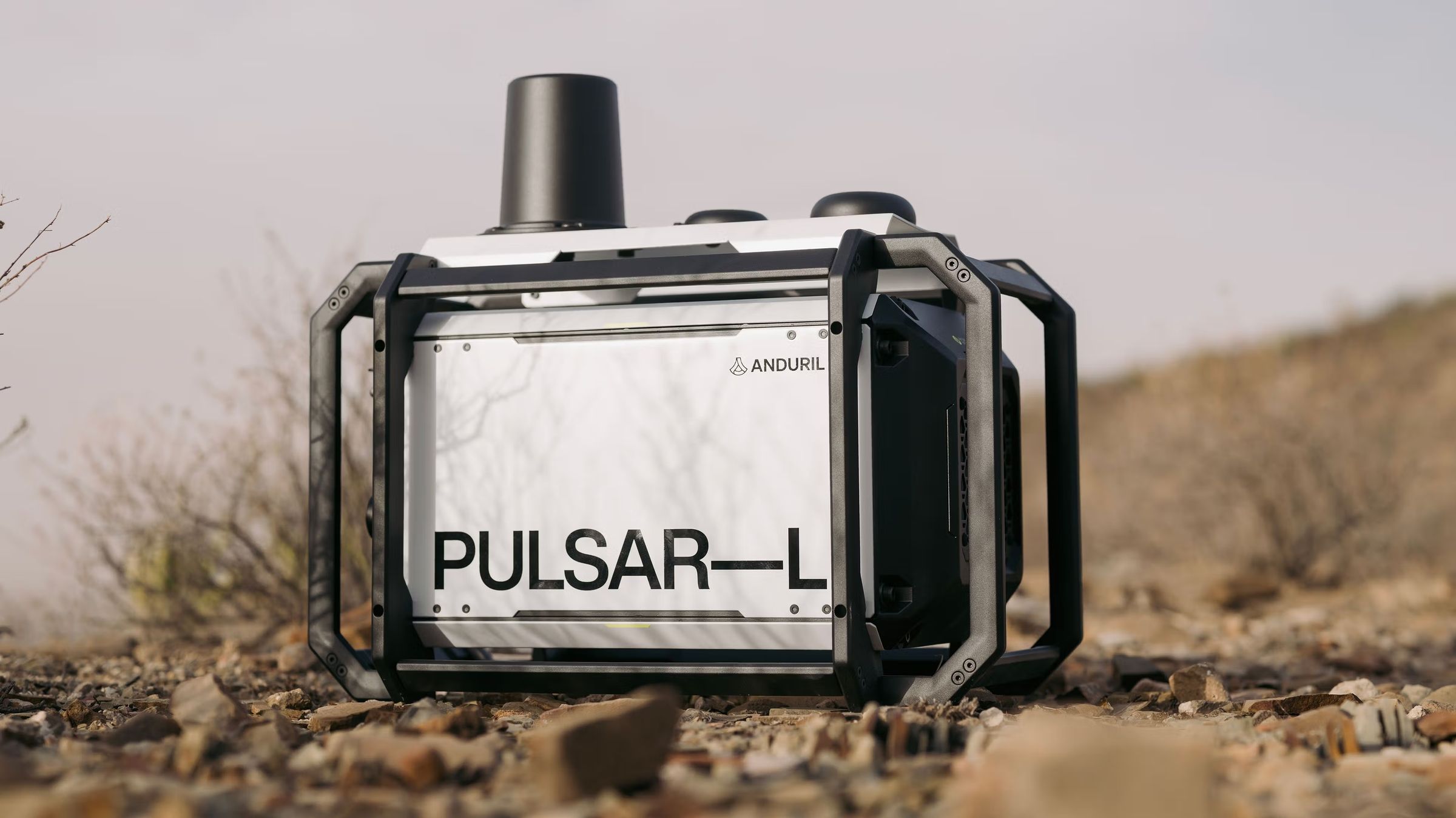
Anduril Pulsar-L is a compact electronic-warfare system designed for counter-uncrewed aerial system missions and other electromagnetic-spectrum operations. It combines radio-frequency sensing and electronic attack functions in a lightweight package that can operate independently or as part of a larger networked system.
Pulsar-L extends the capabilities of Anduril's broader Pulsar family into a smaller form factor intended for tactical deployment. The system can detect, track, identify and electronically defeat radio-frequency-dependent drones while operating from fixed or mobile platforms.
The system was first fielded in 2024 after an approximately eight-month development period from concept to fielding. Anduril publicly unveiled Pulsar-L in April 2025 and identified airborne and expeditionary configurations.
Development and fielding
Pulsar-L was developed as a smaller and lighter counterpart to earlier Pulsar configurations. Its reduced size, weight and power requirements were intended to extend electronic-warfare capabilities farther toward tactical units and platforms where installation space and electrical power are limited.
By April 2025, Pulsar-L was already being used in real-world operations. The system can operate autonomously, with software monitoring the electromagnetic spectrum, identifying potential threats and selecting responses with limited operator involvement. It can also operate with Anduril's Lattice software for command, control and coordination.
Anduril planned to produce more than 100 low-rate initial production units by the end of 2025 and subsequently scale production toward thousands of systems annually.
U.S. Marine Corps ACV integration
During 2026, the U.S. Marine Corps moved to acquire Pulsar-L systems for integration with the Amphibious Combat Vehicle fleet. The requirement was driven by a need for an organic soft-kill counter-UAS capability able to operate while the vehicle is stationary or moving in land, maritime and littoral environments.
The Marine Corps requirement called for a platform-integrated, omnidirectional system combining sensing and jamming functions. Pulsar-L was selected to detect, track, identify and defeat radio-frequency-dependent Group 1 and Group 2 unmanned aerial systems without exceeding the ACV's available space, weight and power allowance for the counter-UAS installation.
In September 2026, Marine Corps Systems Command awarded Anduril a sole-source contract valued at $15,711,445.50 for an unspecified number of Pulsar-L systems. The acquisition addressed an urgent operational requirement while the Marine Corps prepared a broader soft-kill counter-UAS program planned to begin in fiscal year 2027.
Design
Pulsar-L is a software-defined electronic-warfare system weighing less than 11.3 kg (25 lb). Its compact form allows deployment by small units and installation on platforms with limited space, weight and power capacity.
The system is offered in airborne and expeditionary configurations. It can be deployed within minutes and can function as a stand-alone system or integrate with Anduril's Lattice software.
Sensors and electronic attack
Pulsar-L combines radio-frequency sensing and jamming functions in one package. In the counter-UAS role, the system can detect, track and identify radio-frequency-dependent unmanned aircraft before applying a non-kinetic electronic response.
The U.S. Marine Corps configuration is intended to counter Group 1 and Group 2 unmanned aerial systems. Group 1 covers aircraft weighing up to 9.1 kg (20 lb), operating at altitudes up to 366 m (1,200 ft) and speeds up to 100 knots. Group 2 covers aircraft weighing approximately 9.5 to 24.9 kg (21 to 55 lb), operating at altitudes up to 1,067 m (3,500 ft) and speeds up to 250 knots.
Pulsar-L also provides counter-positioning, navigation and timing capabilities. These functions are intended to interfere with radio-frequency-dependent systems that rely on external navigation or timing signals.
Autonomy and adaptation
Pulsar-L can operate in an autonomous mode that continuously monitors the electromagnetic spectrum, evaluates detected emissions and responds to signals classified as threats. This reduces the amount of direct operator management required during engagements.
The system uses machine-learning techniques to adapt to changing unmanned-aircraft technologies and tactics. The Marine Corps selected Pulsar-L partly because it can respond to emerging radio-frequency threats without depending entirely on frequent updates to predefined threat libraries.
Operational history
Pulsar-L entered field use in 2024, before its public unveiling. Operational locations and early customers were not publicly identified at the time of the 2025 announcement.
By 2026, the system was in use by U.S. Special Operations Command. Its low weight, ability to engage multiple unmanned aircraft and capability to conduct the counter-UAS engagement sequence while stationary or moving were cited as important characteristics.
The U.S. Marine Corps subsequently selected Pulsar-L for urgent integration on Amphibious Combat Vehicles. The installation is intended to give deployed ACV units their own mobile electronic defense against small unmanned aircraft without substantially reducing vehicle mobility or operational tempo.
Variants
- Pulsar-L airborne: Configuration intended for installation or deployment on airborne platforms.
- Pulsar-L expeditionary: Lightweight configuration intended for mobile tactical deployment and integration with ground platforms.
Operators
- United States Special Operations Command: Pulsar-L was confirmed in operational use by 2026.
- U.S. Marine Corps: Contracted in 2026 for Pulsar-L systems and integration with Amphibious Combat Vehicles under an urgent counter-UAS requirement.
Specifications (Pulsar-L)
General characteristics
- Manufacturer: Anduril Industries
- Type: Software-defined electronic-warfare and counter-UAS system
- Weight: Less than 11.3 kg (25 lb)
- Configurations: Airborne and expeditionary
- Deployment: Setup within several minutes
- Operating modes: Stand-alone or integrated with Anduril Lattice
Capabilities
- Counter-UAS functions: Detection, tracking, identification and electronic defeat of radio-frequency-dependent unmanned aircraft
- Marine Corps target classes: Group 1 and Group 2 unmanned aerial systems
- Coverage: Omnidirectional in the U.S. Marine Corps platform-integrated configuration
- Electronic warfare: Combined radio-frequency sensing and jamming
- Navigation warfare: Counter-positioning, navigation and timing capability
- Autonomy: Automated spectrum monitoring, threat classification and engagement
- Adaptation: Machine-learning-based response to changing radio-frequency threats
- Mobility: Counter-UAS operation while stationary or moving
Related equipment
- Pulsar-V: Vehicle-oriented member of Anduril's larger Pulsar electronic-warfare family.
- Pulsar airborne system: Earlier airborne member of the Pulsar family from which the smaller Pulsar-L concept extends tactical electronic-warfare capability.
 Argentina
 Armenia
 Australia
 Austria
 Austria-Hungary
 Belgium
 Brazil
 United Kingdom
 United States
 Brunei
 Bulgaria
 Canada
 Chile
Chile China
China Colonial America
 Colombia
 Confederate States
 Croatia
 Czech
Czech Denmark
 Egypt
Egypt Finland
 France
 Georgia
 Germany
 German Imperial
 Greece
 Holland
 Hungary
 India
India Indonesia
 Iran
Iran Iraq
Iraq Ireland
 Israel
 Italy
Italy Japan
Japan Japan (1940)
 Jordan
 Kingdom of Italy
 Malaysia
 Mexico
 Myanmar
 Nazi Germany
 Netherlands
 New Zealand
 North Korea
 Norway
 Pakistan
 Peru
Peru Philippines
 Poland
 Portugal
 Prussia
 Romania
 Russia
 Saudi Arabia
 Serbia
 Singapore
 Slovakia
 Slovenia
 South Africa
 South Korea
 Soviet Union
 Spain
Spain Sweden
 Switzerland
 Syria
Syria Taiwan
 Thailand
 Turkey
 UAE
UAE Ukraine
 Vietnam
 Yugoslavia