
History
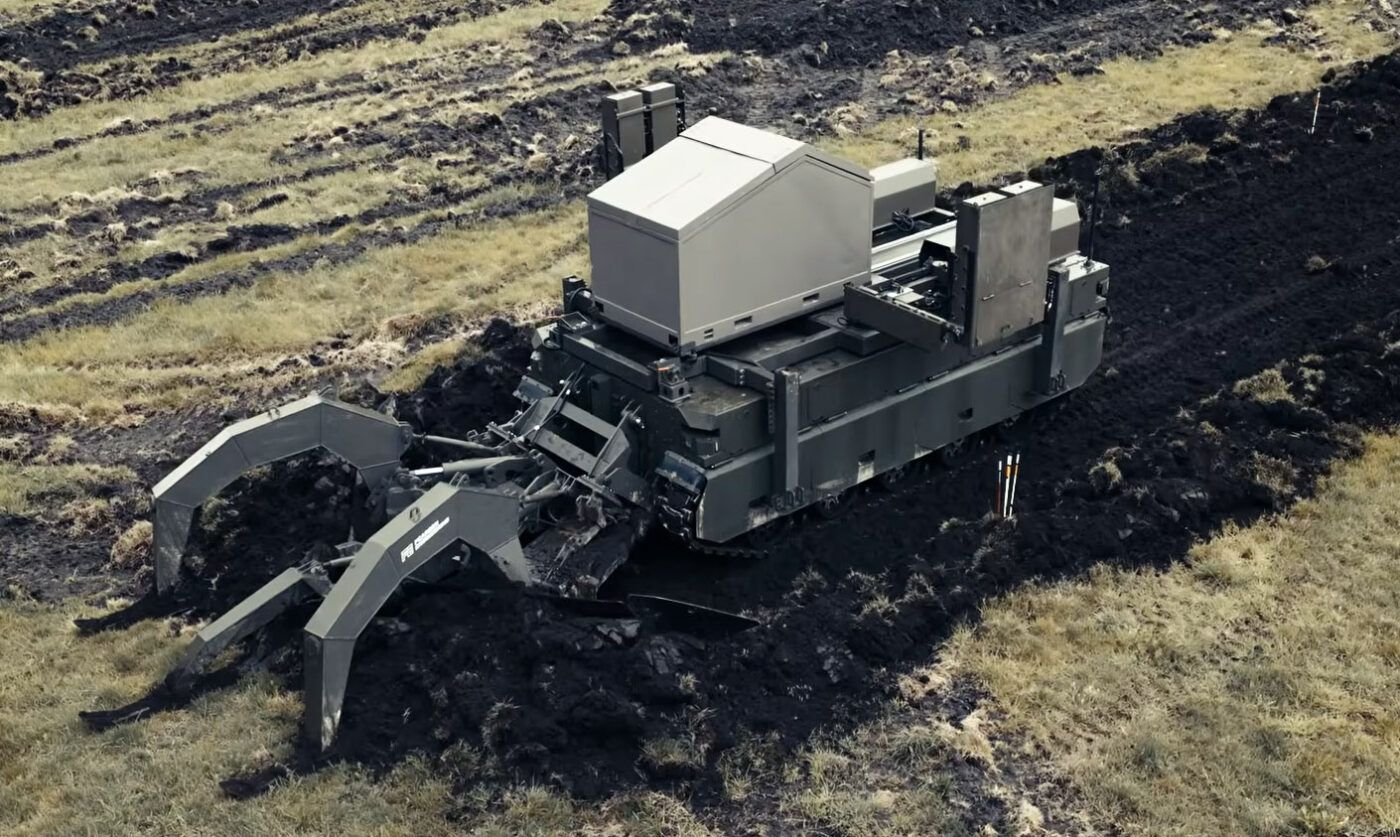
The Rheinmetall MV-8 Komodo is a heavy tracked unmanned ground vehicle intended for engineering, obstacle-reduction, reconnaissance, hazardous-environment, and other missions in which keeping personnel away from danger is important. The modular platform uses remote operation, a diesel-electric hybrid drive, and interchangeable mission equipment. Pasted text
The vehicle originated with Croatian company DOK-ING, whose earlier material identified the platform as the MVC8 Komodo. In 2026, Rheinmetall acquired a majority share of DOK-ING, and the former company continued as Rheinmetall Unmanned Vehicles. Current Rheinmetall material uses the designation MV-8 Komodo.
The platform has subsequently been developed for combat-engineering roles through cooperation involving Rheinmetall, DOK-ING technology, and Pearson Engineering. By September 2026, Rheinmetall Unmanned Vehicles was also testing a bridge-laying configuration fitted with the Cobra MLC 90 system.
Development
DOK-ING developed Komodo as a dual-use robotic system capable of working in hazardous conditions, including chemical, biological, radiological, and nuclear environments. Its mission set included reconnaissance, situational awareness, decontamination, firefighting, obstacle clearance, product control and mitigation, and automated collection of solid, liquid, gas, and vapor samples.
The platform was designed around modular front and rear attachments and a sensor suite that could be changed for different missions. This modular approach was later extended toward military engineering tasks such as breaching minefields, reducing obstacles, marking cleared lanes, and remotely placing bridges.
Bridge-laying development
In 2026, the MV-8 Komodo was tested with the Cobra MLC 90 bridge-laying system produced by General Dynamics European Land Systems. Rheinmetall Unmanned Vehicles identified the resulting configuration as the Unmanned Gap Crossing System, or UGCS.
The bridge system weighs approximately 5.3 tonnes. When deployed, the bridge is 15 m long and 3.75 m wide. It is rated for tracked vehicles weighing up to 81.7 tonnes and wheeled vehicles weighing up to 93.9 tonnes. The bridge is intended to span obstacles such as anti-tank ditches and natural gaps.
When carried in the folded position, the bridge system approximately doubles the vehicle's maximum silhouette height and overall length compared with the base Komodo, while increasing its width by about 0.6 m. The developer states that these dimensional changes do not reduce the platform's stated maximum speed, mobility, range, or other principal vehicle characteristics.
Design
The MV-8 Komodo is a tracked, remotely operated platform with a modular architecture intended to accept different mission systems. Rheinmetall describes the current military engineering configuration as supporting teleoperation and partial autonomy, while its open architecture is intended to permit further autonomous functions and network integration.
Powerplant and mobility
Komodo uses a diesel-electric hybrid propulsion system. The hybrid arrangement is intended to support operation in demanding environments, including areas with low oxygen levels and high temperatures. Rheinmetall also identifies a silent operating mode among the platform's features.
In the documented base configuration with the CBRN mission module, gripper, and manipulator arm, the vehicle has a gross weight of approximately 17,000 kg. Maximum speed is limited to 30 km/h. Ground clearance is 0.34 m.
Remote control and sensors
The vehicle is controlled remotely through a data link with a stated line-of-sight operating distance of up to 1,500 m. Its hazardous-environment configuration can carry chemical and radiological detection equipment, temperature and oxygen sensors, explosive-gas detectors, lidar, a meteorological station, and advanced video equipment.
The CBRN mission package supports decontamination of objects, personnel, and surfaces, as well as partial self-decontamination. The vehicle can also collect solid, liquid, and gaseous samples using automated equipment.
Interchangeable equipment
A documented front blade and gripper assembly weighs approximately 1,200 kg. It is 2.3 m wide and 0.94 m high, with a length varying from 1.35 to 1.9 m. The claws open to 1.8 m and can rotate through 360 degrees. The blade has a stated pushing capacity of 10 tonnes, while the front attachment has a maximum lifting capacity of 2,000 kg.
A rear manipulator arm has a maximum lifting capacity of 990 kg and a maximum outreach of 4 m. These attachments allow the platform to manipulate objects and perform intervention tasks without exposing an onboard crew.
Combat engineering equipment
The military engineering configuration can be equipped for minefield breaching and obstacle reduction. Rheinmetall lists a mine-clearing plough, the Plofadder mine-clearing line charge, and a lane-marking system among the available engineering payloads. Self-defence options include a weapon station, smoke grenade launchers, and ballistic protection.
Other demonstrated integrations include the Skorpion 2 remote mine-laying system and the MANGART counter-drone system with a 25 mm cannon. These integrations illustrate the platform's ability to accept mission-specific equipment rather than defining a single standard combat configuration.
Program status
As of September 2026, the MV-8 Komodo remained a modular unmanned engineering platform undergoing continued integration and testing for multiple roles. The Cobra-equipped Unmanned Gap Crossing System was being tested as an unmanned bridge-laying configuration. The supplied material does not establish operational service entry or a production quantity for this configuration.
Variants
- MVC8 Komodo: Earlier DOK-ING designation for the heavy tracked robotic platform, including configurations intended for CBRN response, reconnaissance, decontamination, firefighting, sample collection, and hazardous-environment intervention.
- MV-8 Komodo: Current designation for the remotely operated modular engineering platform developed for military engineering and obstacle-reduction missions.
- Unmanned Gap Crossing System: MV-8 Komodo bridge-layer configuration fitted with the Cobra MLC 90 bridge system and under testing in 2026.
Specifications (MV-8 Komodo base vehicle)
General characteristics
- Gross vehicle weight: approximately 17,000 kg in the documented CBRN configuration with gripper and manipulator arm
- Length: 7.2 m
- Width: 2.3 m
- Height: 2.9 m
- Ground clearance: 0.34 m
- Propulsion: diesel-electric hybrid
- Control: remote operation with partial-autonomy capability
Performance
- Maximum speed: limited to 30 km/h
- Remote-control distance: up to 1,500 m under line-of-sight conditions
Specifications (UGCS bridge-layer configuration)
Bridge system
- Bridge: Cobra MLC 90
- Bridge-system weight: approximately 5.3 tonnes
- Deployed bridge length: 15 m
- Deployed bridge width: 3.75 m
- Maximum stated tracked-vehicle load: 81.7 tonnes
- Maximum stated wheeled-vehicle load: 93.9 tonnes
 Argentina
 Armenia
 Australia
 Austria
 Austria-Hungary
 Belgium
 Brazil
 United Kingdom
 United States
 Brunei
 Bulgaria
 Canada
 Chile
Chile China
China Colonial America
 Colombia
 Confederate States
 Czech
Czech Denmark
 Egypt
Egypt Finland
 France
 Georgia
 Germany
 German Imperial
 Greece
 Holland
 Hungary
 India
India Indonesia
 Iran
Iran Iraq
Iraq Ireland
 Israel
 Italy
Italy Japan
Japan Japan (1940)
 Jordan
 Kingdom of Italy
 Malaysia
 Mexico
 Myanmar
 Nazi Germany
 Netherlands
 New Zealand
 North Korea
 Norway
 Pakistan
 Peru
Peru Philippines
 Poland
 Portugal
 Prussia
 Romania
 Russia
 Saudi Arabia
 Serbia
 Singapore
 Slovakia
 Slovenia
 South Africa
 South Korea
 Soviet Union
 Spain
Spain Sweden
 Switzerland
 Syria
Syria Taiwan
 Thailand
 Turkey
 UAE
UAE Ukraine
 Vietnam
 Yugoslavia