
History
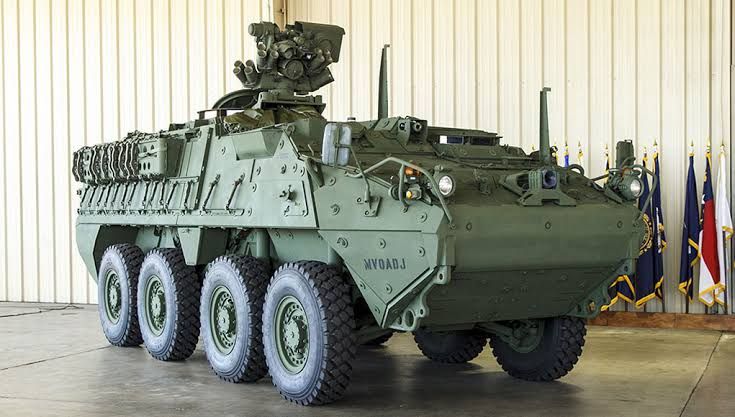
The Stryker Double V-Hull A1, commonly abbreviated DVH A1, is an upgraded 8x8 armored vehicle configuration used by the U.S. Army. It combines the blast-resistant Double V-Hull with a more powerful drivetrain, increased electrical capacity, and other automotive and systems improvements.
The Double V-Hull concept was developed after operational experience showed the vulnerability of earlier flat-bottom Strykers to mines and improvised explosive devices. The V-shaped lower structure redirects blast energy outward and away from the occupied compartment.
The A1 configuration further modernizes the Stryker platform to support heavier mission equipment, digital systems, networked command functions, and newer combat configurations while retaining the wheeled mobility of the Stryker family.
Development
Double V-Hull Strykers entered U.S. Army service after combat experience in Iraq and Afghanistan drove demand for improved underbody protection. The initial DVH vehicles retained the 350 hp Caterpillar C7 engine, and the added weight of protection and mission equipment placed greater demands on their automotive systems.
The DVH A1 addressed these limitations with a 450 hp Caterpillar C9 engine, an improved drivetrain and suspension, wider tires, and increased electrical generation. Its gross vehicle weight rating increased to approximately 28.6 tonnes, providing additional capacity for protection, weapons, sensors, communications equipment, and other mission systems.
Procurement
The U.S. Army had planned to halt future DVH A1 procurement under force-structure changes associated with the Army Transformation Initiative. Congressional funding subsequently supported additional A1 vehicles intended to continue Stryker brigade fielding.
On May 15, 2026, General Dynamics Land Systems received a $229.6 million fixed-price-incentive contract to produce 50 Stryker DVH A1 vehicles. Completion of that work was expected by June 30, 2028.
In September 2026, the Army ordered another 20 DVH A1 vehicles through a $49.3 million contract modification. The additional order extended procurement beyond the earlier planned stop and raised the cited cumulative value of the associated change to $278,947,722. The later modification carried an estimated completion date of December 31, 2028.
Design
Hull and protection
The defining feature of the DVH configuration is its Double V-Hull structure. Instead of the flat-bottom arrangement of early Strykers, the lower hull uses angled surfaces intended to direct the force of an underbody explosion away from the crew and passenger compartment.
The DVH design is supplemented by blast-attenuating seating, spall protection, and provisions for additional armor. These measures are intended to improve occupant survivability against mines, improvised explosive devices, fragmentation, and other battlefield threats.
Mobility
The Stryker DVH A1 uses an eight-wheel configuration and a 450 hp Caterpillar C9 engine. The A1 upgrade includes an improved drivetrain, suspension changes, and wider tires intended to compensate for the increased weight of protection and mission equipment.
The vehicle has a gross vehicle weight rating of approximately 28.6 tonnes. Available descriptions place its road speed at approximately 97 to 105 km/h, depending on configuration and operating conditions.
Electrical and digital systems
A 910-amp air-cooled alternator replaces the lower-capacity electrical generation system used on earlier configurations. The additional electrical capacity supports sensors, communications equipment, digital architecture, command-and-control systems, and other power-intensive mission equipment.
The increased electrical margin also provides capacity for further modernization, including additional sensors, networked systems, and protection equipment.
Program status
The Stryker DVH A1 remained in U.S. Army procurement in 2026 despite an earlier plan to end further purchases. Contracts placed during the year covered at least 70 additional vehicles, with associated work scheduled to continue through 2028.
The platform supports the Army's continued use of Stryker Brigade Combat Teams and provides a common automotive base for several mission configurations. The continued procurement program combines new vehicle production with incremental modernization of the established Stryker fleet.
Variants
- Infantry carrier configurations: DVH A1 vehicles can serve as armored troop carriers while incorporating the upgraded automotive, electrical, and protection features of the A1 chassis.
- 30 mm cannon configuration: Selected Stryker A1 vehicles can be fitted with the XM813 30 mm autocannon in an unmanned turret for increased direct-fire capability.
- M-SHORAD: The Maneuver Short-Range Air Defense configuration uses the modernized Stryker chassis as a mobile platform for countering drones, helicopters, and low-flying aircraft.
Operators
- United States: The U.S. Army operates and continues to procure Stryker DVH A1 vehicles for Stryker Brigade Combat Teams.
Specifications (Stryker DVH A1)
General characteristics
- Configuration: 8x8 wheeled armored vehicle
- Gross vehicle weight rating: approximately 28.6 tonnes
- Engine: Caterpillar C9 diesel
- Engine power: 450 hp
- Electrical generation: 910-amp air-cooled alternator
Performance
- Road speed: approximately 97-105 km/h
 Argentina
 Armenia
 Australia
 Austria
 Austria-Hungary
 Belgium
 Brazil
 United Kingdom
 Brunei
 Bulgaria
 Canada
 Chile
Chile China
China Colonial America
 Colombia
 Confederate States
 Croatia
 Czech
Czech Denmark
 Egypt
Egypt Finland
 France
 Georgia
 Germany
 German Imperial
 Greece
 Holland
 Hungary
 India
India Indonesia
 Iran
Iran Iraq
Iraq Ireland
 Israel
 Italy
Italy Japan
Japan Japan (1940)
 Jordan
 Kingdom of Italy
 Malaysia
 Mexico
 Myanmar
 Nazi Germany
 Netherlands
 New Zealand
 North Korea
 Norway
 Pakistan
 Peru
Peru Philippines
 Poland
 Portugal
 Prussia
 Romania
 Russia
 Saudi Arabia
 Serbia
 Singapore
 Slovakia
 Slovenia
 South Africa
 South Korea
 Soviet Union
 Spain
Spain Sweden
 Switzerland
 Syria
Syria Taiwan
 Thailand
 Turkey
 UAE
UAE Ukraine
 Vietnam
 Yugoslavia