
History
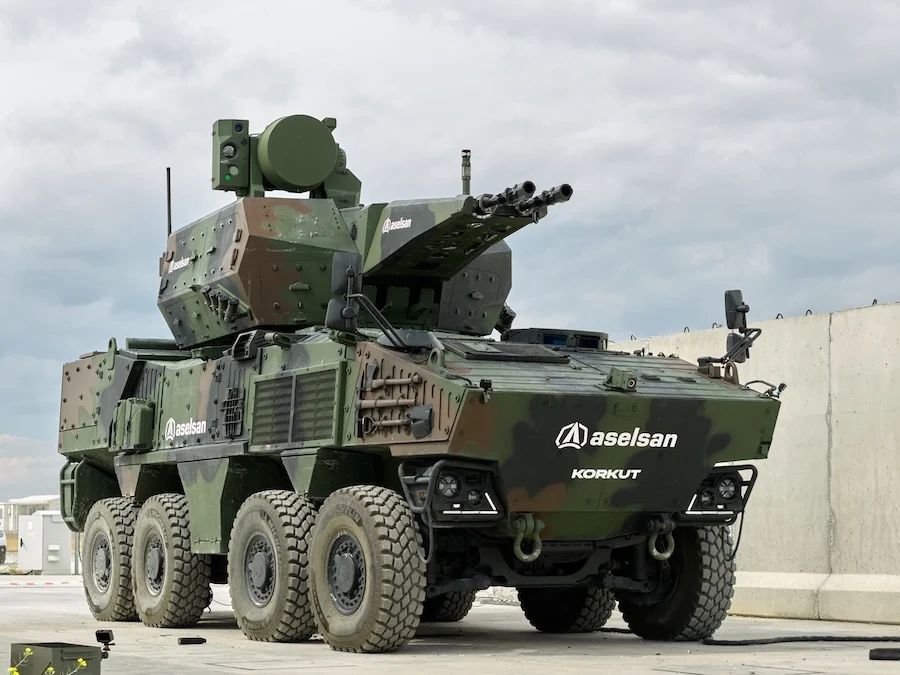
ASELSAN KORKUT 35 is a Turkish mobile short-range air-defense gun system built around a stabilized twin 35 mm cannon installation. It is designed to protect mobile and stationary forces against aircraft, helicopters, unmanned aerial vehicles, cruise missiles and other low-altitude aerial threats.
The system combines radar and electro-optical target tracking with programmable 35 mm airburst ammunition. Its gun vehicles can track assigned targets and fire while moving, while a separate command-and-control vehicle provides the wider local air picture and distributes targets.
KORKUT was originally fielded on the tracked ACV-30 platform for the Turkish Land Forces. ASELSAN later developed wheeled configurations, including KORKUT 140/35 on an 8×8 chassis, while continuing to demonstrate the system against increasingly important unmanned-aircraft threats.
Development and production
A development contract for the tracked KORKUT vehicle was signed in June 2011. The system was publicly unveiled in 2013, establishing the first supported year in which the complete equipment was publicly recognizable. In May 2016, the Turkish Land Forces placed a production contract covering 40 weapon systems and 13 command-post vehicles. Serial production began in 2017.
The standard tracked system uses ACV-30 armored platforms supplied by FNSS, with ASELSAN serving as the air-defense system developer and prime contractor. A typical KORKUT platoon consists of three gun system vehicles and one command-and-control vehicle.
Wheeled development
ASELSAN later adapted the KORKUT concept to wheeled vehicles. The KORKUT 140/35 configuration made its public debut at Eurosatory in June 2024 on an Otokar Arma 8×8 armored combat vehicle chassis. The wheeled version was developed particularly for users requiring greater road mobility, including potential air-base protection missions.
Counter-drone demonstrations
KORKUT has been tested against unmanned aerial targets as part of its short-range air-defense role. Trials have included loitering-munition targets, and a tracked KORKUT was credited with destroying such a target at a range exceeding 3 km while using a limited number of rounds.
In September 2026, ASELSAN demonstrated KORKUT 35 in live fire before military delegations from 12 countries. The aerial scenarios included fixed-wing, delta-wing, mini and micro unmanned aircraft. The demonstration also included an engagement against a moving ground target while the KORKUT vehicle itself was moving.
Design
Weapon system
KORKUT uses a remotely controlled, stabilized turret with two 35 mm cannon. The two guns provide a combined firing rate of approximately 1,100 rounds per minute. The gun system has an effective engagement range of up to 4 km.
An automatic linkless ammunition feed mechanism allows two different ammunition types to be carried in the feed system simultaneously. The selected ammunition type can be changed in less than 15 seconds. The magazine arrangement has been described as carrying 200 ready-to-fire rounds together with 200 additional rounds.
Ammunition
The system can use conventional 35 mm ammunition and ASELSAN ATOM programmable airburst ammunition. ATOM rounds are programmed during firing so that they burst near the calculated target position. The resulting pattern of projectiles is intended to improve effectiveness against small and difficult aerial targets, including unmanned aircraft.
Sensors and fire control
Each gun system vehicle carries fire-control radar and electro-optical sensors for automatic target tracking. The stabilized turret allows target tracking and firing while the vehicle is moving.
The command-and-control vehicle carries a three-dimensional search radar used to build the local air picture, evaluate threats and assign targets to individual gun vehicles. This separates wide-area surveillance and target assignment from the precision tracking equipment carried by the weapon vehicles.
Mobility
The original land configuration uses the tracked ACV-30 armored vehicle family. The later KORKUT 140/35 uses an 8×8 wheeled chassis. Both configurations retain the core twin-35 mm gun and sensor concept while addressing different mobility requirements.
Operational history
The tracked KORKUT entered Turkish service after serial production began in 2017. It provides short-range gun-based air defense for deployed land forces and is organized around groups of gun vehicles supported by a command-and-control vehicle.
ASELSAN has also pursued export use of the KORKUT family. Its 2025 reporting identified a first overseas delivery of the tracked KORKUT 150/35 configuration, although the customer was not identified in the cited material. In September 2026, KORKUT was publicly shown in Pakistan, but the precise configuration and quantity associated with that appearance were not established by the available evidence.
Variants
- KORKUT 150/35: Tracked land-based configuration using the ACV-30 vehicle family. It represents the established KORKUT arrangement used by the Turkish Land Forces.
- KORKUT 140/35: Wheeled configuration publicly introduced in 2024 on an Otokar Arma 8×8 chassis. It retains the twin 35 mm gun concept and is intended for users favoring wheeled mobility.
Operators
- Türkiye: The Turkish Land Forces operate the tracked KORKUT system. A 2016 production order covered 40 weapon systems and 13 command-post vehicles.
Specifications (KORKUT 150/35 tracked configuration)
General characteristics
- Type: Mobile short-range self-propelled air-defense gun system
- Platform: ACV-30 tracked armored vehicle
- Standard unit organization: Three gun system vehicles and one command-and-control vehicle
- Primary armament: Twin 35 mm cannon
- Ammunition feed: Automatic linkless feed mechanism capable of holding two ammunition types
- Ready ammunition: 200 rounds
- Additional ammunition: 200 rounds
Performance
- Effective gun range: Up to 4 km
- Combined firing rate: Approximately 1,100 rounds per minute
- Ammunition change time: Less than 15 seconds between the two loaded ammunition types
- Fire on the move: Supported by the stabilized turret and tracking system
Sensors and fire control
- Gun vehicle tracking: Fire-control radar and electro-optical sensors
- Command vehicle surveillance: Three-dimensional search radar
- Target management: Command vehicle develops the local air picture, evaluates threats and assigns targets to gun vehicles
Armament
- Gun ammunition: 35 mm conventional ammunition and ASELSAN ATOM programmable airburst ammunition
- Intended aerial targets: Aircraft, helicopters, unmanned aerial vehicles, cruise missiles and air-to-ground missiles
 Argentina
 Armenia
 Australia
 Austria
 Austria-Hungary
 Belgium
 Brazil
 United Kingdom
 United States
 Brunei
 Bulgaria
 Canada
 Chile
Chile China
China Colonial America
 Colombia
 Confederate States
 Croatia
 Czech
Czech Denmark
 Egypt
Egypt Finland
 France
 Georgia
 Germany
 German Imperial
 Greece
 Holland
 Hungary
 India
India Indonesia
 Iran
Iran Iraq
Iraq Ireland
 Israel
 Italy
Italy Japan
Japan Japan (1940)
 Jordan
 Kingdom of Italy
 Malaysia
 Mexico
 Myanmar
 Nazi Germany
 Netherlands
 New Zealand
 North Korea
 Norway
 Pakistan
 Peru
Peru Philippines
 Poland
 Portugal
 Prussia
 Romania
 Russia
 Saudi Arabia
 Serbia
 Singapore
 Slovakia
 Slovenia
 South Africa
 South Korea
 Soviet Union
 Spain
Spain Sweden
 Switzerland
 Syria
Syria Taiwan
 Thailand
 UAE
UAE Ukraine
 Vietnam
 Yugoslavia