
History
The Hanwha Aerospace K10 is a South Korean tracked ammunition resupply vehicle developed to support the K9 Thunder 155 mm self-propelled howitzer. It uses a K9-derived chassis and an automated ammunition transfer system so ammunition can be transferred while the crews remain under armored protection.
The K10 carries up to 104 155 mm shells and 504 propellant charge units. Its shared chassis and automotive components provide mobility comparable to the K9 and simplify logistics within artillery units.
Development
An initial concept study for the ammunition resupply system began in November 1998 with Samsung Aerospace Industries and Pusan National University. Detailed design began in February 2002 with Samsung Techwin, the Agency for Defense Development, and the Defense Agency for Technology and Quality. Development was declared complete in October 2005.
The first K10 vehicle rolled out in November 2006 and was assigned to the Republic of Korea Army's 1st Artillery Brigade. The system subsequently became part of the wider K9 artillery family offered for export.
Export programs
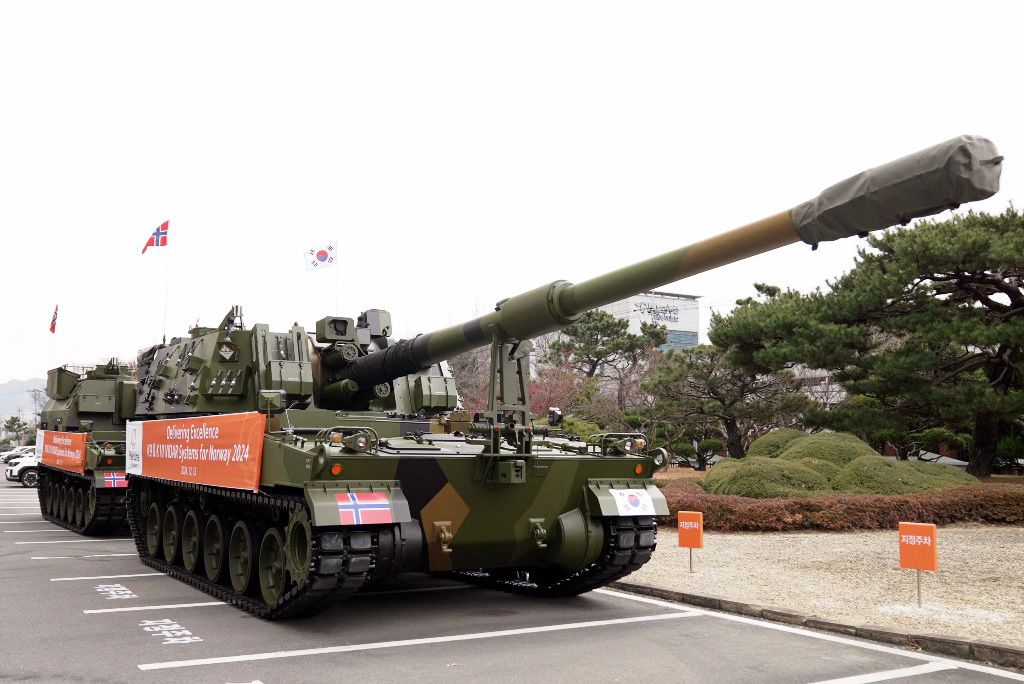
Norway signed its first contract for 24 K9 self-propelled howitzers and six K10 ammunition resupply vehicles in 2017. A follow-on contract was signed in 2022 for additional K9 VIDAR and K10 systems. In December 2024, Hanwha Aerospace shipped another batch that included eight K10 vehicles and four K9 howitzers for Norway.
Romania signed a contract with Hanwha Aerospace on July 9, 2024, valued at nearly $1 billion for 54 K9 howitzers and 36 K10 ammunition resupply vehicles, together with ammunition and other program elements. Romania received its first K9, K10, and K12 tracked vehicles in September 2026.
Design
Layout and ammunition handling
The K10 is based on the tracked chassis of the K9 Thunder but replaces the howitzer turret with a fixed superstructure dedicated to ammunition storage and transfer. A mechanized ammunition-transfer structure extends from the K10 and connects with the rear of a K9, allowing shells and propellant charges to be transferred without requiring the crews of either vehicle to work outside their protected compartments.
The vehicle carries up to 104 155 mm artillery shells and 504 propellant charge units. The automated handling arrangement reduces manual ammunition movement and allows resupply to continue in environments where exposure outside the vehicle would be hazardous.
Mobility
The K10 uses a tracked chassis with six road wheels per side and hydropneumatic suspension. Power is provided by an MTU MT 881 Ka-500 eight-cylinder water-cooled diesel engine rated at 1,000 hp, coupled to an S&T Dynamics X1100-5A3 transmission. The common automotive architecture with the K9 allows the resupply vehicle to accompany the artillery system across similar terrain.
Protection
The vehicle uses a steel armored hull. Available technical data describe protection against 14.5 mm projectiles and 155 mm artillery shell fragments, together with protection against anti-personnel mines. An NBC protection system and fire-suppression equipment are also fitted.
Descriptions of the roof-mounted defensive machine gun are inconsistent. Available data identify either a 7.62 mm machine gun or a 12.7 mm M2HB, so the supplied evidence does not establish a single weapon configuration for all baseline K10 vehicles.
Operational history
The Republic of Korea Army was the first operator of the K10, using it alongside K9 Thunder batteries. The vehicle's purpose is to maintain the ammunition supply of self-propelled artillery while preserving the mobility and protection of the tracked formation.
Norway operates K10 vehicles in support of its K9-based VIDAR artillery fleet. The country initially acquired six K10 vehicles with its 2017 K9 order and later contracted for additional systems.
Romania contracted for 36 K10 vehicles together with 54 K9 howitzers in 2024. Initial Romanian deliveries of the K9-family vehicles, including K10 ammunition resupply vehicles, began in 2026.
Variants
- K10 ARV: Baseline automated ammunition resupply vehicle for the K9 Thunder artillery system.
- K10 VIDAR: Norwegian version associated with the country's K9 VIDAR artillery system.
- K10 AARV: Enhanced-protection development of the K10 ammunition resupply vehicle.
- AS10: Australian implementation of the protected K10 AARV concept.
- POYRAZ: Turkish ammunition transfer vehicle developed through technology transfer associated with the T-155 Fırtına program. It carries up to 96 155 mm shells and incorporates an auxiliary power unit.
Operators
- South Korea: Republic of Korea Army operator of the baseline K10 in support of K9 Thunder artillery units.
- Norway: Acquired six K10 vehicles with its initial 2017 contract for 24 K9 systems and later ordered additional K10 vehicles under a 2022 follow-on agreement.
- Romania: Contracted for 36 K10 ammunition resupply vehicles in July 2024 as part of a package including 54 K9 howitzers. Initial vehicles were received in 2026.
Specifications (K10 ARV)
General characteristics
- Crew: 3
- Combat weight: 47 t
- Length: 8.43 m
- Width: 3.40 m
- Height: 3.56 m
- Chassis: Tracked, six road wheels per side
- Suspension: Hydropneumatic
- Engine: MTU MT 881 Ka-500 eight-cylinder water-cooled diesel
- Engine power: 1,000 hp
- Transmission: S&T Dynamics X1100-5A3
- Ammunition capacity: Up to 104 155 mm shells
- Propellant capacity: Up to 504 charge units
Performance
- Maximum speed: 62 km/h
- Range: 360 km
- Power-to-weight ratio: 21 hp/t
- Vertical obstacle: 0.75 m
- Trench: 2.8 m
- Gradient: 60%
- Side slope: 30%
- Fording depth: 1.5 m
Related equipment
- K9 Thunder: 155 mm tracked self-propelled howitzer for which the K10 was developed as an ammunition resupply vehicle.
- K11 FDCV: Fire direction control vehicle based on the K10 platform and developed for command, control, reconnaissance, and communications functions.
 Argentina
 Armenia
 Australia
 Austria
 Austria-Hungary
 Belgium
 Brazil
 United Kingdom
 United States
 Brunei
 Bulgaria
 Canada
 Chile
Chile China
China Colonial America
 Colombia
 Confederate States
 Croatia
 Czech
Czech Denmark
 Egypt
Egypt Finland
 France
 Georgia
 Germany
 German Imperial
 Greece
 Holland
 Hungary
 India
India Indonesia
 Iran
Iran Iraq
Iraq Ireland
 Israel
 Italy
Italy Japan
Japan Japan (1940)
 Jordan
 Kingdom of Italy
 Malaysia
 Mexico
 Myanmar
 Nazi Germany
 Netherlands
 New Zealand
 North Korea
 Norway
 Pakistan
 Peru
Peru Philippines
 Poland
 Portugal
 Prussia
 Romania
 Russia
 Saudi Arabia
 Serbia
 Singapore
 Slovakia
 Slovenia
 South Africa
 Soviet Union
 Spain
Spain Sweden
 Switzerland
 Syria
Syria Taiwan
 Thailand
 Turkey
 UAE
UAE Ukraine
 Vietnam
 Yugoslavia