
History
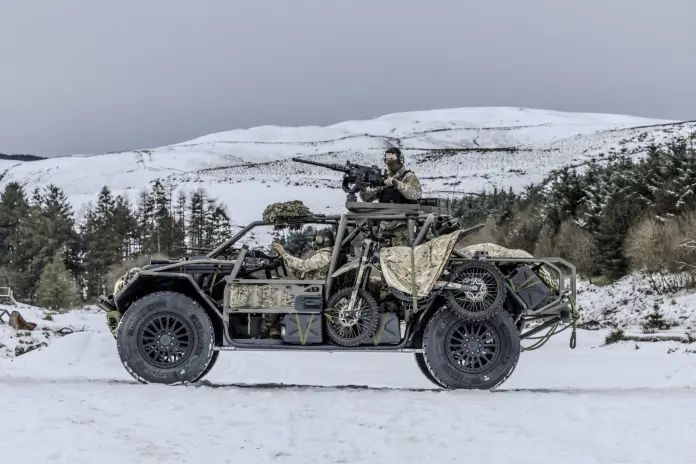
The Fering Pioneer family is a British range-extended hybrid vehicle architecture developed for expeditionary and military mobility. It combines electric drive, onboard power generation, lightweight modular construction and unusually large fuel capacity to support operations far from established logistics networks.
The family includes the original Pioneer 4×4 expeditionary platform, the military-focused Pioneer X 4×4 and a stretched Pioneer X 6×6. The military versions are intended to combine long-range mobility with electric-only movement, electrical power for mission systems and rapid adaptation to different roles.
Fering Technologies was established in London in 2019 to develop vehicles capable of operating across difficult terrain and extreme environments with limited dependence on external support. The original Pioneer established the basic architecture of lightweight construction, electric propulsion and a range-extending generator. The company subsequently developed the Pioneer X as a military-grade derivative with input from specialist military users.
Military development
The Pioneer X production prototype was unveiled in January 2025. Its structure used a carbon-fibre modular central spine with extensive aluminium construction, while electric motors drove the front and rear axles. The vehicle incorporated a generator-based range extender, variable-height air suspension and a modular upper structure intended to accommodate different military roles.
Development also produced a stretched 6×6 configuration. An early prototype was already running by January 2025, demonstrating that the central spine and axle architecture could be extended without redesigning the complete vehicle. The military Pioneer family was subsequently displayed at Defence Vehicle Dynamics 2026 at UTAC Millbrook on 16–17 September 2026, where Fering presented the Pioneer 4×4, Pioneer X 4×4 and Pioneer X 6×6 together.
The Pioneer architecture has been proposed for the British Army Light Mobility Vehicle programme. Fering has presented the platform as a possible common basis for multiple roles rather than as a single fixed vehicle configuration.
International evaluation
Prototype Pioneer vehicles have also been sold for evaluation outside the United Kingdom. Vehicles have been supplied to Canada and to an undisclosed customer in the Middle East for testing. By September 2026, Fering had entered a design-for-manufacture phase and was examining requirements for expanded production capacity.
Design
The Pioneer family is based on a modular lower vehicle architecture containing the propulsion, suspension, braking, fuel and electrical systems. The upper structure can be changed for different missions. The central structural spine is primarily carbon composite, while aluminium is used extensively elsewhere to reduce mass.
Hybrid powertrain
Propulsion is electric, with motors at the front and rear of the 4×4 vehicle. The Pioneer X prototype described in 2025 used two electric motors operating from a 420 V system and producing 650 Nm of torque per axle. A separate 24 V electrical system supports installed equipment.
A 60 kW range-extending generator recharges the traction batteries and can also supply electrical energy to external equipment. The generator can support communications and C4I systems, sensors, UAV charging and other electrically demanding mission equipment. This allows the vehicle to operate as a mobile power source when stationary as well as providing propulsion energy.
The range extender has been designed to accommodate heavy-fuel generation, while hydrogen fuel-cell generation has also been identified as an alternative architecture. The 4×4 design can carry up to approximately 470 litres of fuel within tanks integrated into the central structure.
Maximum range with the range extender has been stated at approximately 7,000 km under suitable operating conditions. Actual endurance depends on terrain, payload, operating cycle and electrical demand. The Pioneer X can also travel for up to 80 km using battery-electric propulsion alone, reducing engine noise and thermal signature during reconnaissance, infiltration and patrol missions.
Suspension and mobility
The Pioneer X uses fully independent, variable-height active air suspension. Separate operating settings are provided for road and off-road use, and individual suspension elements can adjust vehicle attitude on difficult terrain. A central tyre inflation system is fitted to the military configuration.
The 4×4 has been described with a maximum road speed of 130 km/h. Demonstrated or stated mobility figures include climbing a 60% gradient, negotiating a 50-degree side slope and overcoming a 750 mm vertical step. The short front overhang provides a 74-degree approach angle, while the rear layout produces a 48-degree departure angle.
The electrical and mechanical systems are designed for severe environmental exposure. The vehicle has an IP68 waterproof rating and is intended to operate across surfaces including sand, ice, mud and rock.
Modularity and payload
The modular architecture separates the lower mobility platform from the mission body. The upper structure can be removed from the lower chassis, and common axle modules are intended to simplify replacement and maintenance. Fering describes the architecture as suitable for reconfiguration without specialist equipment.
The Pioneer X can be arranged as a 4×4 pickup, 6×6 payload carrier, personnel transporter or command-and-control platform. The structure can accept STANAG-compatible protective systems, although the Pioneer X was not originally designed as a conventionally armoured vehicle.
The 4×4 can carry weapon-ring installations and remote weapon stations. A typical crew arrangement accommodates five personnel, including a driver, commander, two rear occupants and a fifth crew member operating a weapon from the ring mount. A personnel-carrier arrangement can accommodate nine passengers in addition to a two-person crew, while a casualty-evacuation configuration can carry up to four litters on the rear platform.
6×6 architecture
The Pioneer X 6×6 extends the modular spine by approximately one metre and adds a third axle. In the developmental configuration, the additional axle and longer structure increased vehicle mass by approximately 250 kg while providing substantially greater payload capacity.
Payload figures changed during development. An early 2025 description indicated more than 2.5 tonnes of payload, while the prototype displayed in September 2026 was described as weighing approximately 2.3 tonnes and carrying around 2 tonnes. The later prototype retained the mobility and external electrical-power capability of the 4×4, while Fering was developing a revised power system for the heavier configuration.
Transportability
Fering has designed the Pioneer X as a deployable light vehicle. The 4×4 configuration has been presented as suitable for transport by CH-47 and CH-53 heavy-lift helicopters and by C-130 transport aircraft.
Program status
As of September 2026, the Pioneer family remained in development and evaluation rather than large-scale operational service. The Pioneer X was competing for the British Army Light Mobility Vehicle requirement, while prototype vehicles were undergoing evaluation by international customers.
The programme had progressed from experimental vehicle development toward design for manufacture. The Pioneer X 6×6 remained a prototype, with further powertrain development planned as Fering refined the configuration for increased payload and mission-system demand.
Fering is also developing an autonomous version of the Pioneer X with multiple levels of autonomy. Proposed applications include unmanned logistics and casualty-evacuation support, but these capabilities remained developmental.
Variants
- Pioneer 4×4: Original long-range hybrid expeditionary vehicle forming the technical basis of the family.
- Pioneer X 4×4: Military-focused derivative with reduced-signature electric operation, mission-system power supply, modular military configurations and provisions for weapon and protection systems.
- Pioneer X 6×6: Stretched prototype with a third axle, increased payload capacity and the same basic modular architecture as the 4×4.
Specifications (Pioneer X 4×4)
General characteristics
- Configuration: 4×4 range-extended hybrid military mobility vehicle
- Length: 5.12 m
- Width: 1.9 m
- Height: 1.7–2.165 m depending on suspension setting
- Wheelbase: 3.3 m
- Track width: 1.62 m
- Kerb weight: 1,650 kg for the 2025 production prototype; 1,750 kg for the later British LMV configuration
- Gross vehicle weight rating: 3,500 kg for the British LMV configuration
- Maximum payload: 1,550 kg for the British LMV configuration
- Fuel capacity: Up to approximately 470 litres
- Electrical architecture: 420 V traction system with separate 24 V equipment supply
- Range extender: 60 kW generator
- Drive: Front and rear electric motors
- Motor torque: 650 Nm per axle on the 2025 prototype
- Suspension: Fully independent variable-height active air suspension
- Tyres: 22.5×285R70 truck tyres
Performance
- Maximum road speed: 130 km/h
- Maximum stated extended range: Approximately 7,000 km
- Electric-only range: Up to 80 km
- Maximum gradient: 60%
- Side slope: 50 degrees
- Vertical step: 750 mm
- Approach angle: 74 degrees
- Departure angle: 48 degrees
- Water protection: IP68
Armament and mission systems
- Weapon mounting: Heavy-duty ring mount or remote weapon station depending on configuration
- Ring-mount weapons: Compatible with weapons including 12.7 mm machine guns and 40 mm automatic grenade launchers
- Mission power: Generator output available for C4I equipment, sensors, UAV charging and other external electrical loads
- Protection: Structure compatible with STANAG-compliant protection solutions
 Argentina
 Armenia
 Australia
 Austria
 Austria-Hungary
 Belgium
 Brazil
 United States
 Brunei
 Bulgaria
 Canada
 Chile
Chile China
China Colonial America
 Colombia
 Confederate States
 Croatia
 Czech
Czech Denmark
 Egypt
Egypt Finland
 France
 Georgia
 Germany
 German Imperial
 Greece
 Holland
 Hungary
 India
India Indonesia
 Iran
Iran Iraq
Iraq Ireland
 Israel
 Italy
Italy Japan
Japan Japan (1940)
 Jordan
 Kingdom of Italy
 Malaysia
 Mexico
 Myanmar
 Nazi Germany
 Netherlands
 New Zealand
 North Korea
 Norway
 Pakistan
 Peru
Peru Philippines
 Poland
 Portugal
 Prussia
 Romania
 Russia
 Saudi Arabia
 Serbia
 Singapore
 Slovakia
 Slovenia
 South Africa
 South Korea
 Soviet Union
 Spain
Spain Sweden
 Switzerland
 Syria
Syria Taiwan
 Thailand
 Turkey
 UAE
UAE Ukraine
 Vietnam
 Yugoslavia