
History
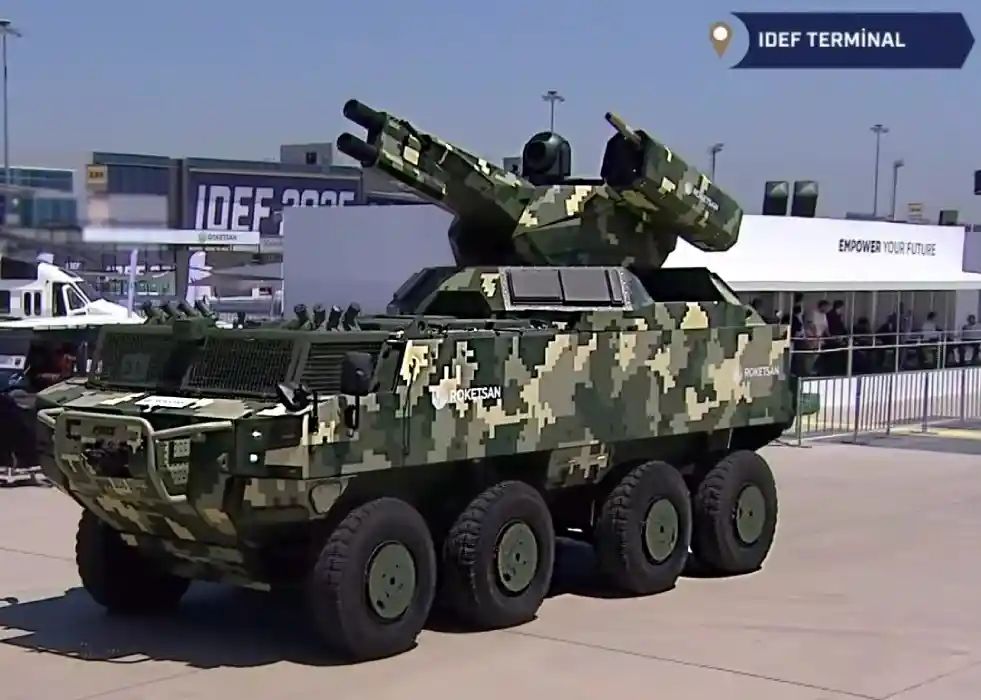
Roketsan Burç is a Turkish mobile short-range air-defence system that combines guided surface-to-air missiles, a cannon, and an integrated sensor suite on a stabilised turret. It is intended to engage fixed-wing aircraft, helicopters, and unmanned aerial vehicles while operating independently or as part of a wider air-defence network.
The system uses Sungur very short-range air-defence missiles as its principal missile armament. Eight Sungur missiles can be carried, while a 20 mm or 30 mm cannon provides an additional weapon for close-range engagements.
Burç integrates active and passive surveillance sensors, electro-optical and infrared equipment, identification friend or foe equipment, and a data link. Its stabilised turret and sensor architecture are designed to provide 360-degree surveillance and support engagements while the carrier vehicle is moving.
Development
Burç was publicly presented by Roketsan in 2025 as a modular mobile air-defence turret suitable for installation on wheeled armoured vehicles. The turret was described as weighing approximately 2 tonnes and as suitable for vehicles weighing 12 tonnes or more. The FNSS PARS 8x8 family was shown as one possible carrier.
The system was designed around a combination of missile and gun armament rather than relying on a single type of interceptor. The Sungur missile provides the longer engagement component of the weapon system, while the cannon is intended for closer targets. The turret can rotate through 360 degrees and is stabilised to maintain surveillance and weapon control while the vehicle is moving.
By 2026, Burç had been integrated on an FNSS PARS SCOUT 8x8 armoured vehicle. The configuration included four fixed radar sensors and an electro-optical/infrared system. A 2026 configuration also showed independently elevating missile launcher positions, allowing the launchers to be controlled separately in elevation.
Testing
On 14 September 2026, Roketsan announced the first firing of a Sungur missile from the Burç mobile ground-based air-defence system. During the test, a missile launched from Burç successfully engaged a moving aerial target. The event demonstrated the integration of the Sungur missile with the Burç turret, sensors, and fire-control architecture.
Design
Turret and vehicle integration
Burç is built around a modular, fully traversable stabilised turret. The turret provides 360-degree coverage and is intended for integration on mobile land platforms. A turret mass of approximately 2 tonnes has been stated, with installation intended for vehicles in the 12-tonne class or heavier.
The FNSS PARS 8x8 and PARS SCOUT 8x8 have been used as carrier examples. The architecture is not limited to a single vehicle type, allowing the air-defence module to be adapted to suitable platforms.
Sensors and fire control
Burç combines active and passive search-and-tracking sensors with an electro-optical and infrared sensor suite. The sensors provide 360-degree air surveillance, target detection, tracking, and classification. Sensor information is fused to support target identification and operator decision-making.
The system incorporates identification friend or foe equipment and a data link. It can operate as a standalone weapon system or exchange information within a wider command-and-control network. The stabilised turret supports fire-on-the-move operation.
Configurations shown during development have used four fixed radar sensors around the turret. A later configuration incorporated EchoShield MESA radar units and a WESCAM MX-15D electro-optical/infrared sensor system. The optical sensor can also contribute to wide-area surveillance in addition to providing tracking and engagement imagery.
Missile armament
The principal missile weapon is the Sungur very short-range surface-to-air missile. Burç can carry eight Sungur missiles in two launcher groups. The missile uses an imaging infrared seeker and operates in lock-on-before-launch and fire-and-forget modes.
Sungur has a stated maximum range of about 8 km and can engage targets at altitudes of up to approximately 4 km. Its intended target set includes fixed-wing aircraft, helicopters, and unmanned aerial vehicles.
A later Burç configuration also demonstrated compatibility with the Levent missile in dual-launcher installations. The documented Levent configuration has an engagement range of approximately 11 km, while the Sungur installation uses four missiles on each launcher side.
Cannon armament
Burç can be fitted with a 20 mm rotary cannon or a 30 mm revolver cannon as an auxiliary weapon. The 20 mm installation has been described as a three-barrel Gatling-type weapon with a firing rate of approximately 750 rounds per minute. The cannon provides a second engagement method against low-altitude aerial threats and complements the guided missiles.
Program status
Burç remained an actively tested mobile air-defence system in September 2026. The successful first Sungur firing demonstrated a complete missile engagement from the vehicle-mounted system. The available evidence establishes testing and integration of the system but does not establish operational service entry or a production quantity.
Variants
- Burç with Sungur: Configuration carrying eight Sungur imaging-infrared surface-to-air missiles, arranged in two four-missile launcher groups, together with a 20 mm or 30 mm cannon.
- Burç with Levent: Demonstrated configuration using Levent missiles in two-missile launcher groups. The configuration expands the missile engagement range beyond that of Sungur.
Specifications (Burç with Sungur missile fit)
General characteristics
- Type: Mobile short-range ground-based air-defence system
- Turret mass: Approximately 2 tonnes
- Carrier requirement: Suitable for vehicles of approximately 12 tonnes or more
- Turret traverse: 360 degrees
- Stabilisation: Stabilised turret supporting engagements while moving
Sensors and control
- Surveillance: Active and passive search-and-tracking sensors with 360-degree coverage
- Electro-optical system: Electro-optical and infrared surveillance and tracking suite
- Identification: Identification friend or foe equipment
- Networking: Data link for integration with command-and-control systems
- Operating modes: Networked or standalone operation
Armament
- Missiles: Eight Sungur surface-to-air missiles
- Missile seeker: Imaging infrared
- Missile guidance mode: Lock-on-before-launch and fire-and-forget
- Maximum missile range: Approximately 8 km
- Maximum engagement altitude: Approximately 4 km
- Missile targets: Fixed-wing aircraft, helicopters, and unmanned aerial vehicles
- Auxiliary weapon: 20 mm rotary cannon or 30 mm revolver cannon, depending on configuration
- 20 mm cannon rate of fire: Approximately 750 rounds per minute
 Argentina
 Armenia
 Australia
 Austria
 Austria-Hungary
 Belgium
 Brazil
 United Kingdom
 United States
 Brunei
 Bulgaria
 Canada
 Chile
Chile China
China Colonial America
 Colombia
 Confederate States
 Croatia
 Czech
Czech Denmark
 Egypt
Egypt Finland
 France
 Georgia
 Germany
 German Imperial
 Greece
 Holland
 Hungary
 India
India Indonesia
 Iran
Iran Iraq
Iraq Ireland
 Israel
 Italy
Italy Japan
Japan Japan (1940)
 Jordan
 Kingdom of Italy
 Malaysia
 Mexico
 Myanmar
 Nazi Germany
 Netherlands
 New Zealand
 North Korea
 Norway
 Pakistan
 Peru
Peru Philippines
 Poland
 Portugal
 Prussia
 Romania
 Russia
 Saudi Arabia
 Serbia
 Singapore
 Slovakia
 Slovenia
 South Africa
 South Korea
 Soviet Union
 Spain
Spain Sweden
 Switzerland
 Syria
Syria Taiwan
 Thailand
 UAE
UAE Ukraine
 Vietnam
 Yugoslavia