
History
Roketsan SUNGUR is a Turkish very-short-range surface-to-air missile developed for the short-range defence of moving and stationary troops and battlefield facilities. The missile can be used in a man-portable configuration and can also be integrated with land vehicles, naval platforms and unmanned aircraft.
SUNGUR uses an imaging infrared seeker with lock-on before launch and fire-and-forget operation. Roketsan publishes a maximum range of about 8 km, while the missile is intended to engage fixed-wing aircraft, rotary-wing aircraft and unmanned aerial vehicles.
Development and testing
Development began under a contract signed between the Turkish Ministry of National Defence and Roketsan on 10 September 2013. Program management was transferred to the Presidency of Defence Industries in November 2016. Initial ballistic and inert-warhead firings were conducted at the Sinop test range during 2018 and 2019.
Guided firings with live warheads followed in June 2020. In July 2020 the development program reached a mature public demonstration stage after successful guided tests. A further firing on 18 July 2020 demonstrated an engagement at the published minimum range of 500 m.
A qualification firing on 26 February 2021 successfully engaged a Banshee target drone at the stated maximum range and altitude. Serial-production preparations followed, and the vehicle-mounted configuration was publicly displayed during 2021.
The first batch of the shoulder-fired configuration entered Turkish service in July 2022. Additional deliveries and acceptance activities continued during the following years, although publicly available information does not establish the total number of missiles or launch systems produced.
Burç integration
Roketsan expanded SUNGUR integration to the Burç mobile ground-based air-defence system. On 14 September 2026 the company announced the first firing of a SUNGUR missile from Burç. During the test, the missile successfully engaged a moving aerial target.
Burç combines short-range missiles with a cannon and an integrated sensor suite. The configuration demonstrated in 2026 showed that SUNGUR could operate as part of a mobile, sensor-equipped air-defence vehicle rather than only as a shoulder-fired weapon.
Design
Guidance and seeker
SUNGUR uses terminal guidance through an imaging infrared seeker. The missile locks onto its target before launch and then operates on a fire-and-forget basis, allowing the launcher operator to disengage from the guidance process after firing.
Roketsan describes the seeker as capable of automatic target tracking and resistance to countermeasures. The published seeker field of view is ±40 degrees. The imaging seeker is intended to distinguish the target through its infrared image instead of relying only on a single heat source.
Warhead and propulsion
The missile carries a high-explosive semi-armour-piercing warhead fitted with a programmable impact fuze. Roketsan also describes the warhead as meeting Type 4 insensitive-munition requirements against fuel fire and bullet attack.
Propulsion consists of a launch motor and a two-stage solid-propellant flight motor. The launch motor separates within the launch tube. Roketsan does not publish an official missile speed in the supplied technical information.
Launch configurations
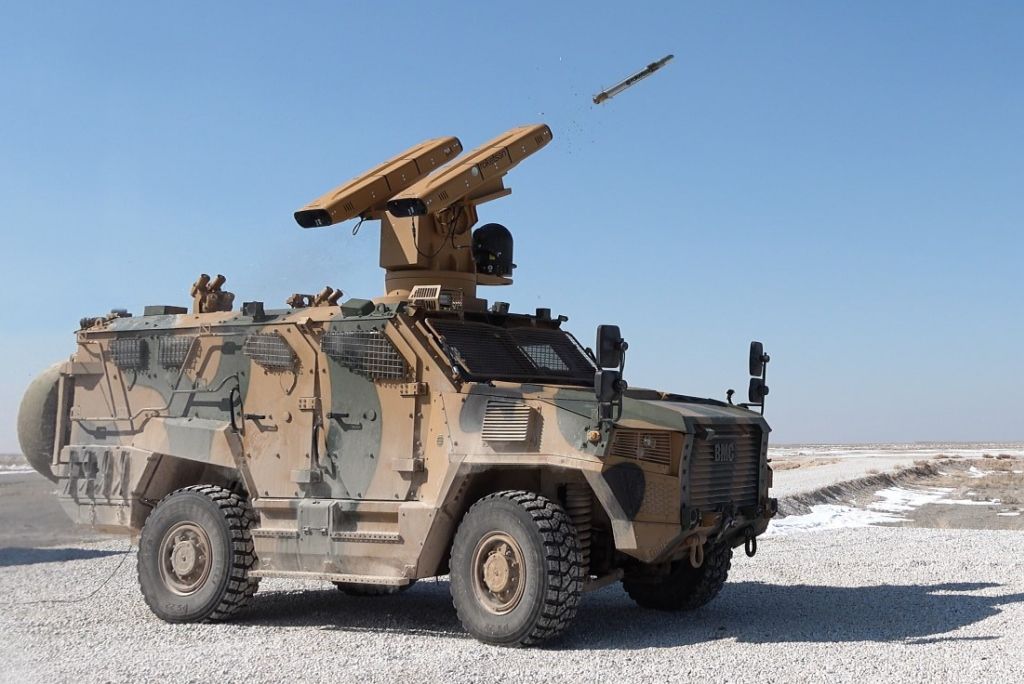
SUNGUR was developed as a modular missile for several launch arrangements. The baseline portable configuration is shoulder-fired. Vehicle installations include a BMC VURAN 4×4 configuration with four ready-to-fire missiles on a stabilised remote-controlled turret.
The missile has also been integrated with the Burç mobile air-defence system. Burç combines SUNGUR missiles, a cannon, search and tracking sensors, electro-optical and infrared equipment, identification friend or foe equipment and a data link. Its stabilised turret supports engagements while the vehicle is moving.
Roketsan also lists naval and aerial platforms among possible SUNGUR launch platforms. Integration with unmanned aircraft has been described as work in progress rather than a confirmed operational capability.
Command and control
SUNGUR is compatible with the HERIKKS-6 air-defence early-warning and command-and-control system. This allows the weapon to receive information within a broader air-defence network instead of relying only on local visual acquisition. Identification friend or foe equipment can also be integrated with the system.
Operational history
The Turkish Land Forces Command is the confirmed service operator of SUNGUR. Shoulder-fired missiles entered inventory in July 2022, and later acceptance activities covered additional single-operator and vehicle-mounted configurations.
SUNGUR has also been used in Turkish live-fire exercises. During EFES 2026 in May 2026, the missile was fielded as part of Turkey's layered air-defence capabilities.
The September 2026 Burç firing demonstrated another operationally relevant integration path. A SUNGUR launched from the mobile system successfully intercepted a moving aerial target during the first announced firing of the missile from Burç.
Variants
- Man-portable configuration: Shoulder-fired configuration intended for very-short-range air defence by dismounted personnel.
- Vehicle-mounted configuration: SUNGUR installation on the BMC VURAN 4×4, using a stabilised launcher with four ready-to-fire missiles and an electro-optical sensor suite.
- Burç integration: Vehicle-mounted configuration combining SUNGUR missiles with a cannon and integrated search, tracking and identification equipment.
- Naval and aerial integrations: Roketsan lists naval platforms and unmanned aerial vehicles as supported or planned platform types, but the supplied evidence does not establish all such configurations as operational.
Operators
- Turkey: The Turkish Land Forces Command operates SUNGUR in man-portable and vehicle-mounted configurations. Deliveries began in 2022 and continued in later years. Publicly disclosed quantities are not available.
Specifications (SUNGUR missile)
General characteristics
- Manufacturer: Roketsan
- Type: Very-short-range surface-to-air missile and man-portable air-defence system
- Length: 1.68 m
- Diameter: 82 mm
- Published weight: 14.5 kg
- Target types: Fixed-wing aircraft, rotary-wing aircraft and unmanned aerial vehicles
Performance
- Maximum range: 8 km on one Roketsan specification; 8 km or more in the 2024 product catalogue
- Minimum range: 500 m
- Engagement altitude: Roketsan has published two different figures: up to 4 km from sea level on one product specification and 6 km in its 2024 catalogue
Guidance and propulsion
- Guidance: Imaging infrared terminal homing
- Operating mode: Lock-on before launch, fire-and-forget
- Seeker field of view: ±40 degrees
- Launch motor: Separation-type motor within the launch tube
- Flight motor: Two-stage solid-propellant rocket motor
Warhead
- Warhead: High-explosive semi-armour-piercing
- Fuze: Programmable impact fuze
- Insensitive-munition qualification: Type 4 against fuel fire and bullet attack
Related equipment
- Burç: Roketsan mobile air-defence system combining SUNGUR missiles with a cannon and integrated sensors.
- LEVENT: Separate naval close-in air-defence missile system developed from the SUNGUR technology base with a larger engagement envelope.
- HERIKKS-6: Air-defence early-warning and command-and-control system with which SUNGUR can be integrated.
 Argentina
 Armenia
 Australia
 Austria
 Austria-Hungary
 Belgium
 Brazil
 United Kingdom
 United States
 Brunei
 Bulgaria
 Canada
 Chile
Chile China
China Colonial America
 Colombia
 Confederate States
 Croatia
 Czech
Czech Denmark
 Egypt
Egypt Finland
 France
 Georgia
 Germany
 German Imperial
 Greece
 Holland
 Hungary
 India
India Indonesia
 Iran
Iran Iraq
Iraq Ireland
 Israel
 Italy
Italy Japan
Japan Japan (1940)
 Jordan
 Kingdom of Italy
 Malaysia
 Mexico
 Myanmar
 Nazi Germany
 Netherlands
 New Zealand
 North Korea
 Norway
 Pakistan
 Peru
Peru Philippines
 Poland
 Portugal
 Prussia
 Romania
 Russia
 Saudi Arabia
 Serbia
 Singapore
 Slovakia
 Slovenia
 South Africa
 South Korea
 Soviet Union
 Spain
Spain Sweden
 Switzerland
 Syria
Syria Taiwan
 Thailand
 UAE
UAE Ukraine
 Vietnam
 Yugoslavia