

History
Uralvagonzavod Shturm is a Russian heavy robotic assault complex based on the T-72 tank family. It combines remotely controlled armored combat vehicles with a separate crewed control vehicle and is intended to provide direct fire support to assault units.
The main combat vehicle retains the ability to operate with personnel on board, making Shturm an optionally manned system rather than a fully autonomous vehicle. Its development has emphasized heavy protection, remote operation and weapons optimized for close-range fighting.
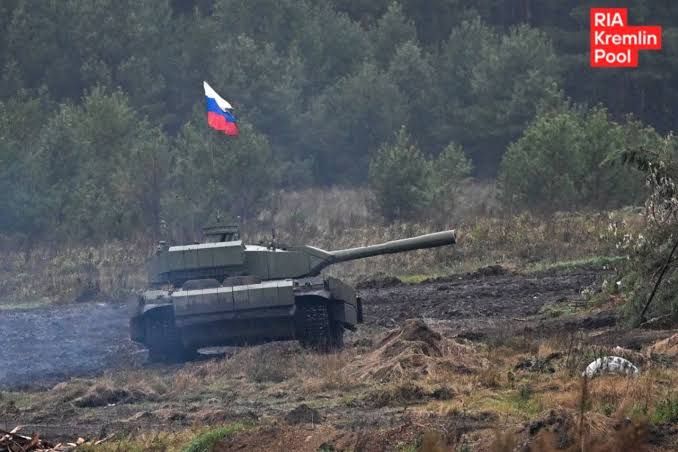
Shturm made a major public appearance during the Tsentr-2026 strategic command-and-staff exercise, where T-72B3M-based robotic vehicles in tank and BMPT-type configurations were demonstrated at the Chebarkul training range in Russia's Chelyabinsk region on 2 October 2026.
Development
Uralvagonzavod disclosed work on a robotic combat complex based on the T-72B3 in 2018. The project was being developed for the Russian Ministry of Defence and built on earlier work involving remotely controlled armored engineering and mine-clearing vehicles.
The design requirements called for a heavily protected vehicle capable of continuing its mission after multiple hits from shoulder-fired anti-tank weapons. One stated requirement called for all-around protection sufficient to retain combat capability after approximately 10 to 15 rocket-propelled anti-tank grenade strikes and after detonation of an anti-tank mine. These figures represented development requirements rather than independently demonstrated protection levels.
The first publicly visible test vehicle appeared at Uralvagonzavod's Nizhny Tagil facility in July 2025. The vehicle retained the basic T-72 layout and could accommodate personnel, indicating that conventional crew operation remained possible alongside remote control.
Tsentr-2026 demonstration
During Tsentr-2026, Russian forces used T-72B3M-based uncrewed combat vehicles to support assault units. Two configurations were shown: a tank-type vehicle and a BMPT-type fire-support vehicle. The combat vehicles were controlled from a separate crewed armored command platform.
The demonstration also highlighted limitations of the remote-control concept. Repeated radio-link interruptions were described during the exercise, and concern over a possible control failure led to the tank-type vehicle being operated with a mechanic-driver on board during part of the demonstration. The same vehicle later became stuck in muddy terrain beside a dirt road.
The communication architecture has been described as requiring the command vehicle to remain relatively close to the robotic combat vehicles. Earlier development information specified a control radius of approximately 3 km. Terrain masking and loss of line of sight can therefore affect the radio connection, making communications reliability a central technical issue for the system.
Design
Shturm is conceived as a complex rather than a single vehicle. Its principal elements are remotely controlled combat vehicles and a crewed command vehicle from which operators control the robotic platforms. The combat vehicles are based on the T-72 family, with the vehicles demonstrated in 2026 identified as using the T-72B3M chassis.
The control vehicle is also based on a tank chassis and is intended to remain protected while its operators control a group of robotic vehicles. Development plans envisaged one command vehicle controlling a platoon of combat vehicles within a radius of about 3 km. Descriptions of the exact control-vehicle chassis differ, with T-72B3 and other T-72 or T-90 family tank chassis being associated with the concept.
Remote and crewed operation
The robotic combat vehicle incorporates mechanisms for remote driving and weapon control while retaining the internal arrangements needed for conventional operation by a tank crew. This allows the vehicle to be driven from inside when remote operation is unavailable or unsuitable.
During the 2026 exercise, operators were described as performing commander, gunner and driver functions from the separate control vehicle. Control equipment included joysticks, first-person-view displays and tablet-type interfaces connected through a multichannel radio link.
Protection and mobility
Shturm was designed around the protection and mobility of a tank chassis. The development concept called for enhanced all-around protection against infantry anti-tank weapons and included additional armor around the vehicle. The tank-type version also carries a bulldozer blade, allowing it to push obstacles and prepare passages during assault operations.
The vehicle shown in 2026 did not display comprehensive additional protection over the turret roof and engine compartment against top-attack threats. Its appearance therefore did not demonstrate that every earlier protection requirement had been incorporated into the test configuration.
Armament
The principal Shturm assault vehicle uses a shortened 125 mm smoothbore tank gun. The shorter weapon is intended to reduce the space required for turret movement in streets and other confined areas where a conventional long tank gun can restrict maneuvering.
Development information identified the shortened weapon as the D-414 and specified a barrel length of 4,000 mm with an autoloader holding 22 rounds. A more heavily armed version using a 152 mm gun was also proposed, but available information does not establish that the 152 mm vehicle has been completed.
The Shturm program has also included concepts using rocket flamethrowers, twin 30 mm automatic cannon and large thermobaric rockets. These configurations were intended to give the complex specialized vehicles for close support, suppression and attacks on fortified positions.
Program status
By October 2026, Shturm had progressed from a development project to publicly demonstrated test vehicles used during a major Russian military exercise. The Tsentr-2026 appearance confirmed that T-72B3M-based vehicles with tank and BMPT-type combat modules had reached the field-testing and demonstration stage.
The available evidence does not establish full-scale production or operational service. Remote-control reliability remains an important limitation because the combat vehicles depend on a radio connection with a nearby crewed command vehicle and are not described as independently autonomous systems.
Variants
- 125 mm assault vehicle: Main Shturm tank-type configuration. Development plans specified a combat weight of up to 50 tonnes, a shortened 125 mm D-414 gun with a 4,000 mm barrel and an autoloader for 22 rounds.
- 152 mm assault vehicle: Proposed heavier-gun development intended to provide greater destructive effect against fortified targets. Completion of a physical 152 mm vehicle has not been established.
- RPO-2 assault vehicle: Planned configuration armed with banks of RPO-2 Shmel rocket flamethrowers and a 7.62 mm PKTM machine gun.
- 30 mm fire-support vehicle: Planned configuration with two 30 mm 2A42 automatic cannon, ammunition capacity of up to 1,000 rounds, a 7.62 mm PKTM machine gun and RPO-2 weapons. A BMPT-type robotic fire-support configuration was demonstrated during Tsentr-2026, although the available information does not establish that it exactly matches every element of the earlier proposal.
- 220 mm thermobaric rocket vehicle: Planned configuration using unguided 220 mm MO.1.01.04M thermobaric rockets of the type associated with the TOS-1A heavy flamethrower system.
- Command vehicle: Crewed armored control platform on a tank chassis from which operators remotely control the Shturm combat vehicles.
Operators
- Russia: Russian forces used Shturm test vehicles during the Tsentr-2026 exercise. The available information does not establish adoption for regular operational service.
Specifications (Shturm 125 mm assault vehicle)
General characteristics
- Type: Heavy remotely controlled assault combat vehicle with optional onboard crew operation
- Base chassis: T-72 family; the 2026 demonstrated vehicle was based on the T-72B3M
- Planned combat weight: Up to 50 tonnes
- Control arrangement: Remote operation from a separate crewed armored command vehicle, with conventional onboard driving retained
- Planned control radius: Approximately 3 km
- Engineering equipment: Bulldozer blade
Armament
- Main armament: Shortened 125 mm smoothbore tank gun
- Planned gun designation: D-414
- Planned barrel length: 4,000 mm
- Planned autoloader capacity: 22 rounds
 Argentina
 Armenia
 Australia
 Austria
 Austria-Hungary
 Belgium
 Brazil
 United Kingdom
 United States
 Brunei
 Bulgaria
 Canada
 Chile
Chile China
China Colonial America
 Colombia
 Confederate States
 Croatia
 Czech
Czech Denmark
 Egypt
Egypt Finland
 France
 Georgia
 Germany
 German Imperial
 Greece
 Holland
 Hungary
 India
India Indonesia
 Iran
Iran Iraq
Iraq Ireland
 Israel
 Italy
Italy Japan
Japan Japan (1940)
 Jordan
 Kingdom of Italy
 Malaysia
 Mexico
 Myanmar
 Nazi Germany
 Netherlands
 New Zealand
 North Korea
 Norway
 Pakistan
 Peru
Peru Philippines
 Poland
 Portugal
 Prussia
 Romania
 Saudi Arabia
 Serbia
 Singapore
 Slovakia
 Slovenia
 South Africa
 South Korea
 Soviet Union
 Spain
Spain Sweden
 Switzerland
 Syria
Syria Taiwan
 Thailand
 Turkey
 UAE
UAE Ukraine
 Vietnam
 Yugoslavia