
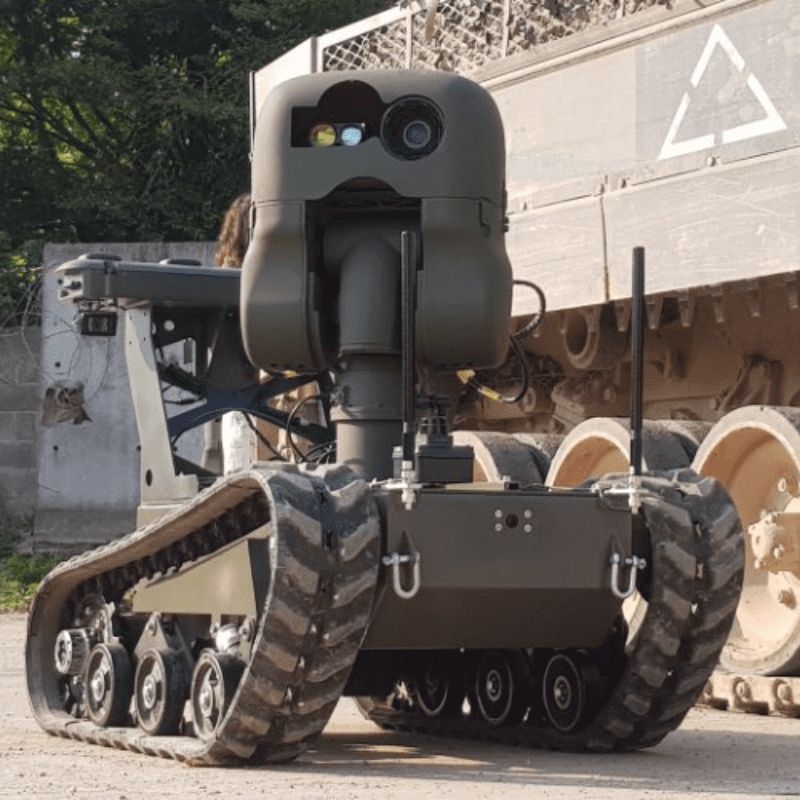
History
The Digital Concepts Engineering X-Series Universal Carrier is a British family of uncrewed ground vehicles developed as a common modular platform for military logistics, casualty evacuation, surveillance, fire support and other battlefield tasks. The design is intended to accept different payloads rather than being restricted to a single mission configuration.
In 2026, the British Army selected the X-Series for its first operational UGV fleet following a competitive procurement. The initial order covers 15 Universal Carrier platforms and marks a transition from experimentation toward regular integration of robotic ground vehicles into British Army land forces.
The X-Series has also been used in multinational trials and demonstrations involving different payloads, command architectures and environmental conditions. By September 2026, vehicles were being presented in logistics, CASEVAC, ISTAR, breaching, fire-support and anti-tank configurations while the Army developed its initial operational UGV capability.
Development and procurement
Digital Concepts Engineering developed the X-Series around the concept of a Universal Carrier able to accept multiple mission payloads on a common base. The approach allows the vehicle to function as a reusable robotic chassis that can be adapted for different tasks and integrated with equipment supplied by other companies.
After a period of British Army experimentation with uncrewed ground systems, Digital Concepts Engineering received a contract in 2026 to supply 15 X-Series Universal Carriers. Production was already underway by early June, and the first vehicles had entered British Army hands. Some were deployed during Exercise Rhino Storm in Germany.
The order represents the initial operational fleet rather than another isolated trial batch. The vehicles are intended to establish a foundation for fielding, integration and support of UGVs within existing Army formations.
Trials and demonstrations
During 2026, X-Series vehicles participated in Project Convergence Capstone in California with the British Army's Experimentation and Trials Group. An X3 Wide Universal Carrier was used during this activity for British Army trials that included hot-weather operation, SAPIENT integration and counter-uncrewed-aircraft detection using the MyDefence Watchdog system.
Additional X-Series vehicles were scheduled to travel to Finland later in 2026 for cold-weather trials with the Finnish Defence Forces. These activities were intended to expose the platform to different climates, command systems and operational requirements.
At DVD 2026, Digital Concepts Engineering presented 20 X-Series vehicles distributed across eight stands. Platforms appeared with JLR, INEOS, Babcock, BAE Systems, Edgar Brothers and NP Aerospace, demonstrating the carrier's intended role as a common host for third-party payloads and mission systems.
Design
The X-Series is an uncrewed ground vehicle architecture built around a modular Universal Carrier concept. Its principal design feature is the ability to accept different payloads on a common base, allowing one vehicle family to support transport, sensor, casualty evacuation and combat-support missions.
The platform is designed to carry loads and tow equipment while operating over difficult ground. Supported terrain includes mud, sand, rubble and steep gradients. This mobility is intended to allow robotic vehicles to accompany land forces in areas where sending a crewed support vehicle could expose personnel to unnecessary risk.
Mission architecture
The common carrier can be configured for logistics resupply, casualty evacuation, intelligence, surveillance, target acquisition and reconnaissance, breaching and fire-support tasks. It can also act as a mobile sensor platform. Different payloads can therefore be installed without requiring a completely separate robotic vehicle for each mission.
Digital Concepts Engineering retains intellectual property across its control stack, including software, hardware and firmware. The architecture has been designed to reduce cyber vulnerabilities and limit potential attack surfaces when robotic vehicles connect with command networks or third-party mission systems.
The company is also developing the Marionette Universal Control System. Marionette is intended to convert existing armoured fighting vehicles and trucks into autonomous platforms. It is a separate control-system effort but reflects the same broader approach of integrating robotic control with different land vehicles.
Logistics and casualty evacuation
In the logistics role, an X-Series vehicle can transport supplies into exposed areas without placing a vehicle crew directly in danger. The common platform can also tow equipment, reducing the physical and transport burden on soldiers operating away from conventional supply vehicles.
A CASEVAC configuration is intended to support casualty extraction from areas where access by crewed vehicles may be dangerous. The available material does not specify its medical equipment, casualty capacity or protection level.
ISTAR and fire support
ISTAR configurations allow the carrier to move sensors closer to the area of interest while keeping operators farther from exposed positions. During Project Convergence trials, an X3 Wide supported integration work involving SAPIENT and the MyDefence Watchdog counter-UAS detection system.
Fire-support configurations extend the modular concept to payloads intended to support combat units. The available information does not establish a standard weapon fit for the X-Series family.
Anti-tank configuration
Digital Concepts Engineering and MBDA developed an anti-tank configuration that was displayed publicly at DVD 2026. This version turns the carrier into an unmanned engagement platform and represents an expansion beyond the transport, surveillance and support roles previously associated with the X-Series.
The missile type, targeting chain and level of autonomy associated with weapon employment have not been disclosed in the supplied information. The anti-tank configuration should therefore be regarded as a demonstrated mission configuration rather than a fully defined production variant with published armament specifications.
Operational history
The British Army became the first confirmed operator of the X-Series Universal Carrier in 2026. The initial procurement covers 15 vehicles, with the first examples already in Army hands by June of that year.
Vehicles were deployed during Exercise Rhino Storm in Germany and subsequently participated in experimentation connected with Project Convergence Capstone in the United States. These activities tested the platform in operationally relevant environments and supported integration with other sensors and command architectures.
By September 2026, the X-Series was moving from individual experimentation toward integration across a broader range of British Army activities. The vehicles shown at DVD 2026 represented logistics, CASEVAC, ISTAR, breaching, fire-support and anti-tank applications rather than a single fixed mission.
Cold-weather trials with the Finnish Defence Forces were planned for later in 2026. These trials had not yet been described as completed in the supplied material.
Variants
- X-Series Universal Carrier: Common modular UGV platform designed to accept different payloads for logistics, surveillance, casualty evacuation and other military roles.
- X3 Wide Universal Carrier: X-Series configuration used during Project Convergence Capstone trials in the United States, including hot-weather testing and sensor integration work.
- Anti-tank configuration: Demonstrated X-Series configuration developed with MBDA for a direct engagement role. The missile type and firing architecture have not been disclosed.
Operators
- British Army: Ordered 15 X-Series Universal Carrier platforms in 2026 for its initial operational UGV capability. The first vehicles were already in Army hands by June 2026.
Specifications (X-Series Universal Carrier)
General characteristics
- Type: Uncrewed ground vehicle.
- Configuration: Modular Universal Carrier architecture with interchangeable mission payloads.
- Primary functions: Logistics, casualty evacuation, ISTAR, breaching, fire support and other payload-dependent battlefield tasks.
- Load functions: Payload carrying and equipment towing.
- Terrain capability: Designed for operation over difficult terrain including mud, sand, rubble and steep gradients.
Mission systems
- Payload architecture: Common vehicle base designed to accept multiple military payloads and third-party mission systems.
- Control architecture: Digital Concepts Engineering retains control-stack intellectual property covering software, hardware and firmware.
- Demonstrated integrations: SAPIENT integration and MyDefence Watchdog counter-UAS detection were included in X3 Wide trials during Project Convergence.
Armament
- Standard armament: No single standard weapon fit is established for the X-Series family in the supplied information.
- Anti-tank configuration: A configuration developed with MBDA has been demonstrated, but the missile type and weapon-employment architecture have not been disclosed.
 Argentina
 Armenia
 Australia
 Austria
 Austria-Hungary
 Belgium
 Brazil
 United States
 Brunei
 Bulgaria
 Canada
 Chile
Chile China
China Colonial America
 Colombia
 Confederate States
 Croatia
 Czech
Czech Denmark
 Egypt
Egypt Finland
 France
 Georgia
 Germany
 German Imperial
 Greece
 Holland
 Hungary
 India
India Indonesia
 Iran
Iran Iraq
Iraq Ireland
 Israel
 Italy
Italy Japan
Japan Japan (1940)
 Jordan
 Kingdom of Italy
 Malaysia
 Mexico
 Myanmar
 Nazi Germany
 Netherlands
 New Zealand
 North Korea
 Norway
 Pakistan
 Peru
Peru Philippines
 Poland
 Portugal
 Prussia
 Romania
 Russia
 Saudi Arabia
 Serbia
 Singapore
 Slovakia
 Slovenia
 South Africa
 South Korea
 Soviet Union
 Spain
Spain Sweden
 Switzerland
 Syria
Syria Taiwan
 Thailand
 Turkey
 UAE
UAE Ukraine
 Vietnam
 Yugoslavia