
History
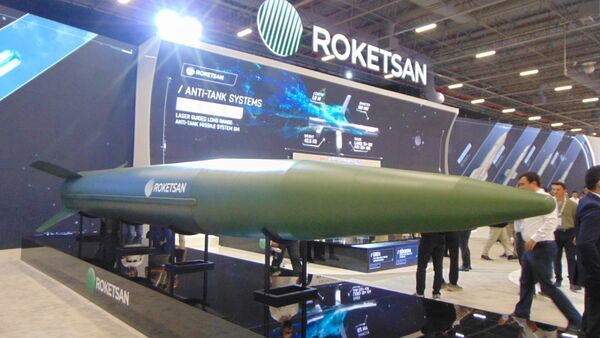
TAYFUN is a Turkish operational-tactical ballistic missile family developed by ROKETSAN under the coordination of the Presidency of Defence Industries (SSB), initiated in line with the requirements of the Ministry of National Defence to enhance Türkiye's capability against strategic targets. The program was conducted in secret, and the system was first revealed to the public during a test launch on 20 October 2022, when the missile struck a target at a range of 561 km after 456 seconds of flight (ROKETSAN materials give 458 seconds).
A subsequent successful test was conducted in May 2023 from Rize-Artvin Airport on the Black Sea coast; the system entered mass production on 29 May 2023. In February 2025, TAYFUN struck a sea target hundreds of kilometres from Rize with a reported accuracy of 5 metres. The hypersonic Block-4 variant was unveiled at the IDEF 2025 defence exhibition in July 2025. In December 2025, the missile completed a third successful test flight covering approximately 561 km from Rize-Artvin Airport.
In July 2026, TAYFUN Block-3 struck a moving unmanned surface vessel in the Black Sea with a live warhead, described by ROKETSAN as a first for a ballistic missile and one of only a handful of such tests worldwide; the engagement also marked the first integration of a seeker head onto a Turkish ballistic missile. A further test was conducted from Rize-Artvin Airport on 1 October 2026. ROKETSAN CEO Murat İkinci announced at ADEX 2026 that Block-2 and Block-3 have entered serial production, with Block-3 deliveries to begin in 2026.
During a visit to Turkey, Polish Chief of the General Staff General Wiesław Kukla inspected TAYFUN at ROKETSAN facilities. The visit took place in the context of Poland's search for long-range missile capability exceeding 1,000 km to complement its current approximately 300 km range achieved with ATACMS and CTM-290 systems.
Specifications
All TAYFUN variants can be launched from a common launch vehicle. The system operates in all weather conditions, day or night, and its hypersonic cruise speed makes it resilient against air defences. Target types include air defence systems, command and control centres, military aircraft hangars, and strategic objectives.
Block-1 (baseline)
Range: more than 280 km; length: 6.5 m; diameter: 610 mm; weight: 2,300 kg; accuracy: 10 metres or less; warhead: pre-shaped fragmentation; anti-jamming capability.
Block-4
Mass: approximately 7.3 tonnes; length: approximately 10 m; diameter: 610 mm; speed: over Mach 5. ROKETSAN reports a range of up to 800 km; unofficial information places the range at approximately 1,000 km. The variant is described as an improved version of the baseline with increased range and higher speed, enabling it to overcome air defence systems.
Variants
Block-2 – In serial production; multiple delivery batches to the Turkish Armed Forces were completed by June 2026, with ongoing deliveries confirmed by ROKETSAN.
Block-3 – Intended primarily for targets such as ships and bunkers; carries a warhead that adds a penetration effect on top of blast and fragmentation. In July 2026, Block-3 struck a moving maritime target approximately 7 metres in size in the Black Sea. The variant travels at hypersonic speeds (exceeding Mach 5) during its terminal dive. Deliveries are due to begin in 2026.
Block-4 – A hypersonic variant with increased range and speed over the baseline, unveiled in July 2025. Designed for high manoeuvrability and survivability, it is intended to strike air defence systems, command centres, and critical infrastructure.
Operators
Turkey – The TAYFUN family is gradually entering service with the Turkish Armed Forces. The Turkish Special Forces Command has completed inspection and acceptance procedures for multiple Block-2 missiles and associated weapon carrier vehicles.
Poland – Expressed interest in TAYFUN as a candidate for long-range strike capability. Polish military leadership inspected the system at ROKETSAN facilities during a visit to Turkey.
 Argentina
 Armenia
 Australia
 Austria
 Austria-Hungary
 Belgium
 Brazil
 United Kingdom
 United States
 Brunei
 Bulgaria
 Canada
 Chile
 China
 Colonial America
 Colombia
 Confederate States
 Croatia
 Czech
 Denmark
 Egypt
 Finland
 France
 Georgia
 Germany
 German Imperial
 Greece
 Holland
 Hungary
 India
 Indonesia
 Iran
 Iraq
 Ireland
 Israel
 Italy
 Japan
 Japan (1940)
 Jordan
 Kingdom of Italy
 Malaysia
 Mexico
 Myanmar
 Nazi Germany
 Netherlands
 New Zealand
 North Korea
 Norway
 Pakistan
 Peru
 Philippines
 Poland
 Portugal
 Prussia
 Romania

 Russia
 Saudi Arabia
 Serbia
 Singapore
 Slovakia
 Slovenia
 South Africa
 South Korea
 Soviet Union
 Spain
 Sweden
 Switzerland
 Syria
 Taiwan
 Thailand
 UAE
 Ukraine
 Vietnam
 Yugoslavia