
History
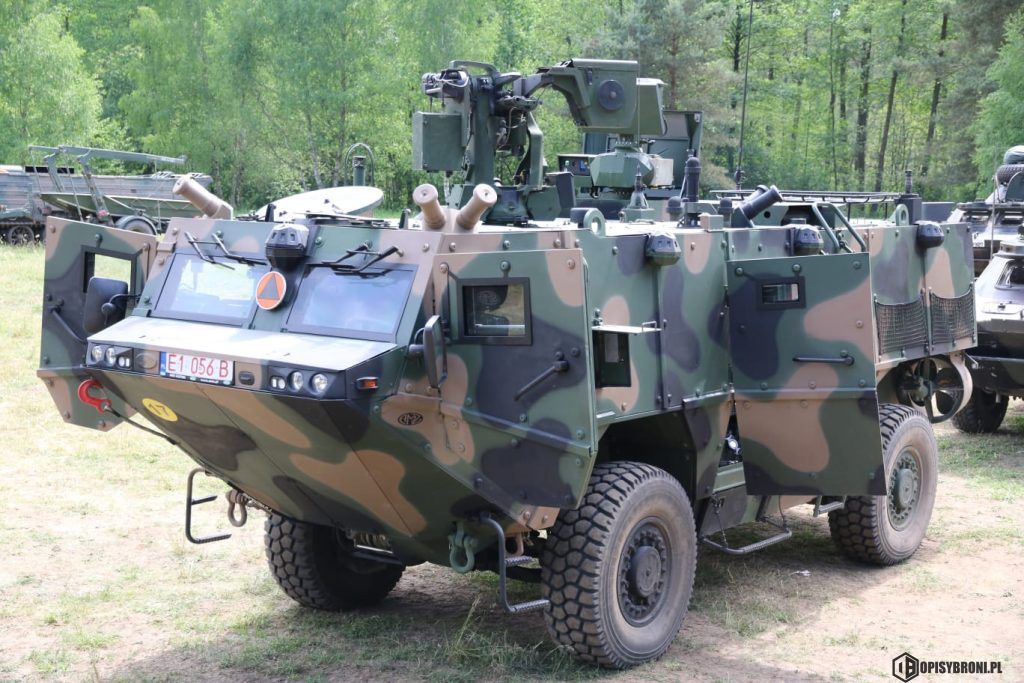
The Kleszcz, factory designation Bóbr-3, is a Polish 4×4 light armored reconnaissance carrier (LOTR) developed between 2013 and 2022 by AMZ-Kutno SA in cooperation with the Military Communication Institute, the Military Institute of Armament Technology, and the Military Institute of Chemistry and Radiometry. The program was launched in 2013 under an agreement between the National Centre for Research and Development and the AMZ-Kutno-led consortium. Poland first introduced the Kleszcz in 2018; two years later, tests of the vehicle's optoelectronic and radar equipment began, with the final phase of preliminary trials concluding the same year. In August 2021, a prototype was sent to the 17th Greater Poland Mechanized Brigade for testing.
The Kleszcz is intended to replace the Soviet-era BRDM-2 armored reconnaissance vehicles and their modernized versions in the reconnaissance units of the Polish Armed Forces. A framework agreement was signed on 28 February 2024 between the Armament Agency and AMZ-Kutno SA, providing for the procurement of 286 vehicles with delivery from 2026 through 2035. The first implementation agreement, signed on 14 August 2024, covers delivery of 28 vehicles along with a logistics and training package, valued at approximately 800 million PLN (US$205–210 million), with deliveries planned from 2026 to 2028. First deliveries to Polish reconnaissance units began on 21 October 2026.
Specifications
The Kleszcz is a wheeled 4×4 platform with independent suspension and all-wheel drive. Its crew comprises five: commander, driver-mechanic, reconnaissance and communications operator, weapon operator, and portable equipment operator. The vehicle is 6.9 m long, 2.5 m wide, and 2.38 m high, with a ground clearance of 400 mm. Mass ranges from 12 to 14 t depending on armor configuration, with a maximum allowable weight of 15.6 t, although other sources cite a range of 14–16 t. Propulsion is provided by a 6-cylinder 7,200 cm³ diesel engine rated at 240 kW (approximately 326 hp) coupled to an Allison automatic transmission. Maximum speed on paved roads is reported as 90 km/h by several sources, while others state up to 100 km/h. Range is 600 km. The vehicle is amphibious, with a swimming speed of 7 km/h, and can ford rivers with currents up to 1.1 m/s.
Ballistic protection meets STANAG 4569 Level 2 (7.62×39 mm at 30 m) with Level 2A mine blast resistance (6 kg), with the capability for additional armor panels to raise protection to Level 3. The main armament is a Kongsberg Protector remotely controlled weapon module, configured with a 12.7 mm and a 7.62 mm machine gun; the platform can optionally be fitted with a 30 mm automatic cannon turret or anti-tank guided missiles. Onboard sensors include a tactical battlefield radar, an electro-optical head, a laser radiation warning system integrated with a smoke grenade launcher, and NBC detection and protection. The communications system supports simultaneous exchange of information with other LOTR vehicles, helicopters, and command echelons up to the battalion level, with encrypted data processing and transmission.
Variants
Two production variants are identified: a light (amphibious) variant with a lower level of protection and a heavy (non-amphibious) variant with a higher level of protection; the heavier variant may sacrifice its swimming capability. The Kleszcz platform is also intended to serve as the base vehicle for a Chemical, Biological, and Radiological Reconnaissance Carrier (TRSK). A wheeled tank-destroyer prototype based on the Bóbr-3 was presented at the MSPO 2019 trade fair.
 Argentina
 Armenia
 Australia
 Austria
 Austria-Hungary
 Belgium
 Brazil
 United Kingdom
 United States
 Brunei
 Bulgaria
 Canada
 Chile
 China
 Colonial America
 Colombia
 Confederate States
 Croatia
 Czech
 Denmark
 Egypt
 Finland
 France
 Georgia
 Germany
 German Imperial
 Greece
 Holland
 Hungary
 India
 Indonesia
 Iran
 Iraq
 Ireland
 Israel
 Italy
 Japan
 Japan (1940)
 Jordan
 Kingdom of Italy
 Malaysia
 Mexico
 Myanmar
 Nazi Germany
 Netherlands
 New Zealand
 North Korea
 Norway
 Pakistan
 Peru
 Philippines
 Portugal
 Prussia
 Romania

 Russia
 Saudi Arabia
 Serbia
 Singapore
 Slovakia
 Slovenia
 South Africa
 South Korea
 Soviet Union
 Spain
 Sweden
 Switzerland
 Syria
 Taiwan
 Thailand
 Turkey
 UAE
 Ukraine
 Vietnam
 Yugoslavia