
History
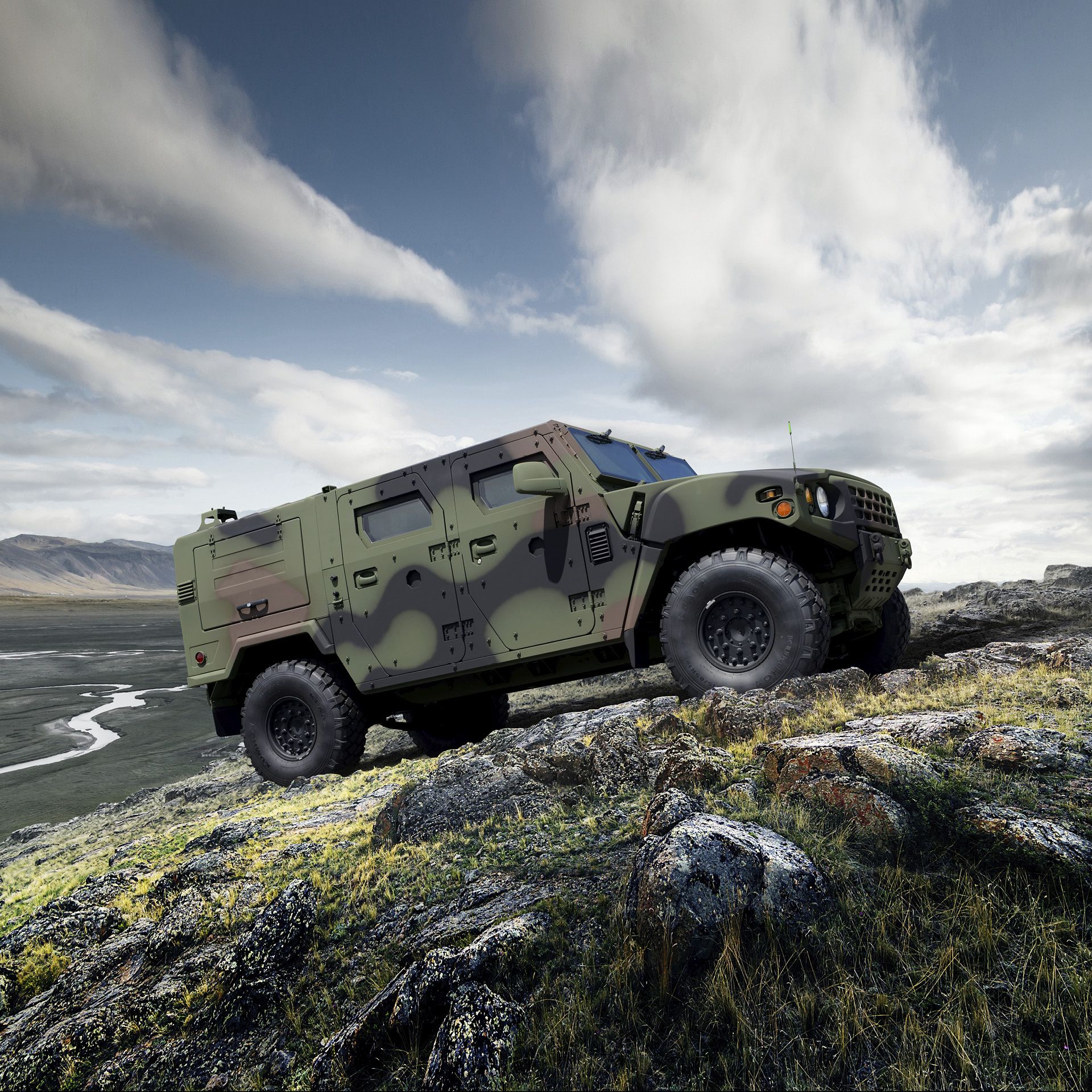
The Kia Light Tactical Vehicle (KLTV) is a South Korean 4×4 military vehicle family developed by Kia for tactical mobility, reconnaissance, command, transport, patrol, and logistics missions. Its modular chassis supports standard and long-wheelbase configurations as well as armored and specialized derivatives.
The KLTV combines a 225 hp diesel powerplant, an eight-speed automatic transmission, independent suspension, and optional protection and weapon systems. Kia designed the family so that a common vehicle architecture could be adapted for different operational roles.
Poland has adopted locally configured KLTV vehicles for reconnaissance and other missions. Polish vehicles entered delivery in 2024, while additional contracts expanded the planned fleet and introduced KLTV platforms for counter-unmanned-aircraft applications.
Kia developed the KLTV in cooperation with the South Korean Ministry of Defense to meet requirements of the South Korean armed forces. The vehicle was publicly displayed at IDEX 2015 in Abu Dhabi. Serial production began in 2016, with Army Recognition reporting that official production started in June of that year.
The KLTV was subsequently offered to export customers. Its modular platform was produced in standard and extended-wheelbase forms, with armored, reconnaissance, command, communications, support, and armed configurations. Army Technology identifies the vehicle as Kia's third-generation light tactical vehicle and describes both standard and stretched chassis.
Poland signed an agreement in August 2023 for approximately 400 Kia light reconnaissance vehicles. The Polish program introduced localized production at Rosomak, which also manufactures the KTO Rosomak armored personnel carrier. The Polish reconnaissance configuration is known as LPR 4×4 and is based on the armored K153 version of the KLTV. Deliveries to the Polish armed forces began in April 2024, and the vehicles are intended to replace older Honker vehicles in Polish service.
On September 25, 2025, Poland signed a framework agreement covering 1,266 Legwan light tactical vehicles based on the KLTV platform. The framework runs through 2035 and expands the number of KLTV-family vehicles planned for Polish service beyond the initial reconnaissance order.
In March 2026, Rosomak announced an agreement with Kia covering 375 KLTV Cab Chassis Truck 4P platforms for Poland's San counter-drone program. According to MILMAG, these chassis are intended to carry components including radars, guided-rocket launchers, electronic-warfare equipment, machine guns, and other elements of the San system.
In August 2026, Polish KLTV armored vehicles were photographed with additional anti-drone slat structures during preparations for a Polish Armed Forces Day parade. The modular structures surrounded parts of the hull and the gunner's turret, while folding side sections provided access to the vehicle. Militarnyi reported that similar protection was also fitted to other Polish vehicles during the parade preparations.
Design
The KLTV uses a 4×4 chassis with fully independent suspension. Standard and long-wheelbase configurations are available, allowing Kia to use the same basic architecture for different payloads and mission equipment. The standard-wheelbase vehicle has a reported gross vehicle weight of 5.7 tonnes, while the stretched configuration can reach 7 tonnes.
Powertrain and mobility
Kia equips the KLTV family with a 2,959 cc V6 diesel engine producing 225 PS at 3,200 rpm. The engine is coupled to an eight-speed automatic transmission. The manufacturer's KLTV information also lists military-specific features including electromagnetic-interference shielding, cold-start capability, waterproofing provisions, and a 24-volt electrical generator.
The vehicle can be equipped with a central tire inflation system for operation on soft terrain and with run-flat tire inserts. Kia states that the run-flat system can allow continued travel for 48 km at 48 km/h after tire damage. Other available equipment includes an electric winch and a 10 kW generator for mission systems.
Protection
KLTV armored configurations can use detachable protection kits. Kia describes ballistic glazing, composite armor panels, mine protection beneath the floor, and blast-absorbing seats as available protection features. The modular approach allows the protection configuration to be adapted according to user requirements.
The Polish LPR 4×4 reconnaissance version uses localized cabin armor described in the source material as meeting STANAG 4569 Level 1. Polish vehicles also have an open rotating roof turret that can accept different weapons.
The anti-drone structures observed on Polish vehicles in August 2026 are additional external protective assemblies rather than part of the original basic KLTV armor package. They consist of modular slat sections positioned around the body and the gunner's station, with hinged sections allowing personnel access.
Armament and mission equipment
The KLTV can be fitted with roof-mounted weapons including a 12.7 mm machine gun, a 7.62 mm machine gun, or a 40 mm automatic grenade launcher. Kia also offers provisions for remote-controlled weapon systems and electrical generation equipment required by electronic mission payloads.
The modular chassis can support anti-tank weapons, mortar systems, electronic-warfare equipment, command-and-control installations, communications equipment, reconnaissance systems, personnel transport, and cargo-carrying configurations. Polish KLTV-family chassis are also being integrated into the San counter-UAS system.
Operational history
The KLTV entered production for South Korean and export use in 2016. South Korea operates the vehicle family, and Army Recognition has also reported KLTV service in Mali.
Poland began receiving LPR 4×4 reconnaissance vehicles in April 2024. The vehicles are being introduced into Polish land-force units as replacements for older Honker vehicles, while Rosomak is responsible for localization and production work in Poland.
The Polish program expanded through the 2025 Legwan framework agreement and the 2026 San counter-drone vehicle-platform agreement. In August 2026, at least one Polish armored KLTV was publicly observed with modular anti-drone slat protection. The available sources document the installation during parade preparations but do not establish combat use of this particular protection configuration.
Variants
- Standard-wheelbase KLTV: Basic chassis configuration used as the foundation for several tactical and armored derivatives.
- Long-wheelbase KLTV: Extended chassis with greater space and a reported gross vehicle weight of up to 7 tonnes.
- Armored reconnaissance vehicle: Protected reconnaissance configuration offered within the KLTV family.
- K153: Armored KLTV version forming the basis of Poland's LPR 4×4 reconnaissance vehicle.
- LPR 4×4: Polish localized light reconnaissance configuration with cabin armor and a rotating open roof turret.
- Legwan: Polish designation applied to KLTV-based light tactical vehicles covered by the 2025 framework agreement.
- KLTV Cab Chassis Truck 4P: Chassis configuration selected as a carrier for components of Poland's San counter-drone system.
- Command and communications configurations: Mission variants equipped for command, control, or communications tasks.
- Special-equipment and shop-van configurations: Long-wheelbase derivatives intended to carry specialized equipment or support installations.
Operators
- South Korea: The KLTV was developed for the South Korean armed forces and is in service in its country of origin.
- Poland: Began receiving locally configured LPR 4×4 vehicles in 2024. An initial order covered approximately 400 vehicles, followed by a 2025 framework agreement for 1,266 Legwan vehicles and a 2026 agreement for 375 KLTV Cab Chassis Truck 4P platforms for the San counter-drone program.
- Mali: Reported by Army Recognition as an operator of the KLTV family.
Specifications (KLTV standard-wheelbase configuration)
General characteristics
- Configuration: 4×4 light tactical vehicle
- Crew and passengers: 1 + 3 in the standard armored command configuration
- Gross vehicle weight: 5.7 tonnes
- Engine: 2,959 cc V6 diesel
- Maximum power: 225 PS at 3,200 rpm
- Transmission: Eight-speed automatic
- Suspension: Fully independent suspension
Performance
- Maximum speed: 130 km/h
- Run-flat capability: Up to 48 km at 48 km/h after tire damage when equipped with Kia's run-flat tire system
Armament
- Roof armament: Optional 12.7 mm machine gun, 7.62 mm machine gun, or 40 mm automatic grenade launcher
- Other weapon options: Remote-controlled weapon systems can be integrated on suitably equipped configurations
 Argentina
 Armenia
 Australia
 Austria
 Austria-Hungary
 Belgium
 Brazil
 United Kingdom
 United States
 Brunei
 Bulgaria
 Canada
 Chile
Chile China
China Colonial America
 Colombia
 Confederate States
 Croatia
 Czech
Czech Denmark
 Egypt
Egypt Finland
 France
 Georgia
 Germany
 German Imperial
 Greece
 Holland
 Hungary
 India
India Indonesia
 Iran
Iran Iraq
Iraq Ireland
 Israel
 Italy
Italy Japan
Japan Japan (1940)
 Jordan
 Kingdom of Italy
 Malaysia
 Mexico
 Myanmar
 Nazi Germany
 Netherlands
 New Zealand
 North Korea
 Norway
 Pakistan
 Peru
Peru Philippines
 Poland
 Portugal
 Prussia
 Romania
 Russia
 Saudi Arabia
 Serbia
 Singapore
 Slovakia
 Slovenia
 South Africa
 Soviet Union
 Spain
Spain Sweden
 Switzerland
 Syria
Syria Taiwan
 Thailand
 Turkey
 UAE
UAE Ukraine
 Vietnam
 Yugoslavia