
History
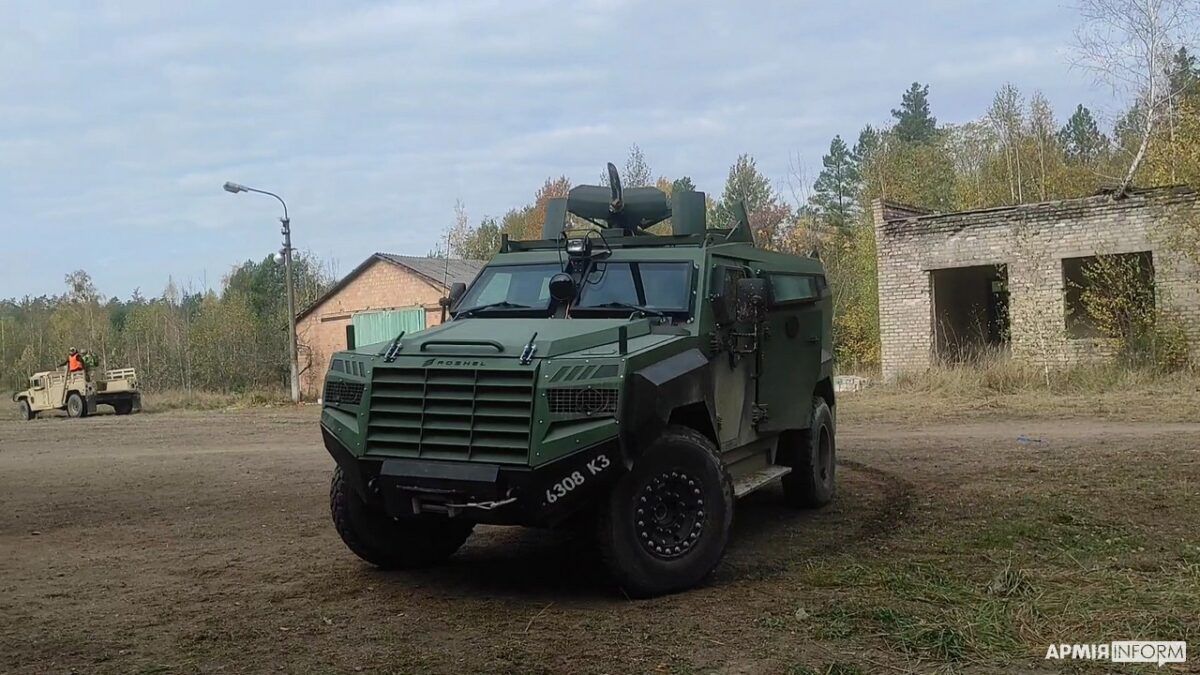
The Roshel Senator is a Canadian 4x4 armored personnel carrier developed by Roshel for protected transport in military, law-enforcement, border-security, and public-safety missions. The original Senator APC is based on the Ford F-550 chassis and uses a modular body that can be configured for several specialist roles.
Serial production began in 2018. Roshel initially emphasized peacekeeping and law-enforcement use, but the Senator later entered military service and combat deployment, especially in Ukraine, while police and government organizations in several other countries adopted the platform.
The Senator family has expanded beyond the original APC to include emergency-response, medical-evacuation, explosive-ordnance-disposal, pickup, and mine-resistant variants. In August 2026 Roshel displayed the Senator APC at COP International 2026 in São Paulo as part of its growing presence in Brazil.
Development and production
Roshel developed the Senator as a multi-purpose protected vehicle combining urban maneuverability with off-road capability. In April 2018, Armada International reported that Roshel had started serial production at its Toronto manufacturing facility. The early production vehicle was intended for peacekeeping and law-enforcement applications, with interchangeable mission configurations including personnel transport, medical evacuation, command and control, explosive-ordnance disposal, reconnaissance, anti-riot, and nuclear-biological-chemical protection roles.
The first production batch was planned for delivery in the third quarter of 2018, and the public debut was scheduled for the AUSA Annual Meeting in Washington in October that year. Production therefore establishes 2018 as the earliest supported physical milestone for the Senator APC.
Demand increased sharply after the start of large-scale deliveries to Ukraine in 2022. By December 2023 the 1,000th Senator had been delivered to Ukrainian forces, and by March 2025 reported deliveries had reached 1,700. Defence Blog reported that deliveries to Ukraine had exceeded 2,000 vehicles by December 2025. The same source stated in August 2026 that Roshel operated four manufacturing facilities in Ontario, employed about 500 people, and could build up to 140 vehicles per month, with an additional facility in Shelby Township, Michigan, supporting U.S. customers.
Design
The original Senator APC is built on a Ford F-550 chassis with four-wheel drive. The platform uses a four-door armored body and a rear access door. Its modular interior and body architecture allow Roshel to tailor the vehicle for personnel transport and specialist public-safety or military functions.
Protection is centered on armored passenger-compartment construction, ballistic glass, protected seating, and configurable mine protection. The 2018 production description stated that protection could reach CEN B7 or STANAG 4569 Level II depending on configuration. The base vehicle was also described with perimeter gun ports, escape hatches, external-view cameras, gas extraction, a siren and public-address system, emergency lighting, mine-protected seats, and three-point military-style seat belts.
Roshel has offered the Senator with surveillance and mission systems that can include thermal and infrared imaging, night vision, two-way communications, fire-source detection, laser range finding, remote weapon integration, and chemical-protection equipment. These systems are configuration-dependent rather than standard on every vehicle.
Powertrain and mobility
Published technical data for the Senator APC identifies a 6.7-liter diesel V8 producing about 330 hp and 750 N·m of torque, connected to a 10-speed automatic transmission and a 4x4 drivetrain. A technical summary from Combat Operators gives overall dimensions of 5,945 mm in length, 2,340 mm in width, and 2,450 mm in height, with a 3,683 mm wheelbase and seating for up to 12. Other published descriptions give slightly different dimensions and seating figures, reflecting configuration differences within the Senator family.
Senator MRAP protection
The Senator MRAP, first presented in 2023, is a distinct mine-resistant variant with a heavily modified body and a V-shaped blast-resistant hull. Ukraine's Ministry of Defence describes the MRAP as having high ground clearance, reinforced suspension, four-wheel drive, run-flat tires, a central tire-inflation system, and a sealed cabin with chemical, biological, and radiological filtration. The ministry also states that the MRAP has been certified to NATO STANAG 4569 Levels 2 and 3, including protection against 7.62×39 mm armor-piercing ammunition and blasts equivalent to up to 8 kg of TNT. These higher blast-protection characteristics apply to the MRAP variant and should not be treated as specifications of every Senator APC.
Operational history
In 2020, Senator vehicles were used to support NASA's Crew Dragon Demo-2 mission by transporting astronauts Bob Behnken and Doug Hurley. The platform's first combat use followed after Senators were sent to Ukraine in 2022 as military aid. A compiled history of the Roshel Senator records subsequent use by Ukrainian military, border-guard, national-guard, and police organizations.
In January 2023 Canada announced funding for 200 Senator vehicles for Ukraine. By October 2023 Ukraine had received at least 750 Senators, and the 1,000th vehicle was delivered in December 2023. Senator vehicles were later observed in Ukrainian operations during 2024. In May 2026, Ukraine's Ministry of Defence announced that humanitarian mine-clearance units had received a further batch of 20 Senator MRAPs through cooperation with the Demining Capability Coalition.
Brazil became another significant public-safety customer. Brazil's Federal District acquired six Senator vehicles in April 2025, including four APCs and two MRAPs for police units. In Paraná state, the Civil Police received the first of seven Senator APCs on 5 May 2026 for high-risk operations, with the remaining vehicles intended for military-police and penal-police special units. Roshel then displayed the Senator APC at COP International 2026 in São Paulo from 11 to 13 August 2026.
Other reported users include police or government organizations in Bosnia and Herzegovina, Canada, Costa Rica, Haiti, Kazakhstan, Moldova, South Korea, Ukraine, and the United States. Haiti also received Senator Ram MRAP vehicles for its armed forces in November 2025.
Variants
- Senator APC: Original production version introduced in 2018, with a four-door armored body and configurable interior for personnel transport and related missions.
- Senator Emergency Response Vehicle: Public-safety and SWAT-oriented configuration with emergency lighting, siren and public-address equipment, external-view cameras, and ballistic protection.
- Senator Pickup: Cargo-oriented variant with a four-door crew cab and increased payload capacity.
- Senator Medical Evacuation Vehicle: Ambulance configuration with improved rear access and medical-evacuation equipment provisions.
- Senator Explosive Ordnance Disposal: EOD version with a higher roof and a heavy-duty rear ramp intended to support bomb-disposal robots and specialist equipment.
- Senator MRAP: Mine-Resistant Ambush Protected version first presented in 2023, with a V-shaped blast-resistant hull and higher mine and IED protection than the standard APC.
- Senator Ram MRAP: Later MRAP derivative based on a Ram pickup platform, reported in 2025.
Operators
- Bosnia and Herzegovina: Senator vehicles are used by Sarajevo Canton Police, Tuzla Canton Police, and the Federation Police Administration.
- Brazil: Federal District police units operate APC and MRAP versions, while Paraná state ordered seven Senator APCs for civil, military, and penal-police special units.
- Canada: The Ottawa Police Service is a reported operator of the Senator Emergency Response Vehicle.
- Costa Rica: The Public Force of Costa Rica is a reported operator.
- Haiti: The Armed Forces of Haiti and Haitian National Police have received Senator-family vehicles, including Ram MRAPs.
- Kazakhstan: The Kazakh Ground Forces are a reported operator.
- Moldova: Moldovan police are a reported operator of Senator vehicles.
- South Korea: The Korean National Police Agency is a reported operator.
- Ukraine: Operators include the Ukrainian Ground Forces, National Guard, National Police, and State Border Guard Service. Ukraine is the largest reported user of the Senator family.
- United States: NASA has used Senator vehicles for astronaut transport; Defence Blog also reports deliveries to the Department of Homeland Security and U.S. Customs and Border Protection.
Specifications (Senator APC)
General characteristics
- Country of origin: Canada
- Manufacturer: Roshel
- Chassis: Ford F-550
- Drive: 4x4
- Length: 5,945 mm
- Width: 2,340 mm
- Height: 2,450 mm
- Wheelbase: 3,683 mm
- Seating capacity: Up to 12, depending on configuration
Powerplant
- Engine: 6.7-liter diesel V8
- Power: 330 hp at 2,600 rpm
- Torque: 750 N·m at 2,000 rpm
- Transmission: 10-speed automatic
Protection and equipment
- Ballistic protection: Up to CEN B7 or STANAG 4569 Level II, depending on configuration
- Standard security features reported for the early APC: Perimeter gun ports, escape hatches, external-view cameras, gas extraction, siren and public-address system, emergency lighting, mine-protected seats, and three-point seat belts
 Argentina
 Armenia
 Australia
 Austria
 Austria-Hungary
 Belgium
 Brazil
 United Kingdom
 United States
 Brunei
 Bulgaria
 Chile
Chile China
China Colonial America
 Colombia
 Confederate States
 Croatia
 Czech
Czech Denmark
 Egypt
Egypt Finland
 France
 Georgia
 Germany
 German Imperial
 Greece
 Holland
 Hungary
 India
India Indonesia
 Iran
Iran Iraq
Iraq Ireland
 Israel
 Italy
Italy Japan
Japan Japan (1940)
 Jordan
 Kingdom of Italy
 Malaysia
 Mexico
 Myanmar
 Nazi Germany
 Netherlands
 New Zealand
 North Korea
 Norway
 Pakistan
 Peru
Peru Philippines
 Poland
 Portugal
 Prussia
 Romania
 Russia
 Saudi Arabia
 Serbia
 Singapore
 Slovakia
 Slovenia
 South Africa
 South Korea
 Soviet Union
 Spain
Spain Sweden
 Switzerland
 Syria
Syria Taiwan
 Thailand
 Turkey
 UAE
UAE Ukraine
 Vietnam
 Yugoslavia