
History
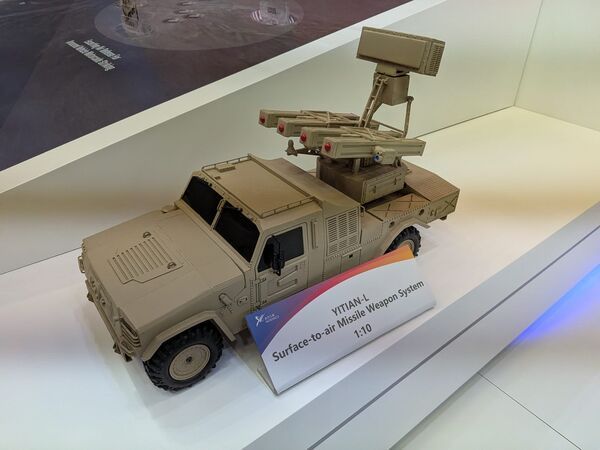
The Yitian-L is a lightweight variant of China's Yitian short-range air defense system, designed to protect troops and fixed sites from low-flying helicopters, drones, and cruise missiles. It is mounted on the Dongfeng Mengshi 4
light tactical vehicle, a platform with mobility similar to the American Humvee. NORINCO (China North Industries Corporation) builds the Yitian family, and the Yitian-L has so far been an export product.
Mauritania was the first known operator, displaying eight Yitian-L systems in June 2024. Mali signed a contract with NORINCO in September 2024 and received Yitian-L systems in deliveries beginning in early 2026. In October 2026, an upgraded Yitian-L variant was photographed while being transported, showing a reworked launcher with two boxes of six launch tubes in place of the four separate canisters on the production model, tripling the ready-to-fire load to 12 missiles. NORINCO has not publicly commented on the new configuration. It remains unclear whether the upgraded vehicle is for the Chinese military or for export, and whether the missiles are the standard TY-90 or a smaller derivative. The original Yitian and Yitian II, mounted on heavier armored personnel carriers, each carry eight TY-90 missiles, making the 12-missile Yitian-L variant potentially the most heavily armed in the family.
Specifications
The production Yitian-L carries four TY-90 infrared-guided missiles. The system includes a folding 3D X-band radar on the roof with a target detection range of up to 18 km for fighter-sized aircraft. NORINCO states the TY-90 engagement range extends from 500 m to 6 km, with an intercept altitude of 15 m to 4 km. Two operators run the system from inside the vehicle using a joystick-based digital console. The system also features a passive sensor suite including thermal imaging and a laser rangefinder, allowing the crew to track and engage targets without emitting radar signals during the engagement.
The TY-90 missile was originally developed as a short-range air-to-air weapon for Chinese attack helicopters in the late 1990s before being adapted for ground launch. It uses all-aspect infrared homing, enabling fire-and-forget engagement without the launcher maintaining a radar lock on the target. The ground-launched TY-90 has a launch weight of approximately 20 kg, a 3 kg high-explosive fragmentation warhead, dimensions of 1.95 m in length and 90 mm in diameter, a maximum speed exceeding Mach 2, and a maximum permissible overload of 20 g.
 Argentina
 Armenia
 Australia
 Austria
 Austria-Hungary
 Belgium
 Brazil
 United Kingdom
 United States
 Brunei
 Bulgaria
 Canada
 Chile
 Colonial America
 Colombia
 Confederate States
 Croatia
 Czech
 Denmark
 Egypt
 Finland
 France
 Georgia
 Germany
 German Imperial
 Greece
 Holland
 Hungary
 India
 Indonesia
 Iran
 Iraq
 Ireland
 Israel
 Italy
 Japan
 Japan (1940)
 Jordan
 Kingdom of Italy
 Malaysia
 Mexico
 Myanmar
 Nazi Germany
 Netherlands
 New Zealand
 North Korea
 Norway
 Pakistan
 Peru
 Philippines
 Poland
 Portugal
 Prussia
 Romania

 Russia
 Saudi Arabia
 Serbia
 Singapore
 Slovakia
 Slovenia
 South Africa
 South Korea
 Soviet Union
 Spain
 Sweden
 Switzerland
 Syria
 Taiwan
 Thailand
 Turkey
 UAE
 Ukraine
 Vietnam
 Yugoslavia