


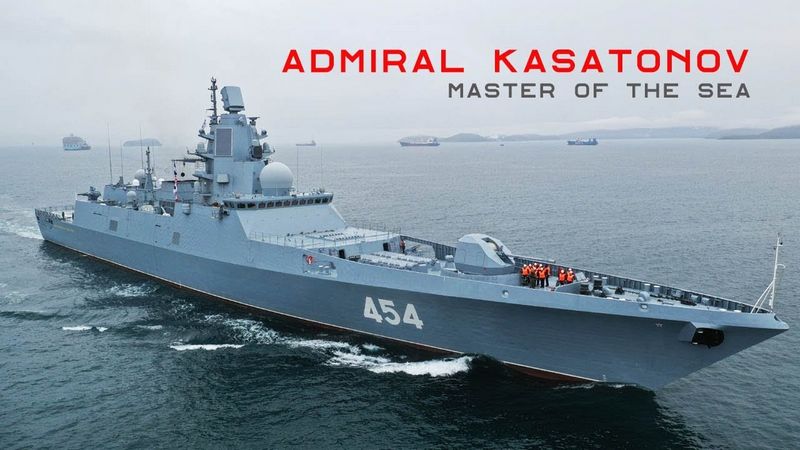

History of Admiral Kasatonov (454)
Admiral Kasatonov is a guided missile frigate in service with the modern Russian Navy. The warship belongs to the relatively new Admiral Gorshkov class, which currently (2019) consists of six ships, with a total of fifteen planned.
The Kasatonov is the second ship of this class, built by Severnaya Verf in St. Petersburg and laid on 26 November 2009. She was launched on December 12, 2014, and officially commissioned in 2019. She was assigned to the Northern Fleet.
A guided missile frigate is a relatively compact warship by modern standards, loaded with advanced processing systems and a wide variety of weapons. These types are designed to operate independently or as part of a main battle fleet in blue water scenarios near and far from home.
All major naval powers rely on the multi-mission approach that frigates currently offer.
Kasatonov has 210 operators with Furke-4 SP-27 main radar unit, Poliment 5P-20K active phased array radar unit, Fit Zarya-M sonar and state-of-the-art fire control system (FCS) ). Electronic warfare is covered by the Prosvet-M kit along with three different deception systems.
Armament includes 1 x 130 mm A-192M "Amethyst"/"Arsenal" main gun, turret located above forecastle, supported by multiple Vertical Launch Systems (VLS), including air-to-surface, anti-ship and anti-ship ground attack cruise missiles. The 2 x Kashtan system provides precise close-range defense, and there are up to 2 x 14.5mm MTPU Heavy Machine Guns (HMG) for defense against oncoming targets closer to Kashtan units.
In addition, the ship is equipped with two quadruple 330mm torpedo launchers to deal with surface and underwater threats.
In addition to this, there is the over-the-horizon (OtH) capability using the Kamov Ka-27 (or similar) naval helicopter. Up to two can be carried, one inside the full-service hangar provided and the other on the aft helipad.
The helicopters are equipped for anti-submarine warfare (ASW) missions and can take on other missions as needed - search and rescue (SAR), location and reconnaissance, sea resupply and anti-ship defense.
Her design lines are consistent with modern warship offerings: the plate sides are used to elegantly blend the hull with the superstructure, and protrusions are kept to a minimum to reduce the ships character. The bow and stern superstructure components are a separate section that interface with a low profile smoke funnel amidships. The mast above the front of the superstructure is completely closed and the height of the structure is low. The bridge section provides an impressive view of all forward parts of the ship.
Above the stern is the aforementioned helipad/stern area for helicopter launch and recovery.
Internally, power is provided by a combined gas and gas unit (COGAG) with 2 gas turbines connected to 2 gas turbines to cover both general and high speed cruising while maximizing fuel efficiency. The range is a useful 4,000 nautical miles, and speeds can reach 20 knots in ideal conditions.
Dimensions include 442.9 ft barrel length, 52.5 ft beam and 14.8 ft draft.
As of this writing (2019), the Gorshkov class consists of the lead ship Admiral Gorshkov and sister ship Kasatonov. Under construction are Admiral Golovko, Admiral Isakov, Admiral Ameilko and Admiral Chichagov.
Golovko, Isakov, Amelko and Chichagov are expected to be commissioned in 2021, 2022, 2024 and 2025, respectively.
Specification
Basic
Roles
- Blue Water Operations
- Fleet Support
- Hunter
- direct attack
Dimensions
394 feet (120.09 m)
46 feet (14.02 m)
15 feet (4.57 m)
Weight
4,500 tons
Performance
Performance
30 knots (34 mph)
4,849 nautical miles (5,580 miles; 8,980 km)
Armor
1 x 130 mm Amethyst / Arsenal A-192M deck gun with turret.
2 x 8 UKSK Vertical Launch System (VLS) to support Kalibr, Oniks and Zircon series cruise missiles.
2 x 16 Redut VLS to support the 9M96 surface-to-air missile family.
2 x 30mm Kashtan Close-In Weapon System (CIWS).
2 x 330mm torpedo tubes in two quadruple launchers.
2 x 14.5mm MTPU Heavy Machine Guns (HMG).
Wing
1 or 2 x Kamov Ka-27 (or similar) Naval Anti-Submarine Warfare (ASW) helicopters, supported by a combined hangar and helipad above the stern.
 Argentina
 Armenia
 Australia
 Austria
 Austria-Hungary
 Belgium
 Brazil
 United Kingdom
 United States
 Brunei
 Bulgaria
 Canada
 Chile
Chile China
China Colonial America
 Colombia
 Confederate States
 Croatia
 Czech
Czech Denmark
 Egypt
Egypt Finland
 France
 Georgia
 Germany
 German Imperial
 Greece
 Holland
 Hungary
 India
India Indonesia
 Iran
Iran Iraq
Iraq Ireland
 Israel
 Italy
Italy Japan
Japan Japan (1940)
 Jordan
 Kingdom of Italy
 Malaysia
 Mexico
 Myanmar
 Nazi Germany
 Netherlands
 New Zealand
 North Korea
 Norway
 Pakistan
 Peru
Peru Philippines
 Poland
 Portugal
 Prussia
 Romania
 Saudi Arabia
 Serbia
 Singapore
 Slovakia
 Slovenia
 South Africa
 South Korea
 Soviet Union
 Spain
Spain Sweden
 Switzerland
 Syria
Syria Taiwan
 Thailand
 Turkey
 UAE
UAE Ukraine
 Vietnam
 Yugoslavia