
History
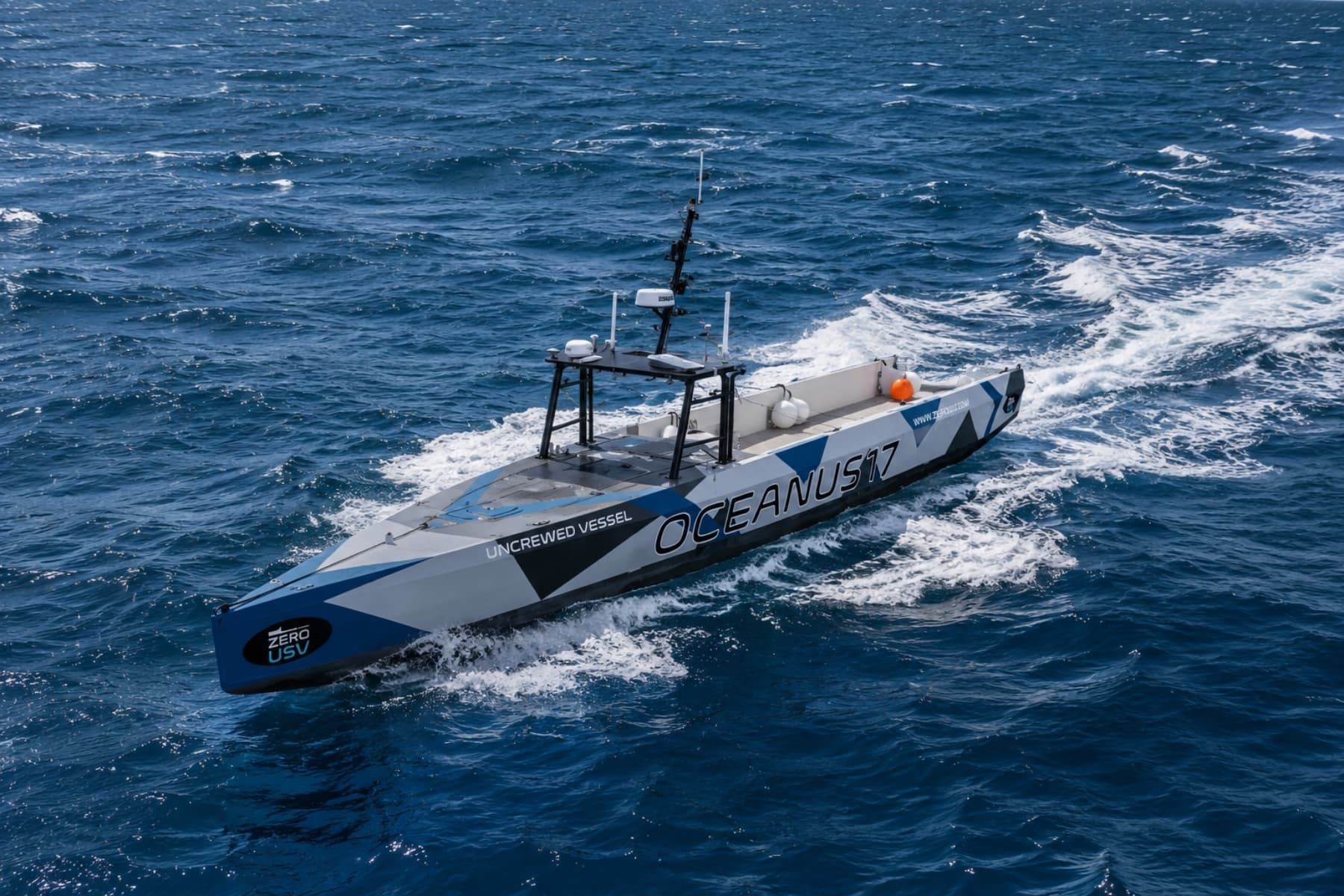
The Lady of the Lake is the first Oceanus17-class uncrewed surface vessel developed by UK-based ZeroUSV. The 17 m vessel was designed for long-range, persistent and over-the-horizon maritime operations with a large modular payload capacity.
Oceanus17 is the largest vessel in ZeroUSV's Oceanus range and follows the smaller Oceanus12 design. It combines level-four autonomous navigation, hybrid diesel-electric propulsion, redundant engineering systems and a configurable mission area for defence, maritime security, offshore survey and scientific research.
The first Oceanus17 was completed in 2026 and officially named The Lady of the Lake in Plymouth on 18 August 2026. It was scheduled to deploy to Portugal at the end of August for NATO Exercise REPMUS during September.
Development and construction
ZeroUSV developed Oceanus17 as an enlarged evolution of the Oceanus12 class. According to EDR Magazine, the first vessel was constructed at Manor Marine's shipyard in Portland, United Kingdom. By July 2026 it had completed Factory Acceptance Tests and had been delivered to ZeroUSV's headquarters at Turnchapel Wharf in Plymouth for final fitout and payload integration.
ZeroUSV stated that the first Oceanus17 was designed, built and delivered in just over six months. The vessel was intended to increase endurance, payload capacity and mission flexibility compared with the preceding Oceanus12 class.
Riviera Maritime Media reported that The Lady of the Lake underwent sea trials off Devon before its official naming. The vessel was formally named in Plymouth on 18 August 2026 during the British National Firework Championships. Rebecca Smith, Member of Parliament for South West Devon, performed the naming ceremony.
The name The Lady of the Lake refers to the figure from Arthurian tradition. Coverage by Workboat365 described the ceremony as the public introduction of the first vessel in the Oceanus17 class.
Design
Hull and mission configuration
Oceanus17 is 17 m long and is designed around a modular mission configuration. It can carry up to 4,000 kg of payload and incorporates a 20-foot ISO-compatible payload bay with 30 kW of dedicated electrical power for mission equipment.
The vessel also has a 9 m by 3 m modular aft deck. This area can accommodate interchangeable payloads for different missions. A gondola keel is provided for subsea and acoustic sensors, while onboard systems support real-time processing and transmission of collected data.
The modular arrangement is intended to allow payload systems to be installed or changed for different mission profiles. ZeroUSV identifies potential applications including defence, maritime security, offshore survey and scientific research.
Autonomy and navigation
The Lady of the Lake uses MarineAI's GuardianAI autonomy suite to provide level-four autonomous navigation. The autonomy system is integrated with the vessel's robotic control architecture for unmanned operation.
Dual-redundant engineering systems are used to reduce single points of failure during extended autonomous missions. The vessel is also equipped with Simrad solid-state radar and uses satellite and mobile-network communications for connectivity.
Propulsion and endurance
The Oceanus17 uses hybrid diesel-electric propulsion. Reported mission endurance exceeds 50 days. Its range is more than 5,000 nautical miles, with Ocean Economist and Riviera Maritime Media specifying approximately 5,000 nautical miles at 6 knots.
The vessel's maximum speed is described as approaching 15 knots. Its propulsion, autonomy and redundant systems are intended to support persistent operations beyond direct line of sight.
Program status
Following its August 2026 naming ceremony, The Lady of the Lake was being prepared for its first major exercise deployment. ZeroUSV planned to mobilise the vessel to Portugal at the end of August 2026 for NATO Exercise REPMUS in September.
Navy Leaders reported that the vessel was expected to operate alongside the Royal Navy and other NATO participants during the exercise. At the time of the available sources, this deployment was planned and had not yet been reported as completed.
Variants
- Oceanus17: 17 m uncrewed surface vessel designed for long-endurance, modular maritime missions. The Lady of the Lake is the first completed vessel of the class.
Specifications (Oceanus17 The Lady of the Lake)
General characteristics
- Length: 17 m
- Propulsion: Hybrid diesel-electric
- Payload capacity: 4,000 kg
- Payload bay: 20-foot ISO-compatible
- Dedicated payload power: 30 kW
- Modular aft deck: 9 m by 3 m
- Autonomous navigation: Level four using MarineAI GuardianAI
- Navigation radar: Simrad solid-state radar
- Communications: Satellite and mobile-network links
Performance
- Maximum speed: Approaching 15 knots
- Range: More than 5,000 nautical miles; approximately 5,000 nautical miles at 6 knots is also reported
- Mission endurance: More than 50 days
Mission equipment
- Sensor installation: Gondola keel for subsea and acoustic sensors
- Data handling: Real-time onboard processing and transmission capability
Related equipment
- Oceanus12: Earlier and smaller ZeroUSV design whose engineering and operational experience formed the basis for development of the larger Oceanus17 class.
 Argentina
 Armenia
 Australia
 Austria
 Austria-Hungary
 Belgium
 Brazil
 United States
 Brunei
 Bulgaria
 Canada
 Chile
Chile China
China Colonial America
 Colombia
 Confederate States
 Croatia
 Czech
Czech Denmark
 Egypt
Egypt Finland
 France
 Georgia
 Germany
 German Imperial
 Greece
 Holland
 Hungary
 India
India Indonesia
 Iran
Iran Iraq
Iraq Ireland
 Israel
 Italy
Italy Japan
Japan Japan (1940)
 Jordan
 Kingdom of Italy
 Malaysia
 Mexico
 Myanmar
 Nazi Germany
 Netherlands
 New Zealand
 North Korea
 Norway
 Pakistan
 Peru
Peru Philippines
 Poland
 Portugal
 Prussia
 Romania
 Russia
 Saudi Arabia
 Serbia
 Singapore
 Slovakia
 Slovenia
 South Africa
 South Korea
 Soviet Union
 Spain
Spain Sweden
 Switzerland
 Syria
Syria Taiwan
 Thailand
 Turkey
 UAE
UAE Ukraine
 Vietnam
 Yugoslavia