
History
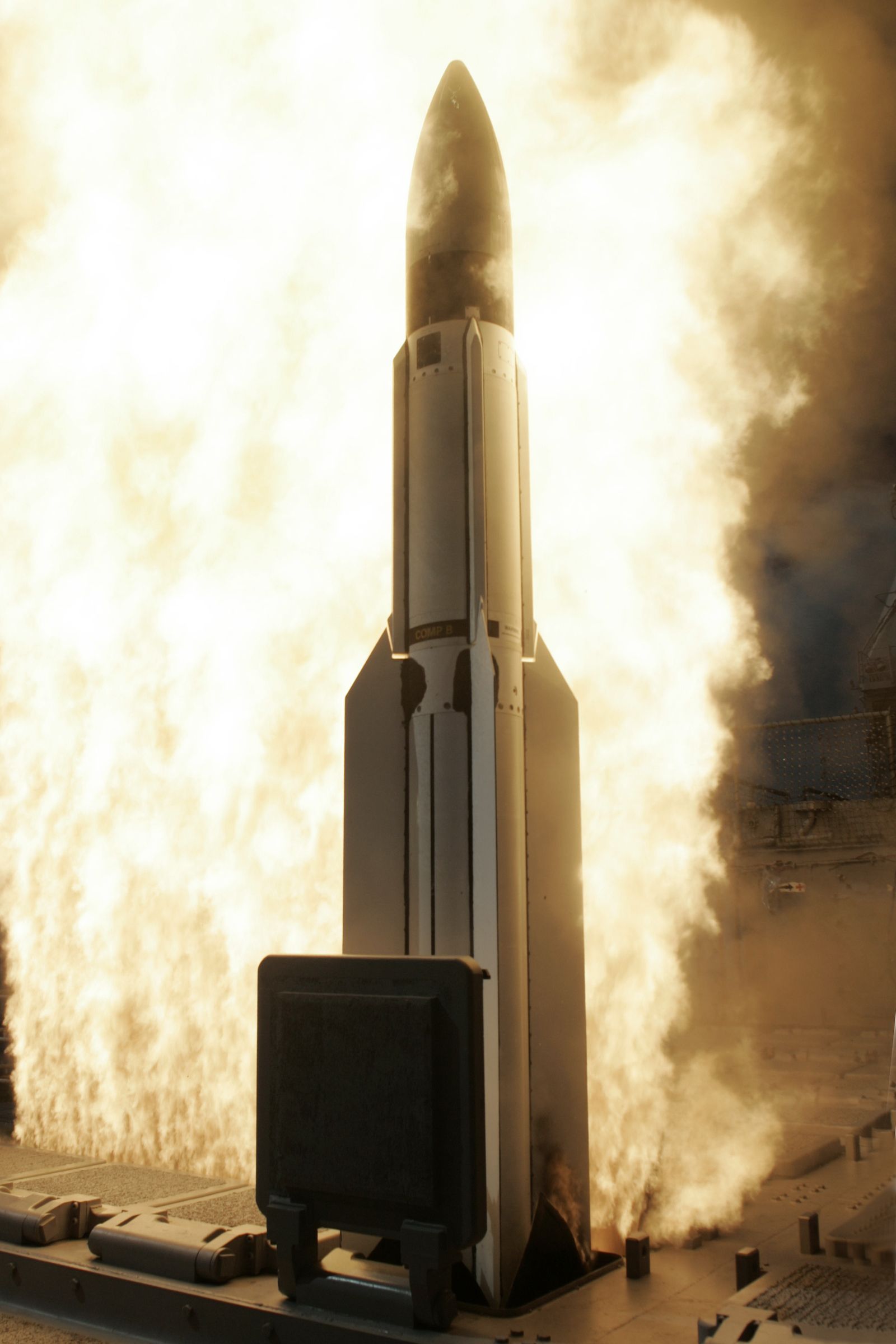
The Raytheon RIM-161 Standard Missile-3, commonly known as the SM-3, is a multi-stage ballistic-missile interceptor developed for the Aegis Ballistic Missile Defense system. It is designed primarily to destroy ballistic missile targets outside the atmosphere by direct impact rather than by detonating a conventional explosive warhead.
The SM-3 developed from the Standard Missile family and the SM-2 Block IV architecture. Its design combines solid-fuel propulsion, ship-based or land-based Aegis fire control, and a Lightweight Exo-Atmospheric Projectile-derived kinetic kill vehicle. Operational versions are launched from Mk 41 Vertical Launch System cells aboard Aegis-equipped warships and from Aegis Ashore installations.
The interceptor has evolved through several blocks, including Block IA, Block IB, the Block IB Threat Update, and the substantially redesigned Block IIA. The United States and Japan jointly developed Block IIA, while Raytheon, now part of RTX, remains the principal U.S. contractor. In August 2026, the U.S. Department of Defense announced framework agreements with RTX and Boeing intended to expand production of critical SM-3 components.
Development
The SM-3 traces its technical lineage to the SM-2 Block IV and to Lightweight Exo-Atmospheric Projectile, or LEAP, research. LEAP technology was developed to provide a compact hit-to-kill vehicle capable of locating and directly colliding with a target outside the atmosphere. The CSIS Missile Threat profile identifies LEAP research and the Navy Theater Wide program as important foundations of the interceptor.
Early SM-3 configurations retained the Mk 72 booster and Mk 104 dual-thrust rocket motor associated with the SM-2 Block IV propulsion architecture, while adding a third solid-fuel stage and the kinetic kill vehicle. The first flight test of an RIM-161A SM-3 took place in September 1999. A January 2001 test demonstrated controlled flight through separation of the kinetic vehicle, and in January 2002 an all-up SM-3 intercepted an Aries ballistic target missile.
The initial Block I configuration was produced in limited numbers and established the first operational Aegis BMD intercept capability. Block IA became the first major production configuration and was deployed in 2006. Block IB added improved target discrimination and maneuvering capability, and became operational in 2014.
The Block IIA represented a larger redesign. Development was undertaken jointly by the United States and Japan following earlier bilateral missile-defense cooperation. Unlike Block IA and Block IB, which narrow above their 533 mm booster, Block IIA maintains a diameter of about 533-540 mm through most of the missile body. The additional internal volume supports larger rocket motors and a larger kinetic kill vehicle.
Testing
SM-3 development has included numerous flight and intercept tests against ballistic missile targets of increasing complexity. Block IA and Block IB testing demonstrated exo-atmospheric interception of short- and medium-range ballistic missile targets, although the program also experienced unsuccessful tests. Independent assessments of early SM-3 testing questioned the realism and demonstrated success rate of some engagements, while the Missile Defense Agency argued that those assessments included early developmental events that did not represent later operational configurations.
The SM-3 Block IIA began flight testing in 2015. Its first flight test evaluated functions including nosecone performance, steering control and stage separation without attempting an intercept. In February 2017, USS John Paul Jones successfully used a Block IIA to intercept a medium-range ballistic missile target. Later tests in June 2017 and January 2018 were unsuccessful, followed by another successful medium-range ballistic missile intercept in October 2018.
On 16 November 2020, USS John Finn launched an SM-3 Block IIA and intercepted an ICBM-class target in a Missile Defense Agency test. The event demonstrated the feasibility of using Block IIA against an intercontinental-class target, although the interceptor had been designed principally for regional defense against shorter-range ballistic missile threats. In February 2024, another Block IIA engagement demonstrated Aegis tracking, discrimination and interception of a medium-range ballistic missile target accompanied by countermeasures.
Production
Raytheon has been the principal U.S. manufacturer of the SM-3 family, while Japan participates in the Block IIA program through Mitsubishi Heavy Industries and other industrial partners. Boeing supplies important elements of the interceptor, including components associated with the kinetic warhead and, under the 2026 production initiative, avionics and ejector assemblies.
RTX announced in October 2024 that the SM-3 Block IIA had received full-rate production approval. Continued production of Block IB and Block IIA has become an important U.S. Department of Defense industrial-base priority as demand for ballistic-missile interceptors has increased.
In August 2026, the Department of Defense announced framework agreements with RTX and Boeing to increase production capacity for the SM-3. Boeing described its arrangement as a seven-year framework agreement covering increased output of avionics and ejector assemblies for the Block IB and Block IIA. Boeing is to provide the components to Raytheon, an RTX business and the interceptor's prime contractor.
The framework arrangements are not themselves production contracts. They are intended to provide industry with a clearer long-term demand signal while the U.S. government seeks congressional approval and negotiates future multiyear procurement arrangements. The Pentagon said the agreements were intended to stabilize supply chains and expand munitions production capacity.
Design
The SM-3 is a vertically launched, multi-stage solid-fuel interceptor. It operates as part of the wider Aegis Ballistic Missile Defense architecture rather than as a completely autonomous weapon. Aegis sensors detect and track the ballistic target, the combat system develops an engagement solution, and the missile receives guidance during its climb toward the predicted intercept region.
Propulsion and flight sequence
Block IA and Block IB use the Mk 72 solid-fuel booster as the first stage, followed by the Mk 104 Dual Thrust Rocket Motor and the Mk 136 Third Stage Rocket Motor. The booster accelerates the missile after launch from the Mk 41 VLS. The Mk 104 continues acceleration through the atmosphere, and the third stage provides the velocity and trajectory required to deploy the kinetic kill vehicle outside the atmosphere.
Block IIA follows the same general multi-stage principle but incorporates larger-diameter rocket stages and increased propellant volume. The redesigned second and third stages provide greater velocity and expand the area from which the interceptor can engage ballistic missile targets.
Guidance and kill vehicle
The interceptor uses inertial navigation together with command and midcourse guidance from the Aegis system. After the propulsion stages have completed their work, the kinetic kill vehicle separates and conducts the terminal engagement independently.
The kill vehicle is derived from the LEAP concept. It uses an infrared seeker to locate and discriminate the target and a divert and attitude control system to maneuver in space. The Block IB introduced a two-color infrared seeker, an advanced signal processor and a throttleable Divert and Attitude Control System. These changes improved discrimination and terminal maneuverability compared with Block IA.
Block IIA incorporates a larger kill vehicle with increased divert capability, improved communications and an enhanced two-color seeker. The greater propulsion performance and more capable kill vehicle allow it to engage faster and more distant threats than earlier SM-3 versions.
Hit-to-kill interception
The SM-3 carries no conventional explosive warhead for its primary interception mission. Its kinetic kill vehicle destroys a ballistic missile or separated warhead by colliding with it at very high relative velocity. This method is commonly described as hit-to-kill. The Smithsonian National Air and Space Museum describes the SM-3 as a three-stage antiballistic missile whose LEAP kinetic warhead uses a seeker and divert and attitude control system to home on the target and destroy it through physical impact.
Launch platforms
At sea, operational SM-3 variants are fired from the Mk 41 Vertical Launch System aboard Aegis BMD-capable cruisers and destroyers. The missile is also deployed from fixed Aegis Ashore installations, which use architecture derived from the naval Aegis system. This allows the same interceptor family to support both maritime and land-based ballistic-missile defense missions.
Operational history
One of the best-known early operational applications of SM-3 technology occurred during Operation Burnt Frost in February 2008. The United States modified an SM-3 for an engagement against the malfunctioning USA-193 reconnaissance satellite. On 21 February, USS Lake Erie launched a single interceptor and destroyed the satellite at an altitude of approximately 247 km. The event demonstrated that the SM-3 kinetic interception architecture could be adapted to engage a low-orbit space object under specific conditions.
Block IB entered operational service in 2014. The interceptor subsequently became an important element of U.S. and allied Aegis BMD deployments, including the European Phased Adaptive Approach. Aegis Ashore installations expanded the system from ship-based operations to permanent land-based missile-defense sites.
The SM-3 was used against hostile ballistic missiles in combat for the first time during the Iranian attack on Israel in April 2024. U.S. Navy destroyers USS Arleigh Burke and USS Carney used SM-3 Block IB interceptors while defending against Iranian ballistic missiles. Reports cited in the supplied research indicate that four to seven SM-3 interceptors were fired during the engagement.
U.S. destroyers again used SM-3 interceptors during the October 2024 Iranian missile attack on Israel. In 2026, further reports described U.S. Navy SM-3 engagements against Iranian ballistic missiles threatening Turkish airspace during the Iran conflict. These operations increased attention on U.S. interceptor inventories and contributed to Department of Defense efforts to expand production capacity.
Variants
- RIM-161A SM-3 Block I: Development and limited-production version derived from the SM-2 Block IV architecture. It introduced the additional third stage, GPS-aided inertial navigation and a LEAP-derived kinetic kill vehicle.
- SM-3 Block IA: First major production version. It retained a 533 mm booster with a narrower upper missile body and used a kinetic kill vehicle with an infrared seeker and Solid Divert and Attitude Control System. Initial deployment began in 2006.
- SM-3 Block IB: Improved version featuring a two-color infrared seeker, advanced signal processing and a throttleable Divert and Attitude Control System. It became operational in 2014 and has been deployed from both ships and Aegis Ashore sites.
- SM-3 Block IB Threat Update: Evolution of Block IB incorporating improved discrimination software and algorithms for more complex ballistic missile threats. A production-representative configuration successfully intercepted a medium-range ballistic missile target in 2017.
- SM-3 Block IIA: Major redesign jointly developed by the United States and Japan. It uses larger rocket stages, a nearly uniform 533-540 mm body diameter, more propulsion and a larger kinetic kill vehicle with improved seeker sensitivity and divert performance. Full-rate production approval was announced in 2024.
- SM-3 Block IIB: Proposed higher-performance follow-on intended to improve capability against long-range ballistic missiles. The program was cancelled in 2013 before production.
Operators
- United States: The U.S. Navy operates SM-3 interceptors aboard Aegis BMD-capable warships, while U.S.-operated Aegis Ashore sites employ land-based SM-3 configurations. U.S. forces have used the interceptor in ballistic-missile defense operations.
- Japan: The Japan Maritime Self-Defense Force operates SM-3 interceptors aboard Aegis-equipped destroyers. Japan is also a co-development partner in the Block IIA program and has participated in repeated SM-3 flight and intercept tests.
Specifications (SM-3 Block IIA)
General characteristics
- Type: Exo-atmospheric ballistic-missile defense interceptor
- Basing: Sea-based and fixed land-based
- Length: Approximately 6.55 m
- Diameter: Approximately 0.53-0.54 m through most of the missile body
- Launcher: Mk 41 Vertical Launch System on Aegis BMD ships and corresponding Aegis Ashore launch installations
- Propulsion: Multi-stage solid-fuel rocket propulsion with enlarged second and third stages compared with Block I variants
- Terminal vehicle: Non-explosive kinetic kill vehicle using hit-to-kill interception
Performance
- Maximum velocity: Approximately 4.5 km/s
Published range figures for Block IIA differ substantially among the supplied sources, so a single range value is not presented here as a definitive specification.
Guidance
- Midcourse guidance: Inertial navigation with command and guidance updates from the Aegis weapon system
- Terminal guidance: Two-color infrared seeker on the kinetic kill vehicle
- Terminal maneuvering: Divert and attitude control system
Related equipment
- SM-2 Block IV: Earlier Standard Missile configuration from which the SM-3 airframe and propulsion architecture evolved.
- SM-6: Standard Missile family weapon used by Aegis-equipped forces for air and missile-defense missions, including lower-altitude ballistic-missile defense roles.
- Aegis Ballistic Missile Defense: Combat-system architecture that provides target detection, tracking, engagement planning and launch support for SM-3 interceptors.
Additional historical and technical information is available from the Missile Defense Advocacy Alliance and the supplied Army Recognition SM-3 profile.
 Argentina
 Armenia
 Australia
 Austria
 Austria-Hungary
 Belgium
 Brazil
 United Kingdom
 Brunei
 Bulgaria
 Canada
 Chile
Chile China
China Colonial America
 Colombia
 Confederate States
 Croatia
 Czech
Czech Denmark
 Egypt
Egypt Finland
 France
 Georgia
 Germany
 German Imperial
 Greece
 Holland
 Hungary
 India
India Indonesia
 Iran
Iran Iraq
Iraq Ireland
 Israel
 Italy
Italy Japan
Japan Japan (1940)
 Jordan
 Kingdom of Italy
 Malaysia
 Mexico
 Myanmar
 Nazi Germany
 Netherlands
 New Zealand
 North Korea
 Norway
 Pakistan
 Peru
Peru Philippines
 Poland
 Portugal
 Prussia
 Romania
 Russia
 Saudi Arabia
 Serbia
 Singapore
 Slovakia
 Slovenia
 South Africa
 South Korea
 Soviet Union
 Spain
Spain Sweden
 Switzerland
 Syria
Syria Taiwan
 Thailand
 Turkey
 UAE
UAE Ukraine
 Vietnam
 Yugoslavia