
History
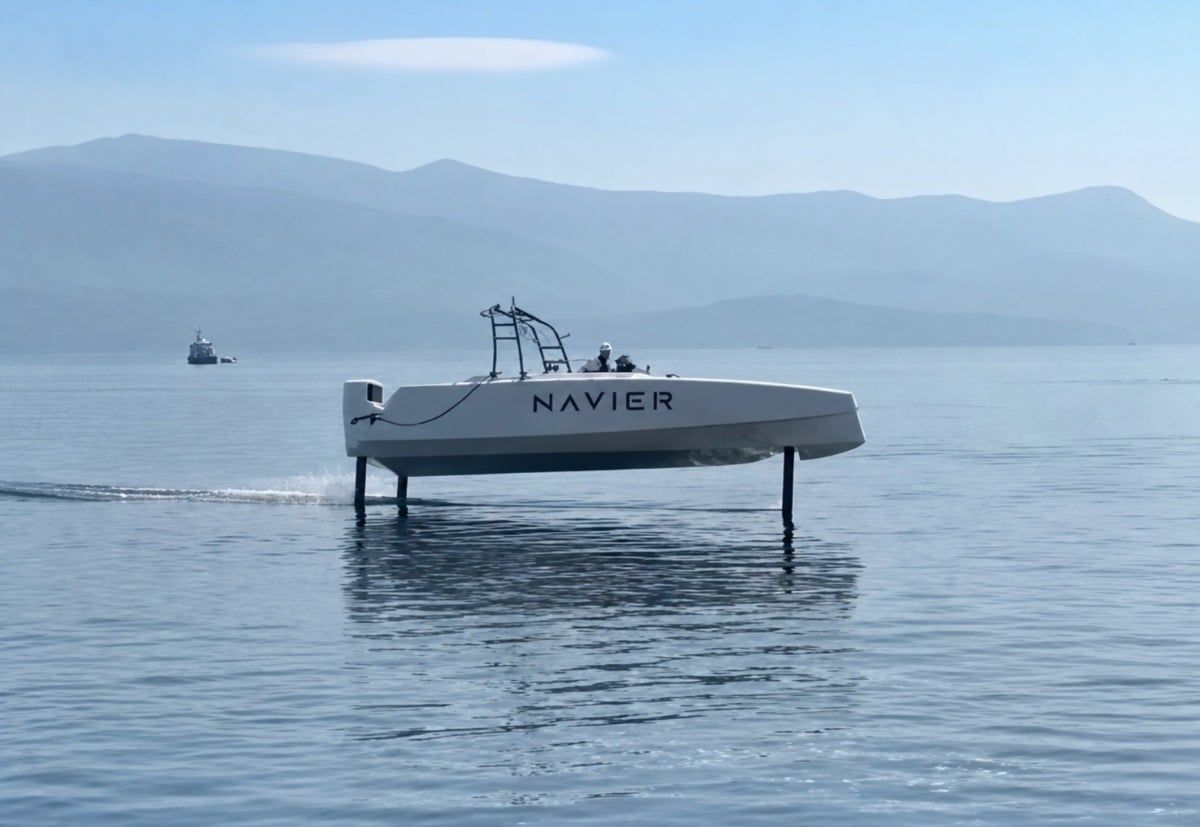
The Navier N30 Quanta-D is a 30-foot hybrid diesel-electric hydrofoil vessel developed in the United States as part of Navier's N30 platform family. It uses three actively controlled foils to lift the hull above the water and reduce hydrodynamic drag.
In August 2026, Navier said the N30 Quanta-D had completed Technical Experimentation 26-3 with U.S. Department of War customers. The exercise placed the vessel through mission profiles in front of special operations evaluators.
The evaluation represented a military test of the Quanta-D in mission-oriented conditions. Navier did not disclose the location or the specific mission profiles used during the exercise.
Technical Experimentation 26-3
Navier announced on 26 August 2026 that the N30 Quanta-D had completed a round of testing during Technical Experimentation 26-3. According to the company's information reported by Defence Blog, the vessel was evaluated with U.S. Department of War customers and special operations evaluators.
During the exercise, the Quanta-D was operated through mission profiles intended to represent real mission scenarios. Navier reported that the vessel maintained pitch and roll to less than 1 degree in sea state 4 and controlled its height above the water to within 2 cm.
Additional reporting from Dealroom also described the Quanta-D as a hybrid diesel-electric hydrofoil and confirmed its participation in Technical Experimentation 26-3.
Design
The N30 Quanta-D belongs to the same N30 platform family as Navier's earlier all-electric N30 vessel. Its approximately 30-foot hull is raised above the water by three actively controlled hydrofoils. By reducing the wetted area of the hull, this arrangement lowers drag compared with a conventional displacement or planing hull.
Hydrofoil control system
The N30 platform uses active control of the foils to respond to changing water conditions. Reporting cited by Defence Blog states that the system can adjust flaps on each foil up to 50 times per second. Navier reported that the Quanta-D held pitch and roll to less than 1 degree in sea state 4 and maintained its commanded altitude above the water to within 2 cm.
Propulsion
The Quanta-D uses a hybrid diesel-electric propulsion system. Navier reported that the electrical system handles peak power loads of 100 kW at 400 V. Available sources do not establish that the Quanta-D has the same range as the related Quanta-R variant, so the Quanta-R's published range should not be treated as a Quanta-D specification.
Program status
As of August 2026, the N30 Quanta-D had completed Technical Experimentation 26-3 with U.S. military customers and special operations evaluators. The available information describes testing and evaluation rather than operational service.
Navier was also preparing an unmanned Quanta-D for a planned unrefueled Atlantic crossing later in 2026. The reported target was approximately 2,000 nautical miles without refueling. This crossing was described as planned and had not occurred at the time of the August 2026 military test report.
Navier indicated that it intended to release additional information about military applications of the Quanta-D after the Technical Experimentation 26-3 exercise.
Specifications (N30 Quanta-D)
General characteristics
- Type: Hybrid diesel-electric hydrofoil vessel
- Hull length: approximately 30 ft
- Hydrofoil arrangement: three actively controlled foils
- Electrical system: 400 V
- Peak electrical power: 100 kW
Control performance
- Pitch and roll control: less than 1 degree in sea state 4, as reported by Navier
- Altitude control: within 2 cm above the commanded height, as reported by Navier
- Foil control rate: flap adjustments up to 50 times per second for the N30 platform
 Argentina
 Armenia
 Australia
 Austria
 Austria-Hungary
 Belgium
 Brazil
 United Kingdom
 Brunei
 Bulgaria
 Canada
 Chile
Chile China
China Colonial America
 Colombia
 Confederate States
 Croatia
 Czech
Czech Denmark
 Egypt
Egypt Finland
 France
 Georgia
 Germany
 German Imperial
 Greece
 Holland
 Hungary
 India
India Indonesia
 Iran
Iran Iraq
Iraq Ireland
 Israel
 Italy
Italy Japan
Japan Japan (1940)
 Jordan
 Kingdom of Italy
 Malaysia
 Mexico
 Myanmar
 Nazi Germany
 Netherlands
 New Zealand
 North Korea
 Norway
 Pakistan
 Peru
Peru Philippines
 Poland
 Portugal
 Prussia
 Romania
 Russia
 Saudi Arabia
 Serbia
 Singapore
 Slovakia
 Slovenia
 South Africa
 South Korea
 Soviet Union
 Spain
Spain Sweden
 Switzerland
 Syria
Syria Taiwan
 Thailand
 Turkey
 UAE
UAE Ukraine
 Vietnam
 Yugoslavia