
History
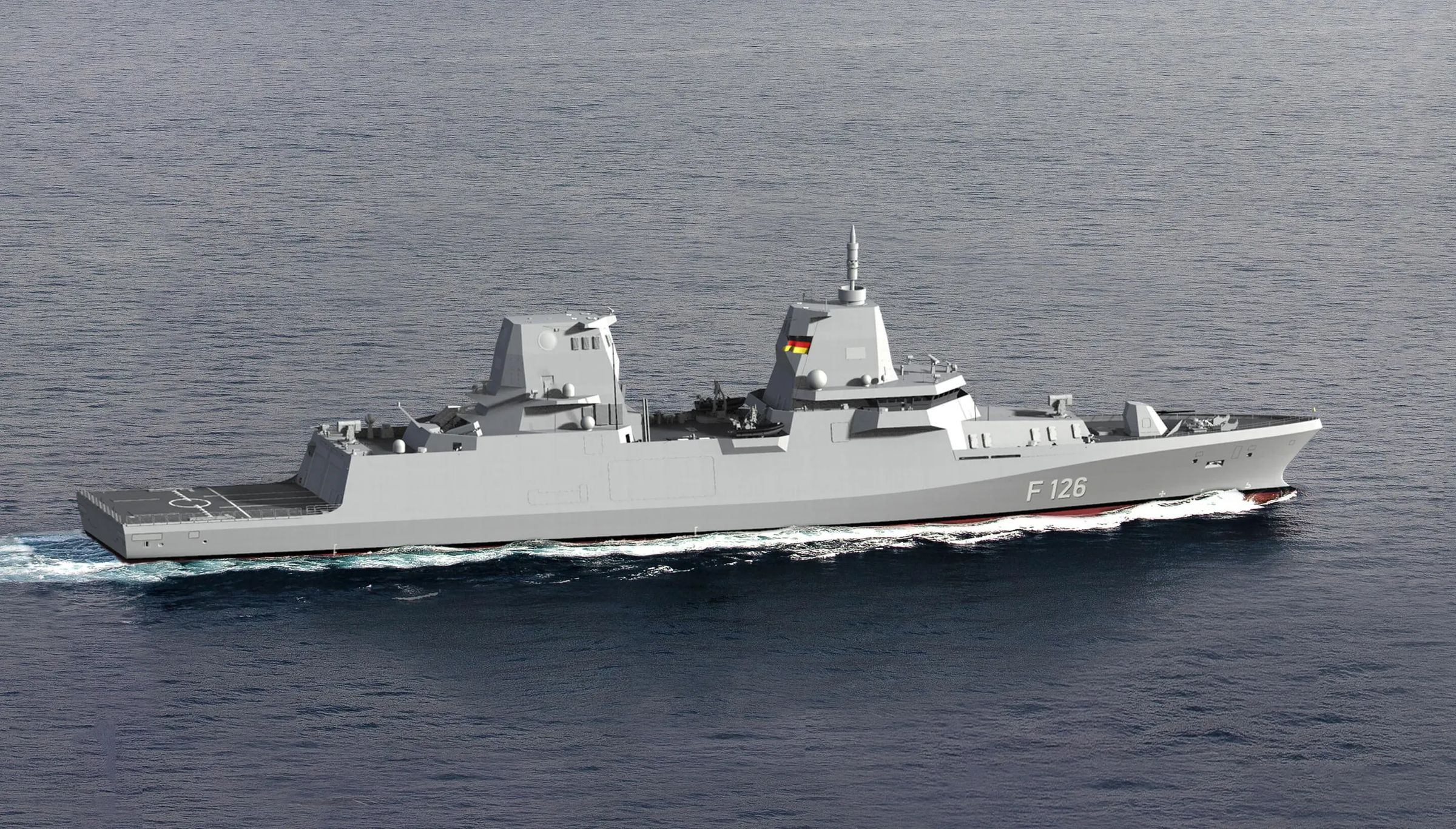
The F126 was a German Navy frigate program developed as a large, modular surface combatant for worldwide deployment. Previously known as the Multi-Purpose Combat Ship 180, or MKS 180, the design was intended to replace the Brandenburg-class frigates and provide anti-submarine, anti-surface and anti-air warfare capabilities.
Damen Schelde Naval Shipbuilding received the program contract in June 2020. Construction was distributed among German shipyards, while the design combined a large hull, interchangeable mission modules, extensive automation and facilities intended for prolonged deployments.
Production work began with steel cutting for the first ship, Niedersachsen, in December 2023, and its keel was laid on 3 June 2024. Germany cancelled the F126 program in June 2026 after delays, rising costs and concerns about transferring responsibility to another shipbuilder. No F126 frigate was completed or entered service.
The program developed from earlier German studies for a new multi-purpose combatant. Requirements evolved toward a vessel capable of long deployments, task-force command, maritime security missions and high-intensity naval warfare. The design was eventually selected through a European procurement process and contracted to the Dutch Damen Group.
The planned class initially comprised four named ships: Niedersachsen, Saarland, Bremen and Thüringen. Germany later planned to acquire six frigates. According to GlobalMilitary, construction of the lead ship progressed through steel cutting and keel laying before the program was terminated.
Germany examined transferring the troubled program from Damen Schelde Naval Shipbuilding to Naval Vessels Lürssen. Rheinmetall acquired NVL in 2026 and could therefore have become involved in completing the ships. A government review concluded that continuing the program through a transfer could raise total expenditure above €18 billion. Germany formally cancelled the six-ship project in June 2026. Rheinmetall subsequently reduced its annual naval-business sales forecast by €300 million as a result of the cancellation.
Following cancellation, Germany moved toward a proposed acquisition of eight TKMS-produced MEKO frigates focused on anti-submarine warfare and NATO requirements. That procurement was reported as dependent on approval by the German parliamentary Budget Committee. Defence24 likewise reported that delays, cost growth and the risks of changing the prime contractor were central to the decision to abandon F126.
Design
The F126 was designed as a 166 m multi-purpose frigate with a displacement of approximately 10,000 tonnes. Damen specified a beam of 21 m and a draught of 6 m. The design emphasized modularity, redundancy, automation and extended deployment periods.
Mission system and modularity
The design used interchangeable mission modules containing equipment, sensors and facilities for specialized tasks. An anti-submarine warfare module was planned around a towed-array sonar. Other proposed modules included detention facilities, mine-countermeasures equipment and diving support. The ship also had mission decks able to accommodate containers and boats for specialized operations.
According to the Damen F126 product sheet, the ship was intended for anti-air, anti-surface, anti-submarine and asymmetric warfare, as well as maritime security, special-forces support and humanitarian assistance. The design provided a helicopter deck and hangar for two NH90 helicopters, integration of unmanned aircraft and space for up to three 12 m rigid-hull inflatable boats.
Propulsion and electrical system
The F126 used a Combined Diesel Electric And Diesel, or CODELAD, propulsion arrangement with two independently operating shafts. Each shaft could be driven by a propulsion diesel engine, an electric motor or both. The arrangement avoided the more complex combining gearboxes used in some earlier German frigate propulsion systems.
An interview with the German BAAINBw procurement office published by Naval Forces described four diesel generator sets connected to a battery-buffered direct-current electrical grid. The electric motors could also operate as generators in power take-off mode. Encapsulation and structure-borne-noise-reducing mounts were intended to reduce acoustic signatures, an important consideration for anti-submarine operations.
The propulsion architecture emphasized redundancy. The ship had two independent shaft lines, and each shaft had redundant electric propulsion capability. Automated power management was intended to start and stop generating units according to demand and monitor the battery system. Condition monitoring and remote technical support were also planned to reduce maintenance demands on the smaller crew.
Sensors and combat systems
Damen listed X-band and C-band multifunction radars, electro-optical tracking and surveillance systems, electronic-support systems and provision for a modular towed-array sonar. Secondary sources identify the Thales TACTICOS combat management system, Hensoldt TRS-4D NR surveillance radar and Thales APAR Block 2 fire-control radar as planned systems.
Armament
The planned armament included a 127 mm main gun, a vertical launching system for ESSM surface-to-air missiles, surface-to-surface missiles and a point-defence missile system. The design also incorporated two MLG27 side-mounted weapon systems and two 12.7 mm weapon stations.
Secondary sources identify a 16-cell Mk 41 vertical launching system, RIM-162 ESSM missiles, two RIM-116 Rolling Airframe Missile launchers, eight Naval Strike Missiles and the Leonardo 127/64 LW naval gun with Vulcano ammunition. These weapons represented the planned configuration rather than equipment fielded by an operational F126 ship.
Aviation and accommodation
The flight deck and hangar were designed to support two NH90 Sea Tiger helicopters and unmanned aircraft such as the Saab Skeldar V-200. Damen listed fully air-conditioned accommodation for up to 198 people. Secondary sources give a standard ship's crew of approximately 114 personnel.
Program status
The F126 program was cancelled in June 2026 before completion of the lead ship. The class therefore never entered German Navy service. Work had progressed through steel cutting and keel laying for Niedersachsen, but none of the planned frigates was commissioned or deployed.
The cancellation ended plans for F126 to become a major German Navy anti-submarine and multi-purpose surface combatant. Germany instead moved toward a smaller MEKO-based frigate solution intended to meet anti-submarine warfare and NATO requirements more quickly.
Specifications (F126 design)
General characteristics
- Type: Multi-purpose frigate
- Length: 166 m
- Beam: 21 m
- Draught: 6 m
- Displacement: approximately 10,000 tonnes
- Standard crew: approximately 114
- Accommodation: up to 198 persons
Propulsion
- Arrangement: CODELAD, Combined Diesel Electric And Diesel
- Propulsion diesel engines: 2 × 12,000 kW
- Electric motors: 2 × 4,000 kW
- Generator sets: 4 × 3,000 kWe
- Shafts: 2
- Propellers: 2 controllable-pitch propellers
Performance
- Maximum speed: more than 26 knots
- Electric-propulsion speed: more than 15 knots
- Range: more than 5,000 nautical miles
- Endurance: 21 days at sea
Armament
- Main gun: 1 × 127 mm naval gun
- Vertical launch system: 16-cell Mk 41 VLS planned for ESSM missiles
- Anti-ship missiles: up to 8 Naval Strike Missiles in the reported planned configuration
- Point defence: 2 × RIM-116 RAM launchers
- Secondary weapons: 2 × MLG27 27 mm weapon systems and 2 × 12.7 mm remote weapon systems
Aviation
- Helicopters: hangar and flight-deck facilities for 2 × NH90 helicopters
- Unmanned aircraft: provision for Saab Skeldar V-200 UAV operations
Related equipment
- Brandenburg-class frigate: German Navy class that the F126 was intended to replace in the anti-submarine warfare role.
- MEKO A-200 DEU: frigate design selected as the basis of Germany's replacement procurement plan after cancellation of F126.
Source package:
 Argentina
 Armenia
 Australia
 Austria
 Austria-Hungary
 Belgium
 Brazil
 United Kingdom
 United States
 Brunei
 Bulgaria
 Canada
 Chile
Chile China
China Colonial America
 Colombia
 Confederate States
 Croatia
 Czech
Czech Denmark
 Egypt
Egypt Finland
 France
 Georgia
 German Imperial
 Greece
 Holland
 Hungary
 India
India Indonesia
 Iran
Iran Iraq
Iraq Ireland
 Israel
 Italy
Italy Japan
Japan Japan (1940)
 Jordan
 Kingdom of Italy
 Malaysia
 Mexico
 Myanmar
 Nazi Germany
 Netherlands
 New Zealand
 North Korea
 Norway
 Pakistan
 Peru
Peru Philippines
 Poland
 Portugal
 Prussia
 Romania
 Russia
 Saudi Arabia
 Serbia
 Singapore
 Slovakia
 Slovenia
 South Africa
 South Korea
 Soviet Union
 Spain
Spain Sweden
 Switzerland
 Syria
Syria Taiwan
 Thailand
 Turkey
 UAE
UAE Ukraine
 Vietnam
 Yugoslavia