
History
T-8 Chekan is a Soviet-built Project 53 minesweeper that later served with the Korean People's Navy. The ship was launched on December 27, 1936, commissioned on November 2, 1938, and transferred to North Korea in December 1953.
The vessel belongs to the Project 53 subclass of the wider Fugas-class minesweeper family. T-8 survived long after most ships of the family disappeared and is described as the last known surviving Project 53 minesweeper.
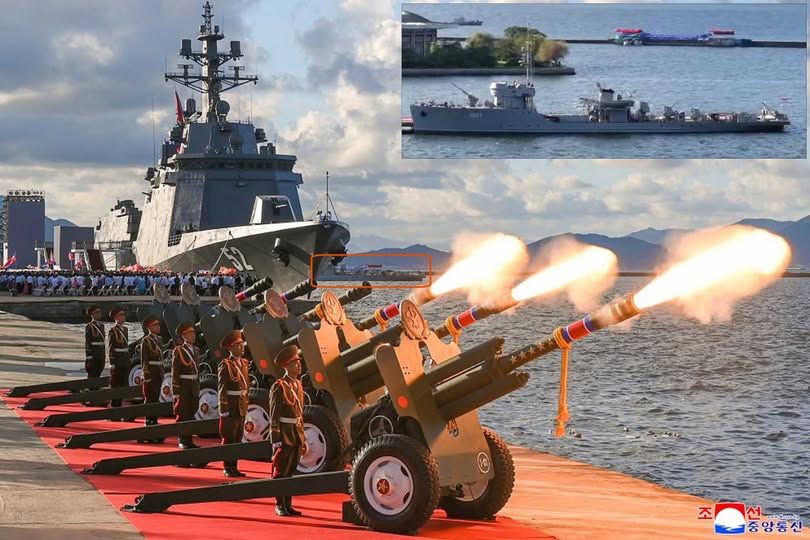
In September 2026, the physical hull was again observed at Wonsan during the commissioning of the Kang Kon guided-missile destroyer. Army Recognition reported that this appearance confirmed the vessel's continued physical survival, although it did not establish that T-8 remained an operational combat ship.
Construction and Soviet service
T-8 was launched on December 27, 1936, and entered service on November 2, 1938. It was part of the Project 53 series within a broader group of Projects 3, 53, 53-U, and 58 minesweepers. A total of 44 ships in this wider family were built between 1933 and 1946.
The Project 53 design combined minesweeping and minelaying duties with escort and secondary anti-submarine functions. Its relatively small hull carried a substantial gun and mine load, while the class could also be used as a transport when required.
Transfer to North Korea
In December 1953, the Soviet Union transferred T-8 and its sister ship T-2 to North Korea. The two Project 53 ships gave the Korean People's Navy substantially larger and more heavily armed hulls than many of the small coastal craft that had formed much of its earlier surface force.
North Korea later reproduced the basic hull proportions of the transferred ships when developing the Sariwon-class corvettes during the 1960s. The later vessels retained dimensions close to those of the Project 53 design but had greater displacement and a gun-heavy armament.
Design
Hull
The Project 53 hull measured approximately 62 m in length, 7.41 m in beam, and 2.5 m in draft. Displacement for ships of the family ranged from about 490 to 535 tonnes. The structure combined riveted and welded construction and contained nine watertight compartments.
The class had limited stability margins for additional topweight. During World War II, increases in anti-aircraft armament therefore had to be balanced against mine and ammunition loads.
Powerplant and performance
Two diesel engines, each rated at about 1,400 hp, drove two shafts for a combined output of approximately 2,800 hp. The general Project 53 configuration reached about 17.5 knots and could achieve a range of up to 7,200 nautical miles at 12 knots.
The later North Korean configuration reported for T-8 Chekan differed in some details. It is listed with a full-load displacement of 503 tonnes, 2,800 hp, a maximum speed of 17.8 knots, 60 tonnes of diesel fuel, and a range of 3,000 nautical miles at 13.9 knots.
Mine warfare and armament
The basic Project 53 armament centered on a 100 mm B-24 gun, supported by smaller anti-aircraft weapons. The ships could carry up to 31 M1926 naval mines. Mine warfare equipment included three mechanical sweeps, with magnetic and acoustic sweeping systems and three-section degaussing coils added to the class in later configurations.
Anti-submarine equipment included depth-charge racks and BMB-1 bomb throwers. Certain Project 53 configurations carried as many as 40 depth charges, although the specific North Korean T-8 configuration is listed with 20.
For T-8 Chekan in North Korean service, the reported armament consisted of one 100 mm B-24-BM gun, three 37 mm 70-K guns, four 12.7 mm weapons, 20 depth charges, and up to 31 mines.
Service history
T-8 remained in North Korean possession for decades after its 1953 transfer. The ship was seen beside USS Pueblo during the 2000s, while its sister ship T-2 had disappeared from public view after an appearance in 1993.
Naval inventories have listed T-8 as stricken in 2005. This makes later sightings evidence that the hull survived rather than proof that the minesweeper remained in active combat service.
On September 6, 2026, T-8 was visible at Wonsan during the commissioning ceremony for the Kang Kon destroyer. Its presence beside a modern approximately 5,000-tonne missile destroyer emphasized the technological distance between North Korea's early Soviet-supplied surface fleet and its newer large combatants.
Specifications (T-8 Chekan, North Korean configuration)
General characteristics
- Type: Project 53 minesweeper
- Length: approximately 62 m
- Beam: approximately 7.41 m
- Draft: approximately 2.5 m
- Full-load displacement: approximately 503 tonnes
- Power: approximately 2,800 hp from two diesel engines
- Propulsion: two shafts
- Fuel: approximately 60 tonnes of diesel
Performance
- Maximum speed: approximately 17.8 knots
- Range: approximately 3,000 nautical miles at 13.9 knots
Armament and mine load
- Main gun: one 100 mm B-24-BM gun
- Anti-aircraft guns: three 37 mm 70-K guns
- Machine guns: four 12.7 mm weapons
- Depth charges: 20
- Mines: up to 31
Related equipment
- T-2 Tros: sister Project 53 minesweeper transferred to North Korea together with T-8 in December 1953. It was extensively modified and disappeared from public view after 1993.
- Sariwon class: North Korean corvette design developed during the 1960s using hull dimensions closely resembling those of the transferred Project 53 minesweepers.
- Kang Kon: modern North Korean guided-missile destroyer commissioned at Wonsan in September 2026, where T-8 Chekan was also visible.
 Argentina
 Armenia
 Australia
 Austria
 Austria-Hungary
 Belgium
 Brazil
 United Kingdom
 United States
 Brunei
 Bulgaria
 Canada
 Chile
Chile China
China Colonial America
 Colombia
 Confederate States
 Croatia
 Czech
Czech Denmark
 Egypt
Egypt Finland
 France
 Georgia
 Germany
 German Imperial
 Greece
 Holland
 Hungary
 India
India Indonesia
 Iran
Iran Iraq
Iraq Ireland
 Israel
 Italy
Italy Japan
Japan Japan (1940)
 Jordan
 Kingdom of Italy
 Malaysia
 Mexico
 Myanmar
 Nazi Germany
 Netherlands
 New Zealand
 North Korea
 Norway
 Pakistan
 Peru
Peru Philippines
 Poland
 Portugal
 Prussia
 Romania
 Russia
 Saudi Arabia
 Serbia
 Singapore
 Slovakia
 Slovenia
 South Africa
 South Korea
 Spain
Spain Sweden
 Switzerland
 Syria
Syria Taiwan
 Thailand
 Turkey
 UAE
UAE Ukraine
 Vietnam
 Yugoslavia