
History
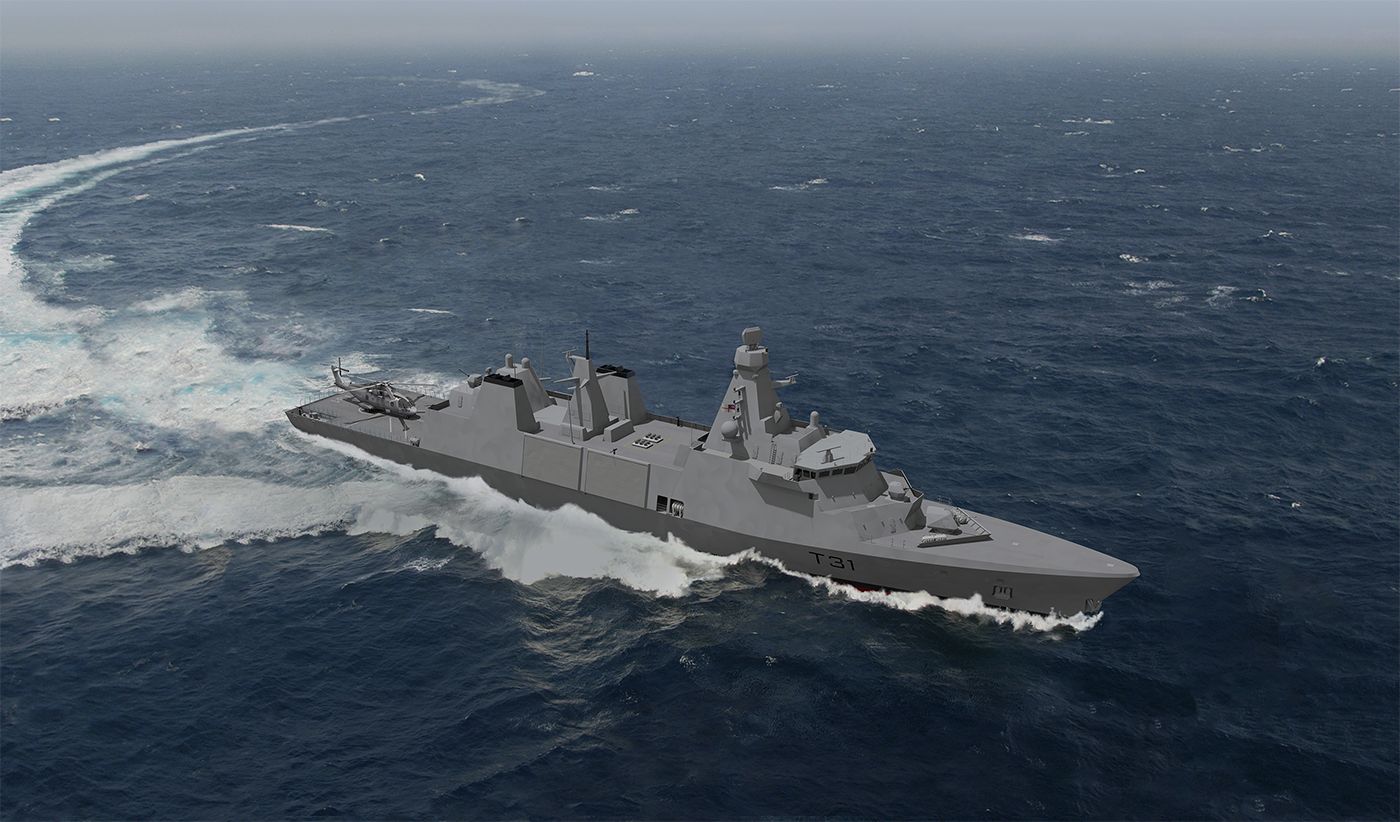
The Type 31 frigate, also known as the Global Battleclass Offshore Vessel (GBOW) or, for the Royal Navy's five ships, the Inspiration class, is a class of general-purpose frigates procured for the Royal Navy as a lower-cost alternative to the Type 26 anti-submarine warfare frigate for long-range offshore patrol and multirole operations. The programme emerged from the 2010 Strategic Defence and Security Review, which authorised the Global Combat Ship programme to replace the Royal Navy's thirteen Type 23 frigates. The 2015 Strategic Defence and Security Review split the requirement into eight high-end Type 26 anti-submarine warfare frigates and five cheaper general-purpose ships. Babcock International offered its Arrowhead 140 design, a development of the Royal Danish Navy's Iver Huitfeldt-class frigate, and was selected as preferred bidder in September 2019. The contract for five ships was signed in November 2019 with an initial value of approximately £1.25 billion, averaging £250 million per ship. The original ambition was for the lead ship to enter service in 2023, but the schedule has slipped substantially; the Ministry of Defence's current position is that HMS Venturer is scheduled to be handed over by the end of the 2020s.
Construction of HMS Venturer began in September 2021 and the ship floated on 14 June 2025, approximately 15 months later than the revised early-2024 target. HMS Active had its steel cut in January 2023, was laid down in September 2023, and floated on 21 March 2026. Construction of HMS Formidable began in October 2024 with keel-laying in December 2025, and HMS Bulldog had its steel cut in February 2026. HMS Campbeltown will complete the five-ship production run. Successive steel-cutting intervals of 16, 21, and 16 months have been recorded against an original 12-month target.
Specifications
The Type 31 is a general-purpose frigate of approximately 5,700 tonnes full-load displacement, 138.7 metres in length and 19.8 metres in beam. Propulsion is provided by four MTU 20V 8000 M71 diesel engines in a Combined Diesel and Diesel arrangement driving two shafts through MAN Alpha VBS Mk 5 CP propellers. The design achieves speeds in excess of 26 knots, while the British procurement specification calls for 28 knots at a range of 7,500 nautical miles; the published export-design range is 9,000 nautical miles at 18 knots. The intended crew complement is 110 to 115 sailors, with additional accommodation for approximately 140 to 190 personnel including mission specialists, aircrew, and Royal Marines depending on the deployment. The hangar accommodates a Wildcat or Merlin helicopter, and the flight deck can accept aircraft up to Chinook size. The baseline configuration does not include hull-mounted, variable-depth, or towed-array sonar, which limits sustained anti-submarine warfare capability without an embarked helicopter carrying dipping sonar and sonobuoys or additional sensors. The armament consists of one Bofors 57 mm Mk 3 medium-calibre gun on the forecastle, two Bofors 40 mm Mk 4 mounts, Sea Ceptor surface-to-air missiles with an engagement range of approximately 25 km, and Naval Strike Missiles, confirmed in the June 2026 Defence Investment Plan. Structural foundations accommodate up to four Mk 41 strike-length vertical launch modules providing a theoretical maximum of 32 cells, although the final allocation remains unconfirmed and the first two ships will require post-construction installation. The primary sensor is the Thales NS110 S-band active electronically scanned array radar, operating with the Thales TACTICOS combat management system and Mirador electro-optical directors. Three boat bays and an enclosed mission space below the flight deck support additional craft and equipment, though large payloads require crane loading in port.
Program Status
No Type 31 has yet completed operational certification. In May 2026, Babcock recorded a £140 million charge for rework and construction sequencing on HMS Venturer and HMS Active, raising cumulative losses on the five-ship contract above £300 million. Estimated average expenditure has approached £400 million per vessel compared with the original £250 million benchmark, although the cost categories differ between the original and current estimates. A five-ship Capability Insertion Period contract worth approximately £65 million covers equipment outside the original build specification, including the Mk 41 vertical launch system. The ships are expected to pass through several fitting-out stages before reaching their intended fighting configuration.
Variants
Babcock has licensed Arrowhead 140 derivatives to several foreign navies. Indonesia's PT PAL is building the four-ship Balaputradewa-class (Red-White Frigate) in Surabaya; the first vessel, KRI Balaputradewa, was launched in December 2025. Poland's PGZ Stocznia Wojenna is constructing the three-ship Wicher (Miecznik) class in Gdynia, with the lead ship ORP Wicher launched in August 2026. Babcock is also pursuing export opportunities in Chile, New Zealand, and Denmark, and previously proposed the design to the Royal Australian Navy, though it was not selected for Australia's general purpose frigate programme, for which the Improved Mogami-class was chosen in August 2025.
US Navy Procurement Interest
Following a presidential memorandum on 13 August 2026 that permitted limited foreign warship construction under a national-security exception, Babcock confirmed on 25 October 2026 its interest in offering the Arrowhead 140 design to the U.S. Navy as a potential surface combatant. The initiative follows the December 2025 reduction of the Constellation-class programme to two vessels and places the British design in potential competition with Japan's Mogami-class, South Korea's Chungnam-class, and Turkey's Istanbul-class frigates. Babcock has held preliminary meetings with Pentagon officials and is exploring a partnership with Huntington Ingalls Industries for domestic assembly, though no formal bid, construction site, or contract has been confirmed. The Secretary of War is required to submit a surface-combatant acquisition plan by 12 November 2026. A key technical gap for the U.S. requirement is that the Type 31's baseline lacks the shipborne sonar required for sustained anti-submarine operations, which the Navy considers a primary mission for a general-purpose frigate. Babcock's existing industrial relationship with the U.S. submarine programme, including missile-tube manufacturing for the Columbia and Virginia classes since 2014 and a 2023 strategic agreement with HII, provides a foundation for the proposed cooperation, but the company's lack of a U.S. shipyard complicates compliance with the August memorandum's requirement that foreign suppliers either establish a new American shipyard or acquire ownership of an existing facility.
 Argentina
 Armenia
 Australia
 Austria
 Austria-Hungary
 Belgium
 Brazil
 United States
 Brunei
 Bulgaria
 Canada
 Chile
 China
 Colonial America
 Colombia
 Confederate States
 Croatia
 Czech
 Denmark
 Egypt
 Finland
 France
 Georgia
 Germany
 German Imperial
 Greece
 Holland
 Hungary
 India
 Indonesia
 Iran
 Iraq
 Ireland
 Israel
 Italy
 Japan
 Japan (1940)
 Jordan
 Kingdom of Italy
 Malaysia
 Mexico
 Myanmar
 Nazi Germany
 Netherlands
 New Zealand
 North Korea
 Norway
 Pakistan
 Peru
 Philippines
 Poland
 Portugal
 Prussia
 Romania

 Russia
 Saudi Arabia
 Serbia
 Singapore
 Slovakia
 Slovenia
 South Africa
 South Korea
 Soviet Union
 Spain
 Sweden
 Switzerland
 Syria
 Taiwan
 Thailand
 Turkey
 UAE
 Ukraine
 Vietnam
 Yugoslavia