
History
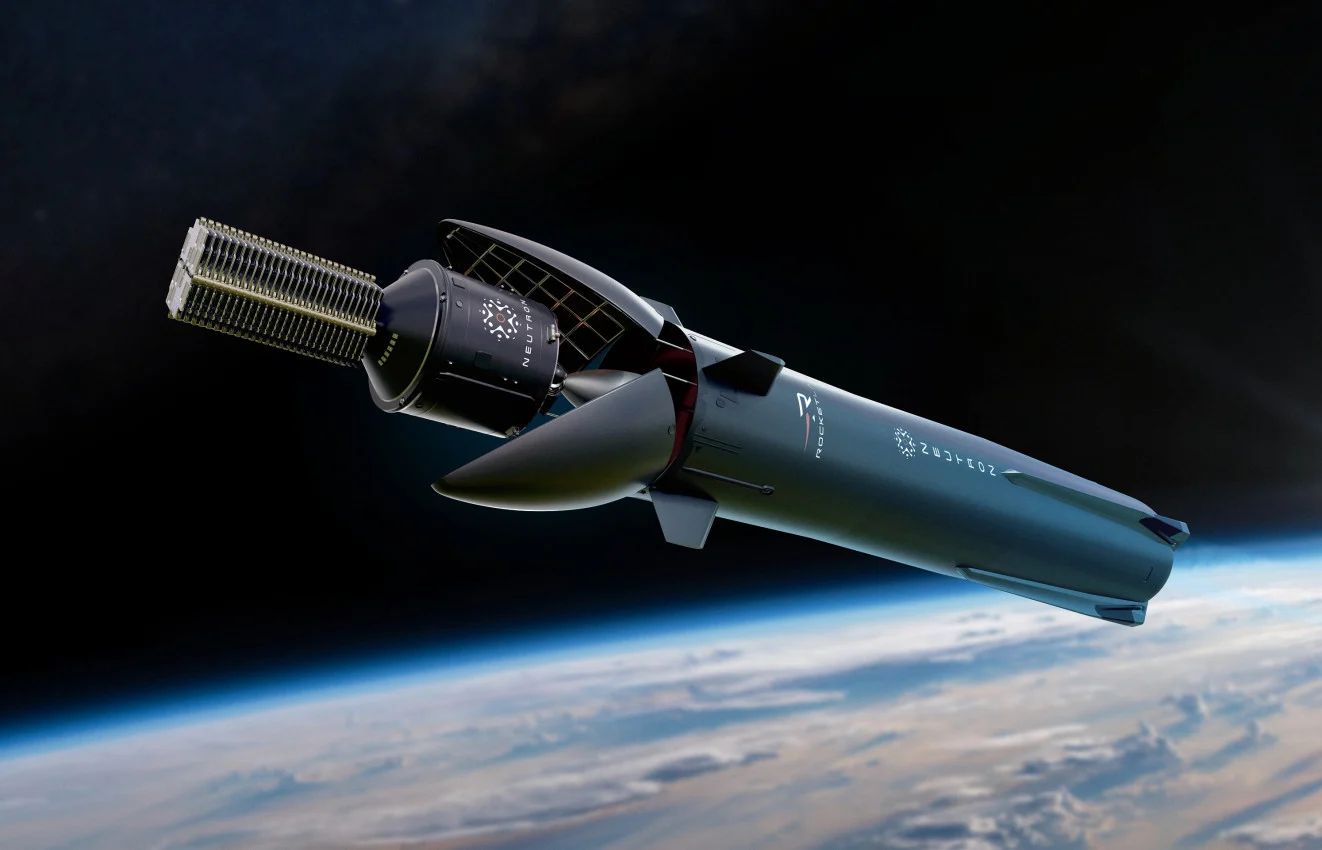
Rocket Lab Neutron is a reusable medium-lift orbital launch vehicle under development for constellation deployment, national-security missions, and deep-space payloads. Rocket Lab designed the vehicle around a reusable first stage, methane and liquid-oxygen propulsion, carbon-composite structures, and a captive payload fairing.
The current Neutron design is approximately 43 m tall and 7 m in maximum diameter, with a 5 m fairing diameter and a liftoff mass of about 480,000 kg. Rocket Lab states that the reusable vehicle is designed to place 13,000 kg into low Earth orbit.
Neutron remained in development in August 2026. Rocket Lab was targeting delivery of the first flight vehicle to Launch Complex 3 in Virginia in the fourth quarter of 2026, but warned that the opportunity to conduct the inaugural launch before the end of 2026 was narrowing and that the flight could slip into 2027.
Development
Rocket Lab announced Neutron on 1 March 2021 as a larger launch vehicle intended to complement the company's Electron rocket and serve the growing market for satellite constellations. The original concept was more conventional in appearance and was initially associated with a 2024 first-flight goal.
On 2 December 2021, Rocket Lab revealed a substantially revised architecture. The vehicle used a broad, tapered carbon-composite first stage and a reusable payload fairing that remained attached to the booster. The early revised concept used seven Archimedes engines on the first stage and one vacuum-optimized Archimedes engine on the upper stage. Rocket Lab said the design was being optimized for reuse rather than maximum engine performance.
In 2022, the program moved into hardware and infrastructure development. Rocket Lab selected the Mid-Atlantic Regional Spaceport at NASA's Wallops Flight Facility in Virginia for Neutron launches and began work on a nearby production complex. The company also opened an Archimedes engine test complex at NASA's Stennis Space Center in Mississippi. By September 2022, the first-stage engine count had increased from seven to nine and the Archimedes cycle had changed to oxygen-rich staged combustion. The fairing arrangement was also simplified.
During 2023, Rocket Lab built and tested second-stage hardware. Development updates described the first full-scale second-stage build and subsequent structural and cryogenic testing. Concept artwork released that year also showed refinements to the landing legs and the captive fairing, reflecting a shift toward downrange recovery on an offshore platform rather than relying only on return-to-launch-site recovery.
In 2024, Rocket Lab completed the first Archimedes development engine and conducted the engine's first hot-fire test. The company also reported hardware-in-the-loop testing of avionics, communications equipment, flight software, and guidance, navigation, and control functions. The first-flight schedule, however, moved beyond the original 2024 target.
Program infrastructure and customer commitments expanded in 2025. Rocket Lab completed Launch Complex 3 in Virginia and continued qualification work on the vehicle, including the stage structures, fairing, engines, and flight mechanisms. The company also developed an offshore recovery concept using a customized 120 m landing platform called Return On Investment. Commercial and U.S. government missions were booked for Neutron while the vehicle was still in development.
In January 2026, a tank built for the first Neutron vehicle ruptured during testing, creating another setback. In February, Rocket Lab projected the first launch for late 2026. By August, work was progressing toward final checkout and assembly of flight hardware, followed by integration at Launch Complex 3. Rocket Lab said delivery to the pad in the fourth quarter of 2026 remained the target, but emphasized that integrated stage testing, static-fire tests, and other pad work still had to be completed before launch. The company therefore warned that a first flight in 2027 had become possible. A detailed August 2026 schedule update was reported by SpaceNews.
Design
Neutron is a two-stage liquid-propellant orbital rocket with a reusable first stage and an expendable second stage. The current configuration uses carbon-composite primary structures, liquid oxygen and methane propellants, and Rocket Lab's Archimedes engines. The manufacturer's current overview is available on the Rocket Lab Neutron page.
Structure and stage arrangement
The first stage has a maximum diameter of 7 m and incorporates landing legs and aerodynamic control surfaces for recovery. The second stage is carried within the first stage's captive fairing volume and is suspended from the stage-separation plane. Both stages use carbon-composite structures intended to reduce structural mass.
Rocket Lab calls the reusable payload fairing Hungry Hippo. Instead of being discarded after ascent, the fairing remains attached to the first stage. It opens like a clamshell to release the second stage and payload, then closes before the booster re-enters the atmosphere. This arrangement is intended to eliminate separate fairing recovery and support faster reuse of the first stage.
Propulsion
The first stage is powered by nine sea-level Archimedes engines. Each engine uses liquid oxygen and methane in an oxygen-rich staged-combustion cycle and is rated by Rocket Lab at about 733 kN of thrust. The company gives a combined first-stage liftoff thrust of approximately 1.45 million lbf, or about 6.45 MN.
The second stage uses one vacuum-optimized Archimedes engine with an extended nozzle. Rocket Lab rates this engine at about 890 kN of vacuum thrust. The Archimedes family was designed for reuse and for operating at lower stress than very high-performance engines, reflecting the program's emphasis on repeatable operation and launch cadence.
Recovery system
Neutron's first stage is designed for propulsive landing after launch. Rocket Lab's current baseline calls for downrange recovery on Return On Investment, a modified offshore platform in the Atlantic Ocean. The platform is intended to use station-keeping thrusters and autonomous systems to secure the landed stage and return it for reuse.
Payload and missions
Rocket Lab lists a 5 m fairing diameter and a reusable-configuration payload capacity of 13,000 kg to low Earth orbit. Other program material also describes an expendable configuration capable of carrying up to 15,000 kg to low Earth orbit. Neutron is intended for satellite-constellation deployment, national-security payloads, and planetary missions. Rocket Lab has also discussed future uses such as cargo delivery and, eventually, human spaceflight, but these are planned capabilities rather than operational roles.
Program status
As of August 2026, Neutron had not yet flown. Rocket Lab was assembling flight hardware and preparing for integrated tests at Launch Complex 3. Remaining milestones included final vehicle integration, stage static-fire tests, a wet dress rehearsal, and regulatory approval before the inaugural mission.
Rocket Lab has announced commercial and government demand for the vehicle despite the schedule delays. A 2024 agreement covered two dedicated Neutron missions for a confidential satellite-constellation customer. In 2025, the U.S. Air Force Research Laboratory selected Neutron for a Rocket Cargo survivability experiment under the REGAL effort. In May 2026, Rocket Lab announced another confidential multi-launch agreement that included five Neutron launches planned between 2026 and 2029. In August 2026, the company also announced a mission for Kepler Communications planned no earlier than 2028.
Rocket Lab has described an initial launch-cadence plan of one, three, and five Neutron missions in the vehicle's first three years of operation, with higher cadence dependent on successful first-stage recovery and reuse. These figures are planning targets and had not been demonstrated by August 2026.
Variants
- Neutron reusable configuration: Baseline configuration with recovery of the first stage on an offshore landing platform. Rocket Lab lists a payload capacity of 13,000 kg to low Earth orbit.
- Neutron expendable configuration: Mission configuration in which first-stage recovery is not required. Published program data gives a payload capacity of up to 15,000 kg to low Earth orbit.
Specifications (Neutron reusable configuration)
General characteristics
- Type: Two-stage medium-lift orbital launch vehicle
- Manufacturer: Rocket Lab
- Status: In development as of August 2026
- Height: approximately 43 m (141 ft)
- Maximum diameter: 7 m (23 ft)
- Fairing diameter: 5 m (16.4 ft)
- Liftoff mass: approximately 480,000 kg
- Propellants: liquid oxygen and methane
- First-stage engines: 9 × Archimedes sea-level engines
- Second-stage engine: 1 × Archimedes Vacuum engine
- Launch site: Launch Complex 3, Mid-Atlantic Regional Spaceport, Wallops Island, Virginia
Performance
- Payload to low Earth orbit: 13,000 kg in the reusable configuration
- First-stage engine thrust: about 733 kN each
- Total first-stage liftoff thrust: about 6.45 MN (1.45 million lbf)
- Second-stage engine thrust: about 890 kN in vacuum
Related equipment
- Rocket Lab Electron: Rocket Lab's smaller operational orbital launch vehicle. Neutron was developed as a larger system while drawing on company experience with Electron technologies and launch operations.
 Argentina
 Armenia
 Australia
 Austria
 Austria-Hungary
 Belgium
 Brazil
 United Kingdom
 Brunei
 Bulgaria
 Canada
 Chile
Chile China
China Colonial America
 Colombia
 Confederate States
 Croatia
 Czech
Czech Denmark
 Egypt
Egypt Finland
 France
 Georgia
 Germany
 German Imperial
 Greece
 Holland
 Hungary
 India
India Indonesia
 Iran
Iran Iraq
Iraq Ireland
 Israel
 Italy
Italy Japan
Japan Japan (1940)
 Jordan
 Kingdom of Italy
 Malaysia
 Mexico
 Myanmar
 Nazi Germany
 Netherlands
 New Zealand
 North Korea
 Norway
 Pakistan
 Peru
Peru Philippines
 Poland
 Portugal
 Prussia
 Romania
 Russia
 Saudi Arabia
 Serbia
 Singapore
 Slovakia
 Slovenia
 South Africa
 South Korea
 Soviet Union
 Spain
Spain Sweden
 Switzerland
 Syria
Syria Taiwan
 Thailand
 Turkey
 UAE
UAE Ukraine
 Vietnam
 Yugoslavia