
History
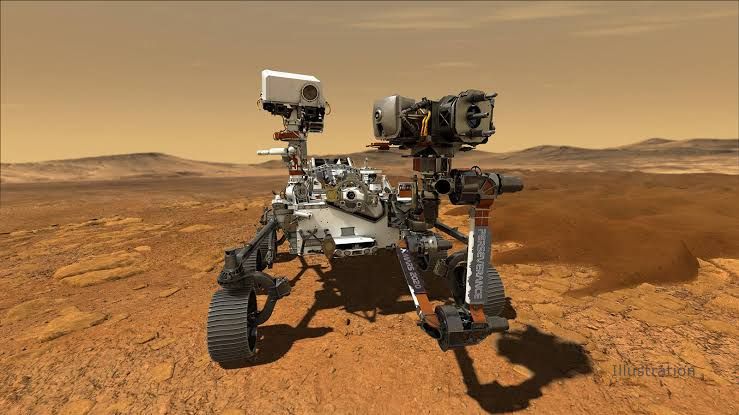
The Mars 2020 Perseverance rover is a NASA robotic vehicle built and managed by the Jet Propulsion Laboratory for surface exploration of Mars. It was developed to investigate the geology and past habitability of Jezero Crater, search for possible signs of ancient microbial life, collect and cache samples, and demonstrate technologies relevant to future human exploration.
Perseverance was launched on July 30, 2020 aboard an Atlas V 541 launch vehicle and landed in Jezero Crater on February 18, 2021. The rover is based on the general configuration of the earlier Curiosity rover but incorporates a new sampling and caching system, redesigned wheels, updated scientific instruments, autonomous navigation improvements, and technology demonstrations including MOXIE.
NASA lists Mars 2020 as an active mission. Perseverance has conducted successive science campaigns across the crater floor, delta, margin, and crater-rim terrain while collecting geological samples and making remote and contact observations. Official mission information is available from NASA Science.
Development
The program emerged from NASA planning for continued Mars exploration and sample return. The 2011 Planetary Science Decadal Survey identified the start of a Mars Sample Return campaign as a major planetary-science priority. Following the successful landing of Curiosity in 2012, NASA announced plans in December 2012 for another Mars rover mission with a 2020 launch target.
A NASA science definition team reported in 2013 that the rover should select and store a scientifically valuable set of samples in a returnable cache. NASA announced the mission's seven primary scientific instrument groups in July 2014. The rover ultimately incorporated both scientific instruments and engineering systems intended to support geological investigation, astrobiology, sample acquisition, environmental monitoring, autonomous driving, and technology demonstrations.
The rover design drew heavily on the Mars Science Laboratory architecture used for Curiosity. Perseverance retained a similar body plan, cruise and landing concepts, and radioisotope power system, while receiving stronger wheels and a substantially more elaborate sample-caching mechanism. The combination of larger instruments, the sampling system, and other changes increased rover mass to about 1,025 kg.
NASA announced the name Perseverance on March 5, 2020 after a nationwide student naming competition. The rover was launched from Cape Canaveral on July 30, 2020 and spent about 29 weeks in interplanetary flight before reaching Mars.
Landing and commissioning
Perseverance landed successfully in Jezero Crater on February 18, 2021. Its entry, descent, and landing sequence used a heat shield, parachute, powered descent stage, and sky-crane system. Terrain Relative Navigation compared images acquired during descent with stored surface maps so the spacecraft could adjust its trajectory and select a safer landing location.
The first approximately 100 sols after landing were used for commissioning the rover and the Ingenuity helicopter. Activities included deployment of the remote sensing mast and robotic arm, instrument health checks, initial drives, autonomous-navigation tests, operation of the MOXIE oxygen-production experiment, and deployment of Ingenuity. The first powered and controlled flight of Ingenuity took place in April 2021.
Design
Chassis and mobility
Perseverance is a six-wheeled rover approximately the size of a small car. The rover measures about 2.9 m long, 2.7 m wide, and 2.2 m high and has a dry mass of approximately 1,025 kg. Its aluminum wheels were redesigned after experience with wheel damage on Curiosity. Perseverance uses wheels approximately 52.5 cm in diameter with traction cleats and curved titanium spokes.
The rover incorporates autonomous navigation capabilities intended to permit faster movement through difficult terrain. Navigation cameras and hazard-avoidance cameras provide stereo imagery for driving and positioning, while the rover's onboard systems can evaluate terrain during autonomous traverses.
Robotic arm and sample caching
A 2.1 m robotic arm carries tools used for close examination, abrasion, drilling, and sample-related operations. The turret supports proximity-science instruments including SHERLOC, WATSON, and PIXL as well as components of the coring system.
The Sampling and Caching Subsystem can abrade rock surfaces, drill cylindrical cores, place material into sample tubes, document the contents, and hermetically seal filled tubes. A Sample Handling Assembly inside the rover transfers tubes and tools through the Adaptive Caching Assembly. The system includes stations for imaging, measuring sample volume, dispensing seals, and sealing sample tubes.
Perseverance was designed to collect scientifically documented samples representing the geological diversity of its exploration area. Some tubes have been deposited on the Martian surface as a backup cache, while others remain with the rover for possible retrieval by a future mission.
Power system
Electrical power is supplied by a Multi-Mission Radioisotope Thermoelectric Generator. The system uses heat from the radioactive decay of plutonium-238 oxide to generate electricity. Its output was approximately 110 W at launch and decreases gradually as the power source decays. The generator charges two lithium-ion batteries that support periods of higher electrical demand.
The radioisotope system permits operation independently of sunlight and therefore supports activities at night, during seasonal changes, and during dusty atmospheric conditions.
Computing and communications
The rover uses a radiation-hardened BAE Systems RAD750 computer based on the PowerPC 750 architecture. The cited configuration includes 128 MB of volatile memory, a 133 MHz processor, and access to 4 GB of NAND non-volatile storage. Flight software operates using VxWorks.
Perseverance carries multiple communications antennas. UHF communications are primarily used to exchange data with spacecraft orbiting Mars for relay to Earth, while X-band equipment provides an additional direct communications capability. Published specifications give a maximum UHF data rate of about 2 Mbit/s.
Scientific instruments
Perseverance carries seven principal scientific instrument groups supplemented by engineering cameras, microphones, and the sampling system. The payload was selected to study geology, mineralogy, chemistry, organics, subsurface structure, weather, and technologies for future exploration.
- Mastcam-Z: A pair of zoom-capable multispectral stereo cameras mounted on the remote sensing mast. They provide panoramic imaging, three-dimensional observations, video, and multispectral measurements. Their ability to record dynamic astronomical phenomena also enabled observations of Martian moon transits and eclipses.
- SuperCam: A remote-sensing instrument suite combining imaging, laser-induced breakdown spectroscopy, Raman spectroscopy, visible and near-infrared spectroscopy, time-resolved luminescence measurements, and a microphone for remote study of rocks and regolith.
- PIXL: The Planetary Instrument for X-ray Lithochemistry, a micro-X-ray fluorescence spectrometer mounted on the robotic arm for fine-scale elemental mapping of rocks.
- SHERLOC: Scanning Habitable Environments with Raman and Luminescence for Organics and Chemicals, an ultraviolet Raman and fluorescence instrument designed for fine-scale mineralogical and organic-compound investigations. It operates with the WATSON close-up imaging camera.
- RIMFAX: The Radar Imager for Mars' Subsurface Experiment, a ground-penetrating radar operating over approximately 150 to 1,200 MHz for investigating subsurface structure along the rover traverse.
- MEDA: The Mars Environmental Dynamics Analyzer, a suite of sensors measuring atmospheric and environmental parameters including temperature, pressure, humidity, wind, radiation, and airborne dust properties.
- MOXIE: The Mars Oxygen In-Situ Resource Utilization Experiment, a technology demonstrator that produced oxygen by processing carbon dioxide from the Martian atmosphere.
A detailed description of the rover's payload and campaign procedures is available in the JGR campaign study. A technical overview of the instruments is also provided by the German Aerospace Center.
Operational history
Jezero Crater exploration
Perseverance began its surface mission in Jezero Crater, a roughly 45 km-wide basin containing evidence of an ancient lake and river delta. The mission investigates rocks and sediments for information about the crater's geological history, former environments, and potential habitability.
Following commissioning, the rover's first main science campaign examined the Máaz and Séítah formations on the crater floor. Research published in 2023 reported that both formations were igneous. Séítah was interpreted as an olivine-rich cumulate formed from a slowly cooling melt or magma body, while Máaz was interpreted as a separate sequence likely associated with lava flows. Both showed evidence of later alteration by water. During this campaign, Perseverance traversed more than 5 km, created seven abrasion patches, and sealed nine samples plus a witness tube.
Subsequent exploration included the delta and other geological units within and around Jezero. NASA reports that the rover found evidence for a stable ancient lake, delta, and river system and studied volcanic rocks that had interacted with water. The mission has continued to collect rock and regolith cores for possible future return to Earth. NASA's current traverse information is published on the Perseverance location map.
Technology demonstrations
Perseverance carried the Ingenuity helicopter to Mars and provided communications support for the aircraft. Ingenuity completed the first powered and controlled flight of an aircraft on another planet in April 2021 and later continued beyond its original demonstration program before NASA retired it in January 2024 after its 72nd flight.
MOXIE demonstrated extraction of oxygen from the carbon-dioxide-rich Martian atmosphere. NASA later reported total oxygen production of 122 g during the experiment. The demonstration was intended to evaluate technology that could contribute to future life-support or propellant-production systems.
Scientific results and sample collection
Perseverance has documented volcanic, sedimentary, and water-altered rocks across Jezero. The scientific payload has been used from regional to microscopic scales: Mastcam-Z and SuperCam characterize distant targets, while PIXL and SHERLOC investigate fine-scale chemistry, mineralogy, and organic compounds at selected rocks. RIMFAX acquires subsurface radar measurements along the rover's route, and MEDA records atmospheric conditions.
In July 2024, the rover investigated a rock nicknamed Cheyava Falls. NASA later described the Sapphire Canyon sample collected from this rock as containing potential biosignatures. The findings do not establish that life existed on Mars; they identify features that could have biological or non-biological explanations and require additional evidence.
Perseverance has also collected rock, regolith, atmospheric, and witness samples in sealed tubes. The sample-return architecture has undergone later review and redesign because of cost and complexity, but the rover's sampling activity remains part of the mission's scientific record.
Astronomical observations
Mastcam-Z can be used to observe atmospheric and astronomical events in addition to surface geology. Perseverance has recorded transits of Mars' moons and other objects across the Sun from the Martian surface.
On August 13, 2026, Perseverance used its left Mastcam-Z camera to photograph a partial solar eclipse from Mars. The supplied report identified the object crossing the Sun as apparently Phobos, the larger of Mars' two moons. The observation illustrates the rover's ability to use its mast-mounted imaging system for time-dependent phenomena in the Martian sky.
Program status
NASA identifies Mars 2020 Perseverance as an active mission. The rover continues geological and environmental investigations, autonomous traverses, remote sensing, close-up analysis, and sample collection. Its route has extended from the interior of Jezero Crater toward and across crater-rim terrain.
The mission's continuing scientific goals remain focused on reconstructing the geological and environmental history of Jezero, evaluating past habitability, searching for potential biosignatures, and preserving carefully documented samples for possible future laboratory analysis on Earth.
Specifications (Mars 2020 Perseverance rover)
General characteristics
- Type: Robotic Mars rover
- Owner: NASA
- Manufacturer and mission management: Jet Propulsion Laboratory
- Dimensions: Approximately 2.9 m × 2.7 m × 2.2 m
- Dry mass: Approximately 1,025 kg
- Robotic arm length: Approximately 2.1 m
- Wheel diameter: Approximately 52.5 cm
Power and computing
- Power source: Multi-Mission Radioisotope Thermoelectric Generator
- Electrical output: Approximately 110 W at launch
- Energy storage: Two rechargeable lithium-ion batteries
- Main computer: BAE Systems RAD750 radiation-hardened computer
- Processor frequency: 133 MHz
- Volatile memory: 128 MB DRAM
- Non-volatile storage: 4 GB NAND memory
Communications
- UHF: Approximately 400 MHz, with published maximum data rate around 2 Mbit/s
- X band: Approximately 7–8 GHz
Primary payload
- Mastcam-Z: Zoom-capable multispectral stereo imaging system
- SuperCam: Remote imaging, spectroscopy, laser analysis, and acoustic instrument suite
- PIXL: X-ray fluorescence spectrometer for fine-scale elemental analysis
- SHERLOC: Ultraviolet Raman and fluorescence spectrometer with WATSON imaging
- RIMFAX: Ground-penetrating radar
- MEDA: Environmental and meteorological sensor suite
- MOXIE: Experimental oxygen-production system
Mission milestones
- Launch: July 30, 2020
- Launch vehicle: Atlas V 541
- Mars landing: February 18, 2021
- Landing site: Jezero Crater, Mars
Related equipment
- Curiosity: NASA Mars Science Laboratory rover whose architecture formed the basis for major elements of the Perseverance design.
- Ingenuity: Experimental Mars helicopter transported and deployed by Perseverance and supported by the rover during its flight campaign.
 Argentina
 Armenia
 Australia
 Austria
 Austria-Hungary
 Belgium
 Brazil
 United Kingdom
 Brunei
 Bulgaria
 Canada
 Chile
Chile China
China Colonial America
 Colombia
 Confederate States
 Croatia
 Czech
Czech Denmark
 Egypt
Egypt Finland
 France
 Georgia
 Germany
 German Imperial
 Greece
 Holland
 Hungary
 India
India Indonesia
 Iran
Iran Iraq
Iraq Ireland
 Israel
 Italy
Italy Japan
Japan Japan (1940)
 Jordan
 Kingdom of Italy
 Malaysia
 Mexico
 Myanmar
 Nazi Germany
 Netherlands
 New Zealand
 North Korea
 Norway
 Pakistan
 Peru
Peru Philippines
 Poland
 Portugal
 Prussia
 Romania
 Russia
 Saudi Arabia
 Serbia
 Singapore
 Slovakia
 Slovenia
 South Africa
 South Korea
 Soviet Union
 Spain
Spain Sweden
 Switzerland
 Syria
Syria Taiwan
 Thailand
 Turkey
 UAE
UAE Ukraine
 Vietnam
 Yugoslavia