History
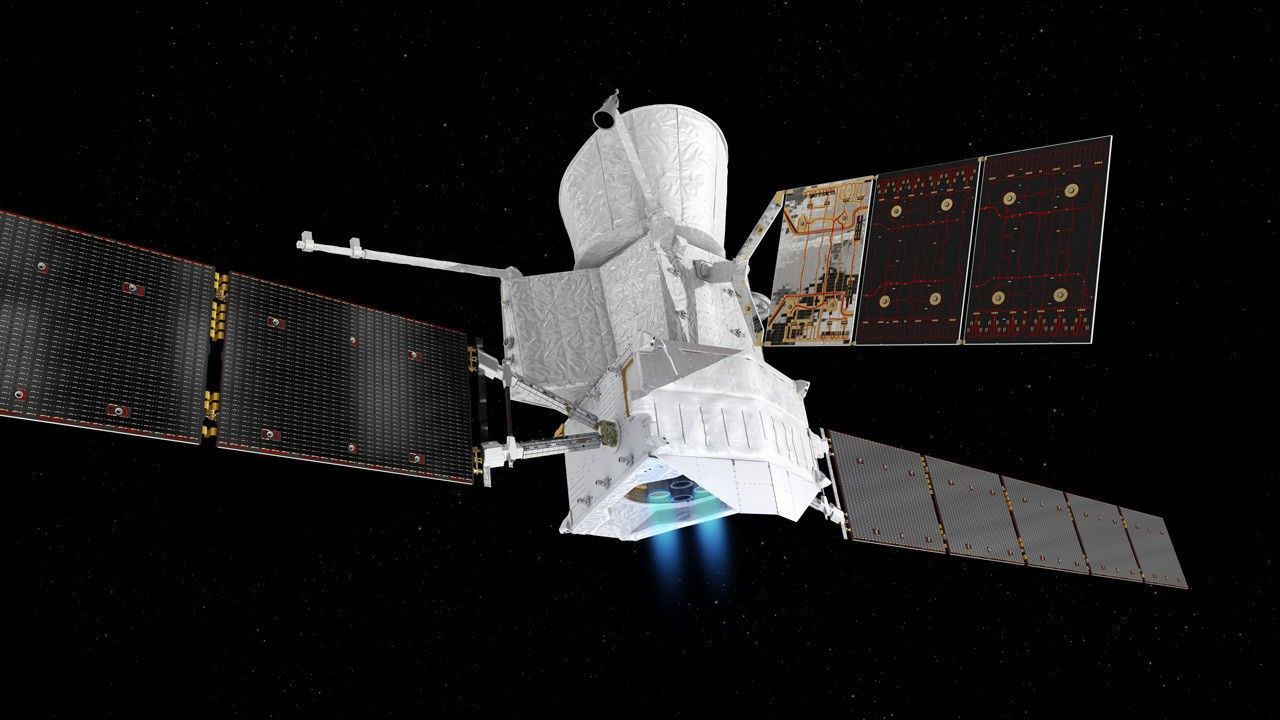
BepiColombo is a joint European Space Agency (ESA) and Japan Aerospace Exploration Agency (JAXA) mission to Mercury. The spacecraft system carries two science orbiters, ESA's Mercury Planetary Orbiter (MPO) and JAXA's Mercury Magnetospheric Orbiter, known as Mio, to investigate the planet and its surrounding environment.
The mission was launched on an Ariane 5 from the Guiana Space Centre on 20 October 2018. Its interplanetary transfer combined solar electric propulsion with gravity-assist flybys of Earth, Venus, and Mercury before the planned start of Mercury orbital operations in 2026.
BepiColombo is intended to characterize Mercury's interior, surface, exosphere, magnetic field, and magnetosphere. The two-orbiter arrangement permits complementary observations of the planet and its space environment from separate orbits.
Development
European studies of a Mercury mission date to the 1980s. A Mercury orbiter concept that eventually developed into BepiColombo was proposed to ESA in 1993. The mission was selected as a candidate in 1996 and approved in October 2000 within ESA's Horizon 2000 Plus science program.
The early concept included the Mercury Planetary Orbiter, Mercury Magnetospheric Orbiter, and a Mercury Surface Element. The surface element was removed from the baseline in November 2001 because of its effect on spacecraft mass, launch requirements, and program cost.
Japan had separately studied a spinning Mercury orbiter from the late 1990s. Cooperation with ESA was discussed in 1999 and formally proposed in 2000. Japanese participation was subsequently approved, and in November 2003 ESA approved the mission configuration combining the European MPO with the JAXA-provided Mercury Magnetospheric Orbiter. The Japanese spacecraft received the name Mio shortly before launch.
A common ESA-JAXA instrument selection process resulted in 16 instruments and instrument suites being selected and confirmed in 2005. During development, BepiColombo encountered major thermal, structural, mass, and propulsion challenges because equipment had to operate close to the Sun. A 2008 mass crisis, including unexpected solar-array degradation during testing, led to larger solar arrays, structural changes, and replacement of the planned Soyuz launch vehicle with Ariane 5. The redesigned mission received final approval in November 2009.
Further testing and technical problems caused additional delays. BepiColombo was finally launched from Kourou, French Guiana, on 20 October 2018. The ESA factsheet records a launch mass of about 4,100 kg and identifies Ariane 5 as the launch vehicle.
Interplanetary cruise
The Mercury Composite Spacecraft travelled with the two science orbiters attached to the Mercury Transfer Module (MTM), while the MMO Sunshield and Interface Structure protected Mio. The cruise architecture combined solar electric propulsion with planetary gravity assists to reduce the large velocity change required to enter orbit around Mercury.
The mission completed an Earth flyby in April 2020, Venus flybys in October 2020 and August 2021, and six Mercury flybys between October 2021 and January 2025. ESA's current schedule places separation of the MTM from the MPO-Mio combination on 3 September 2026 and Mercury orbit capture on 21 November 2026.
The two science orbiters are scheduled to remain connected during initial Mercury capture. MPO is then planned to release Mio on 9 or 10 December 2026. Mio is intended to enter a highly elliptical orbit ranging from about 590 km to 11,640 km altitude. MPO is scheduled to reach its final 480 km by 1,500 km orbit on 10 March 2027, with science operations planned to begin in April 2027. NASA likewise lists Mercury orbital insertion for 21 November 2026 on its BepiColombo mission page.
Design
BepiColombo was launched as a mechanically and electrically integrated spacecraft stack. Its principal elements are the Mercury Transfer Module, the Mercury Planetary Orbiter, the MMO Sunshield and Interface Structure, and Mio. During cruise the MTM supplies propulsion and electrical power for the combined spacecraft, while MPO and Mio become independent science orbiters after arrival at Mercury.
The spacecraft was designed for an unusually severe thermal environment. Near Mercury, solar irradiance can reach about 14.5 kW/m². Components exposed to the Sun and to infrared radiation from Mercury therefore use specialized thermal-control materials, high-temperature solar cells, reflective surfaces, insulation, radiators, and mechanisms designed for operation at high temperature. A detailed scientific and engineering overview is available in the Space Science Reviews mission paper.
Mercury Transfer Module
The MTM is the cruise-stage propulsion and power module at the bottom of the spacecraft stack. Two solar-array wings provide more than 40 m² of collecting area. At peak output the arrays can provide about 13 kW, of which about 10.3 kW is required by the solar electric propulsion system during thrusting.
The primary cruise propulsion system uses four 125 mN ion thrusters. They were designed to operate individually and later in pairs, providing most of the velocity change during the interplanetary transfer. The MTM also has a bipropellant system with 12 redundant 10 N thrusters for attitude control and navigation manoeuvres. Its solar arrays are rotated away from direct Sun pointing as necessary to limit operating temperature.
Mercury Planetary Orbiter
MPO is the ESA-led, three-axis-stabilized planetary science spacecraft. It carries 11 scientific instruments and instrument suites for studying Mercury's surface, interior, exosphere, magnetic field, and surrounding environment. ESA gives dimensions of about 2.4 m by 2.2 m by 1.7 m, with a 3.7 m radiator width and a deployed solar wing about 7.5 m long.
MPO uses a dedicated radiator and heat-pipe system because most spacecraft faces can receive direct sunlight during parts of the Mercury orbit. The solar array combines solar cells with optical solar reflectors and is continuously oriented to control its temperature while generating power. The average power demand during science operations is about 1,140 W.
Communications use high-, medium-, and low-gain antennas. The high-gain antenna supports X-band and Ka-band links and is also used for precise radio-science measurements. The attitude-control system uses four reaction wheels, redundant 5 N thrusters, star trackers, Sun sensors, and gyroscopes.
MPO's main orbital-manoeuvre propulsion system uses four redundant 22 N thrusters. A separate set of 5 N thrusters supports attitude control and reaction-wheel desaturation. The dual-mode propulsion arrangement uses hydrazine and Mixed Oxides of Nitrogen for bipropellant manoeuvres, while the smaller thrusters operate on hydrazine alone.
Mio
Mio, formerly designated the Mercury Magnetospheric Orbiter, is the JAXA-led spacecraft optimized for measurements of plasma, magnetic and electric fields, waves, sodium in Mercury's exosphere, and dust. After separation it is spin-stabilized at a nominal 15 revolutions per minute, corresponding to a four-second spin period.
Mio has an approximately octagonal body about 1.8 m in diameter and 1.1 m high. ESA and the detailed mission design paper give a mass of 255 kg, including nitrogen used for attitude control. NASA's current mission page lists 275 kg for the orbiter; the ESA value is used here because it agrees with the detailed spacecraft description.
Mio uses solar cells, optical solar reflectors, multilayer insulation, radiators, and heaters to manage the extreme thermal cycle near Mercury. A lithium-ion battery with a nominal capacity of 23.5 Ah supports operation during eclipses. Communications use an 80 cm high-gain X-band antenna and a medium-gain antenna.
Attitude control is provided by cold-gas nitrogen thrusters. The propulsion system has six approximately 0.4 N thrusters and carries about 3.69 kg of nitrogen, including residual propellant. Four tangential thrusters provide roll control and two axial thrusters are mounted on the bottom of the spacecraft.
MOSIF sunshield
The MMO Sunshield and Interface Structure, or MOSIF, connects Mio to MPO during the cruise phase and shields the Japanese orbiter from direct solar heating. It is a metal truss structure covered with multilayer insulation and specialized thermal finishes. Its conical geometry also provides clearance for Mio during spin-up and separation.
Program status
As of September 2026, BepiColombo is beginning its Mercury-arrival phase. The Mercury Transfer Module is scheduled to separate from MPO and Mio on 3 September 2026. The two science orbiters are then planned to enter Mercury orbit together on 21 November 2026.
Mio is scheduled for release into its operational orbit on 9 or 10 December 2026. MPO is planned to begin the manoeuvres leading to its lower science orbit about a week later and to reach that orbit on 10 March 2027. The main science phase is scheduled to begin in April 2027 and is planned to last at least one Earth year.
MPO is intended to produce global observations of Mercury at several wavelengths, investigate surface mineralogy and elemental composition, study the planet's interior, and examine its magnetic field and exosphere. Mio will concentrate on the magnetosphere and its interaction with the solar wind. The coordinated measurements are designed to provide simultaneous observations from two different locations around Mercury.
Components
- Mercury Planetary Orbiter (MPO): ESA science orbiter for global investigation of Mercury's surface, interior, exosphere, magnetic field, and environment.
- Mio / Mercury Magnetospheric Orbiter (MMO): JAXA spin-stabilized science orbiter for plasma, fields, waves, exosphere, and magnetospheric studies.
- Mercury Transfer Module (MTM): ESA cruise-stage spacecraft providing solar electric propulsion, electrical power, and attitude-control functions during the interplanetary transfer.
- MMO Sunshield and Interface Structure (MOSIF): Protective and structural element that shields Mio from direct solar radiation and connects it to MPO during cruise.
Scientific instruments
Mercury Planetary Orbiter
- BELA: BepiColombo Laser Altimeter.
- ISA: Italian Spring Accelerometer.
- MPO-MAG: Magnetometer.
- MERTIS: Mercury Radiometer and Thermal Infrared Spectrometer.
- MGNS: Mercury Gamma-ray and Neutron Spectrometer.
- MIXS: Mercury Imaging X-ray Spectrometer.
- MORE: Mercury Orbiter Radio Science Experiment.
- PHEBUS: Probing of Hermean Exosphere by Ultraviolet Spectroscopy.
- SERENA: Search for Exosphere Refilling and Emitted Neutral Abundances.
- SIMBIO-SYS: Spectrometers and Imagers for MPO BepiColombo Integrated Observatory.
- SIXS: Solar Intensity X-ray and Particle Spectrometer.
Mio
- MGF: Magnetometer.
- MPPE: Mercury Plasma Particle Experiment.
- PWI: Plasma Wave Instrument.
- MSASI: Mercury Sodium Atmosphere Spectral Imager.
- MDM: Mercury Dust Monitor.
Specifications (BepiColombo composite spacecraft)
General characteristics
- Mission type: Mercury flyby and orbital planetary exploration mission.
- Organizations: European Space Agency and Japan Aerospace Exploration Agency.
- Launch date: 20 October 2018.
- Launch vehicle: Ariane 5.
- Launch mass: about 4,100 kg, including about 1,400 kg of propellant.
- Composite dimensions: approximately 3.9 m by 3.6 m by 6.3 m.
- Composite span: approximately 30 m with the MTM solar wings deployed.
Mercury Planetary Orbiter
- Mass: 1,230 kg according to the ESA factsheet, including 85 kg of science payload; the detailed mission paper gives a nominal dry mass of 1,146.6 kg.
- Dimensions: approximately 2.4 m by 2.2 m by 1.7 m.
- Radiator width: 3.7 m.
- Solar wing length: about 7.5 m when deployed.
- Science instruments: 11 instruments and instrument suites.
- Science-orbit altitude: approximately 480 km by 1,500 km.
- Average science-phase power demand: about 1,140 W.
- Main orbital thrusters: four redundant 22 N bipropellant thrusters.
- Attitude-control thrusters: four redundant 5 N hydrazine thrusters.
Mio
- Mass: 255 kg according to ESA and the detailed mission design paper.
- Dimensions: approximately 1.8 m in diameter and 1.1 m high.
- Stabilization: spin stabilized.
- Nominal spin rate: 15 rpm.
- Science instruments: five instruments and instrument suites.
- Science-orbit altitude: approximately 590 km by 11,640 km.
- Battery: 23.5 Ah lithium-ion.
- Attitude-control propulsion: six approximately 0.4 N nitrogen cold-gas thrusters.
Mercury Transfer Module
- Solar-array area: more than 40 m² across two wings.
- Peak solar-array output: about 13 kW.
- Solar electric propulsion demand: about 10.3 kW during thrust mode.
- Electric propulsion: four 125 mN ion thrusters.
- Chemical propulsion: 12 redundant 10 N bipropellant thrusters.
Related equipment
- Mariner 10: NASA spacecraft that made three Mercury flybys in 1974 and 1975.
- MESSENGER: NASA Mercury orbiter that operated around the planet from 2011 until 2015 and provided observations that BepiColombo is designed to extend with complementary measurements.
 Argentina
 Armenia
 Australia
 Austria
 Austria-Hungary
 Belgium
 Brazil
 United Kingdom
 United States
 Brunei
 Bulgaria
 Canada
 Chile
Chile China
China Colonial America
 Colombia
 Confederate States
 Croatia
 Czech
Czech Denmark
 Egypt
Egypt Finland
 France
 Georgia
 Germany
 German Imperial
 Greece
 Holland
 Hungary
 India
India Indonesia
 Iran
Iran Iraq
Iraq Ireland
 Israel
 Italy
Italy Japan
Japan Japan (1940)
 Jordan
 Kingdom of Italy
 Malaysia
 Mexico
 Myanmar
 Nazi Germany
 Netherlands
 New Zealand
 North Korea
 Norway
 Pakistan
 Peru
Peru Philippines
 Poland
 Portugal
 Prussia
 Romania
 Russia
 Saudi Arabia
 Serbia
 Singapore
 Slovakia
 Slovenia
 South Africa
 South Korea
 Soviet Union
 Spain
Spain Sweden
 Switzerland
 Syria
Syria Taiwan
 Thailand
 Turkey
 UAE
UAE Ukraine
 Vietnam
 Yugoslavia