
History
Lockheed Martin Genesis was a NASA robotic spacecraft designed to collect particles from the solar wind and return the material to Earth for laboratory analysis. The mission was managed by NASA's Jet Propulsion Laboratory and formed part of the Discovery Program.
Genesis operated near the Sun-Earth L1 Lagrange point, outside most of Earth's magnetospheric influence, where its high-purity collectors were exposed directly to the solar wind. The returned material was intended to improve measurements of the Sun's elemental and isotopic composition and provide evidence about the formation of the Solar System.
The spacecraft successfully collected solar-wind material for more than two years. Its sample return capsule reached Earth on September 8, 2004, but a parachute deployment failure caused it to strike the Utah desert at high speed. Although many collectors shattered and were contaminated, significant portions of the samples were recovered and later produced important scientific results.
Development and mission objectives
The solar-wind sample-return concept was initially known as Suess-Urey during the early project phase in 1995 and was renamed Genesis in 1996 after Phase A. Lockheed Martin Astronautics in Denver developed and built the spacecraft and its Sample Return Capsule. Los Alamos National Laboratory developed the solar-wind concentrator and the electron and ion monitoring instruments, while NASA's Johnson Space Center supported clean-room assembly, sample recovery and long-term curation.
The primary scientific objective was to obtain precise measurements of solar isotopic and elemental abundances. Particular emphasis was placed on oxygen, nitrogen and noble-gas isotopes. Because the outer Sun is considered a useful indicator of material from the original solar nebula, samples of solar wind could be compared with meteorites, lunar material, planetary atmospheres and other Solar System samples. NASA describes the mission and its objectives on the Genesis mission page.
Launch and flight to L1
Genesis was launched from Cape Canaveral on August 8, 2001 aboard a Delta 7326-9.5 launch vehicle. Its launch mass was 636 kg. After initial parking-orbit operations, the launch vehicle sent the spacecraft toward the Sun-Earth L1 region.
Genesis reached L1 on November 16, 2001. A hydrazine-engine burn inserted it into a halo orbit around the Lagrange point. NASA states that the halo orbit had a radius of about 800,000 km and a period of approximately six months.
Solar-wind collection
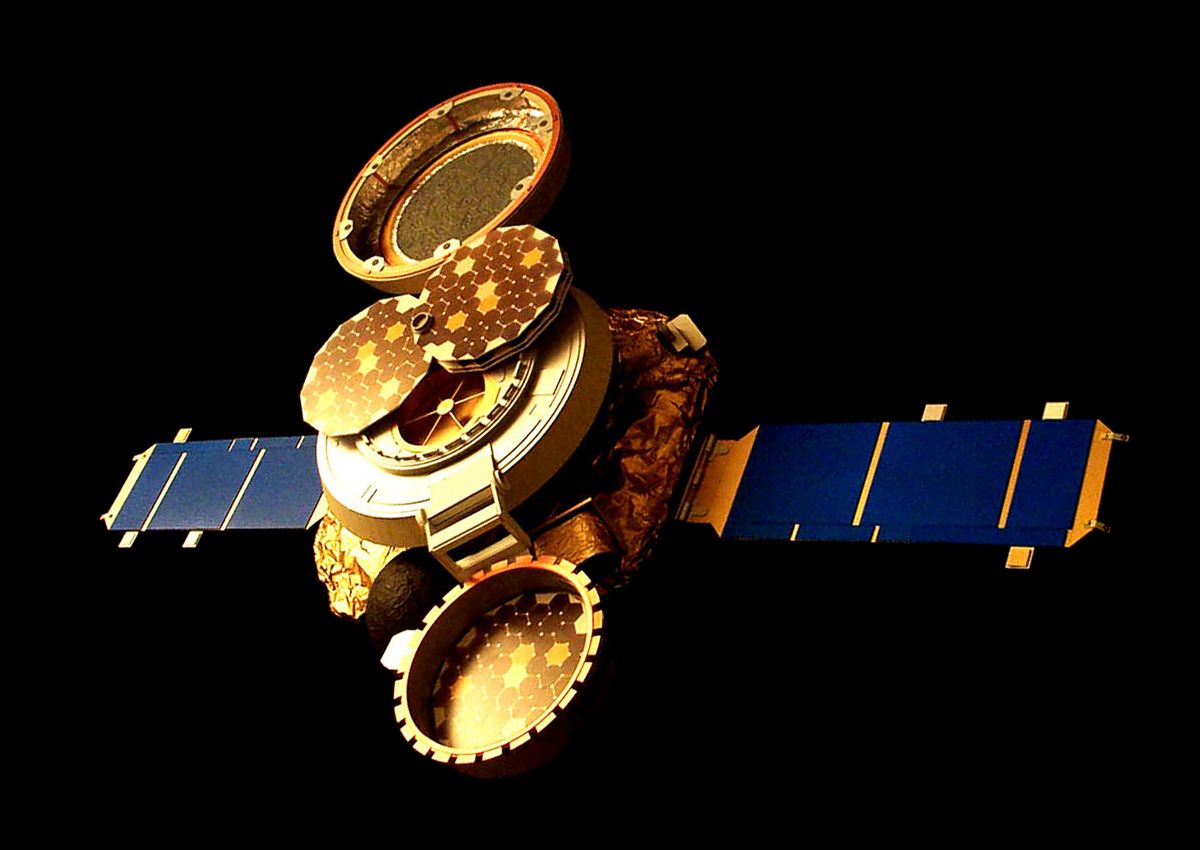
The first collector array was exposed at the end of November 2001. Genesis carried a stack of four circular collector trays. One was continuously exposed, while three others could be deployed according to the solar-wind regime detected by the spacecraft's monitoring instruments.
The collectors used extremely pure materials so that atoms and ions from the solar wind could become implanted in their surfaces with as little terrestrial contamination as possible. Materials included silicon and other specially selected substances suited to laboratory measurements of different elements and isotopes.
Genesis also carried an electrostatic solar-wind concentrator. It rejected most solar-wind protons and concentrated selected heavier ions, particularly elements such as carbon, nitrogen and oxygen, onto a smaller target. The concentration factor was greater than 20 for selected ions. An electron monitor and an ion monitor continuously characterized the solar wind so the spacecraft could identify fast wind, slow interstream wind and coronal-mass-ejection conditions.
All collector trays were stowed by April 1, 2004. The samples were sealed inside the science canister and Sample Return Capsule for the return to Earth. A detailed technical description of the spacecraft, payload and mission sequence is available from eoPortal.
Return to Earth
After leaving the L1 region, Genesis followed a trajectory that included passages near Earth and the Sun-Earth L2 region before approaching Earth for a daylight reentry. On September 8, 2004, the Sample Return Capsule separated from the main spacecraft several hours before atmospheric entry.
The planned recovery sequence called for a drogue parachute to deploy first, followed by a larger parafoil. Two specially equipped helicopters were positioned over the Utah Test and Training Range to capture the descending capsule in mid-air. This method was intended to prevent the delicate collector materials from striking the ground.
The drogue parachute did not deploy. The capsule entered the atmosphere normally but struck the ground in Utah at an estimated speed of about 311 km/h. The impact badly damaged the capsule, shattered many collector wafers and exposed parts of the scientific payload to terrestrial contamination.
Mishap investigation
NASA established a Mishap Investigation Board after the accident. The investigation determined that the direct cause was the inverted orientation of gravity-switch sensors in the Sample Return Capsule. The switches were intended to sense the deceleration profile during atmospheric entry and initiate deployment of the parachute system.
The sensors had been installed according to an erroneous design, so they could not generate the required deployment signal. The investigation found that the original design process introduced the inversion and that design review, verification and independent review processes failed to detect it. Both the primary and backup parachute deployment sequences were consequently affected.
Sample recovery and scientific results
The impact did not destroy the entire scientific payload. Recovery teams removed the damaged science canister and transferred surviving material through clean-room facilities. NASA later reported that teams cataloged about 15,000 fragments from the returned capsule and collector system.
Some collector pieces remained in sufficiently good condition for analysis, and solar-wind ions had been implanted beneath the collector surfaces before the crash. This allowed researchers to distinguish at least part of the extraterrestrial material from surface contamination. The recovered material was transferred to Johnson Space Center for curation and distribution to scientific laboratories.
Subsequent studies measured noble-gas isotopes and produced important results concerning oxygen and nitrogen in the Sun. Research based on Genesis samples found measurable isotopic differences between the Sun and terrestrial planetary material, providing new evidence about the chemical evolution of the early Solar System.
The main spacecraft bus did not reenter with the capsule. After capsule separation it maneuvered away from Earth and later entered a heliocentric trajectory. NASA maintained contact with the spacecraft until December 16, 2004.
Design
Genesis was a Sun-oriented, spin-stabilized spacecraft built around a structural platform carrying the Sample Return Capsule, scientific payload, propulsion, communications, electrical power and attitude-control systems. During operations near L1 it rotated once every 37.5 seconds.
Structure and power
The spacecraft platform used a lightweight composite truss with titanium fittings and a reinforced equipment deck. Two fixed solar-array wings provided electrical power. The deployed span across the solar arrays was approximately 7.9 m. Published mission data give an average end-of-life electrical output of about 202 W and a maximum output of approximately 254 W.
The spacecraft had a dry mass of approximately 494 kg and a launch mass of 636 kg. Electrical storage supported periods when the solar arrays could not alone meet mission requirements.
Propulsion and attitude control
Trajectory corrections and attitude changes were performed by a blowdown monopropellant propulsion system using hydrazine and helium pressurization. Genesis was spin stabilized during its science mission.
Attitude determination used Sun sensors and star trackers. These sensors provided information needed for spin-rate control, precession of the spacecraft's angular-momentum vector, trajectory corrections and contingency operations.
Communications and computing
Genesis communicated in S-band and carried low-gain and medium-gain antennas. Its command and data-handling system used redundant RAD6000-class processing hardware. The low data rate of the solar-wind monitoring instruments allowed science and engineering information to be returned through periodic Deep Space Network contacts.
Sample Return Capsule
The Sample Return Capsule was mounted above the spacecraft platform. It was approximately 1.5 m in diameter and 1.31 m high. Inside was a science canister approximately 0.97 m across that housed the collector system and solar-wind concentrator.
The reentry system incorporated a heat shield, backshell, drogue parachute and main parafoil. Under the planned sequence, atmospheric deceleration would trigger the drogue deployment system. The drogue would then initiate the sequence that released and deployed the larger parafoil for helicopter recovery.
Collector arrays
The collector system consisted of four trays containing multiple ultra-high-purity wafers. Many wafers were hexagonal and made primarily from silicon, while other collector materials included aluminum, gold and additional specialized substances selected for particular analytical requirements.
Solar-wind atoms and ions struck the exposed collector surfaces and became implanted into the material. Different arrays could be exposed for different solar-wind regimes, allowing scientists to compare samples from fast solar wind, slow solar wind and coronal-mass-ejection conditions.
Solar-wind concentrator
The concentrator used electrostatic fields to suppress much of the incoming proton component while transmitting and focusing selected heavier ions. A negatively biased internal region accelerated incoming ions, and an electrostatic mirror directed selected particles toward a small target. The system increased the density of important light elements on the target and improved the signal available for isotope analysis.
Solar-wind monitors
The Genesis Electron Monitor and Genesis Ion Monitor characterized local plasma conditions. Their measurements were processed onboard to determine the prevailing solar-wind regime and to control collector deployment and concentrator settings.
The electron instrument used an electrostatic analyzer and the spacecraft's rotation to sample a large portion of surrounding velocity space. The ion monitor used an electrostatic analyzer and microchannel-plate detector to track the solar-wind beam over changing flow conditions.
Operational history
- August 8, 2001: Genesis launched from Cape Canaveral aboard a Delta 7326-9.5.
- November 16, 2001: The spacecraft entered its halo orbit around the Sun-Earth L1 point.
- Late November 2001: Solar-wind collection began with exposure of the collector system.
- April 1, 2004: The collector trays were stowed after more than two years of sampling.
- September 8, 2004: The Sample Return Capsule reentered Earth's atmosphere. Its parachutes failed to deploy, and the capsule struck the Utah Test and Training Range at high speed.
- October 2004: Recovered scientific material was transferred for curation and analysis.
- December 16, 2004: NASA maintained its final contact with the surviving spacecraft bus after it had departed the Earth-return trajectory.
Specifications (Genesis)
General characteristics
- Type: Robotic solar-wind sample-return spacecraft
- Manufacturer: Lockheed Martin Astronautics
- Operator: NASA
- Mission management: NASA Jet Propulsion Laboratory
- Launch mass: 636 kg
- Dry mass: approximately 494 kg
- Solar-array span: approximately 7.9 m
- Sample Return Capsule diameter: approximately 1.5 m
- Sample Return Capsule height: approximately 1.31 m
- Science canister diameter: approximately 0.97 m
Spacecraft systems
- Stabilization: Spin stabilized
- Science-orbit spin rate: one revolution every 37.5 seconds
- Propulsion: Hydrazine monopropellant with helium pressurization
- Electrical power: Two fixed solar arrays
- Power output: approximately 202 W average at end of life; up to approximately 254 W maximum
- Communications: S-band
Mission
- Launch date: August 8, 2001
- Launch vehicle: Delta 7326-9.5
- Primary operating region: Halo orbit around the Sun-Earth L1 Lagrange point
- Science objective: Collection and terrestrial laboratory analysis of solar-wind material
- Sample-return date: September 8, 2004
Scientific payload
- Collector system: Four circular collector trays using ultra-high-purity materials
- Concentrator: Electrostatic solar-wind concentrator with greater than 20-fold concentration for selected ions
- Plasma instruments: Genesis Electron Monitor and Genesis Ion Monitor
 Argentina
 Armenia
 Australia
 Austria
 Austria-Hungary
 Belgium
 Brazil
 United Kingdom
 Brunei
 Bulgaria
 Canada
 Chile
Chile China
China Colonial America
 Colombia
 Confederate States
 Croatia
 Czech
Czech Denmark
 Egypt
Egypt Finland
 France
 Georgia
 Germany
 German Imperial
 Greece
 Holland
 Hungary
 India
India Indonesia
 Iran
Iran Iraq
Iraq Ireland
 Israel
 Italy
Italy Japan
Japan Japan (1940)
 Jordan
 Kingdom of Italy
 Malaysia
 Mexico
 Myanmar
 Nazi Germany
 Netherlands
 New Zealand
 North Korea
 Norway
 Pakistan
 Peru
Peru Philippines
 Poland
 Portugal
 Prussia
 Romania
 Russia
 Saudi Arabia
 Serbia
 Singapore
 Slovakia
 Slovenia
 South Africa
 South Korea
 Soviet Union
 Spain
Spain Sweden
 Switzerland
 Syria
Syria Taiwan
 Thailand
 Turkey
 UAE
UAE Ukraine
 Vietnam
 Yugoslavia