
History
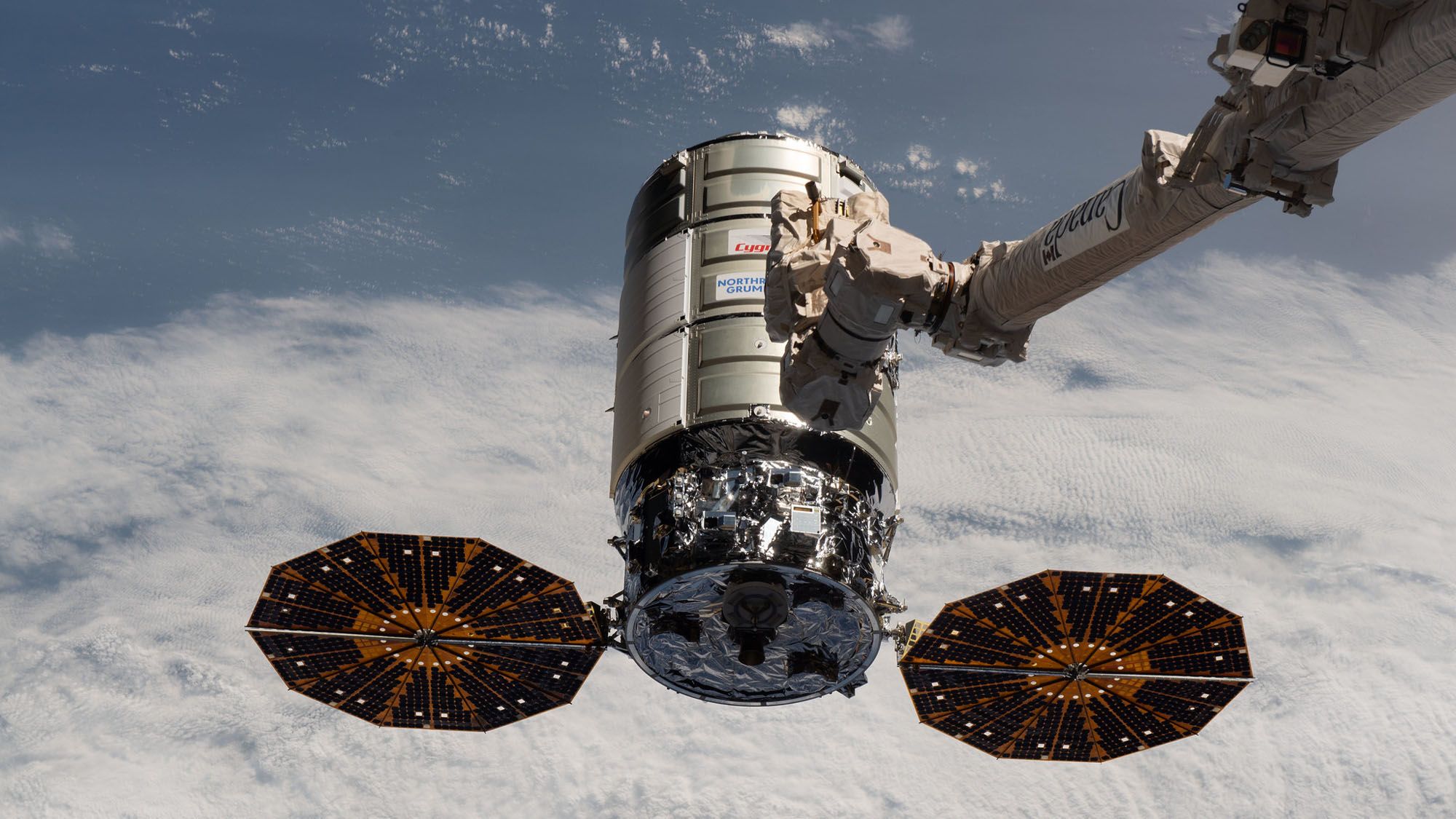
Northrop Grumman Cygnus is an American uncrewed cargo spacecraft developed to deliver pressurized supplies, equipment and scientific payloads to the International Space Station. The system originated at Orbital Sciences Corporation under NASA commercial cargo programs and is now operated by Northrop Grumman.
Cygnus combines a service module containing propulsion, power and avionics with a pressurized cargo module supplied by Thales Alenia Space. After completing its station mission, the expendable spacecraft can be loaded with waste and is deliberately destroyed during atmospheric reentry.
The spacecraft has evolved from the original Standard Cygnus through Enhanced Cygnus to the larger Cygnus XL. In addition to cargo transport, later missions have demonstrated secondary satellite deployment, free-flying research and International Space Station orbital reboost.
Development
NASA began the Commercial Orbital Transportation Services program in 2006 as part of its effort to develop commercial cargo transportation to the International Space Station. Orbital Sciences entered the second COTS competition with a spacecraft based largely on existing hardware. Its service module drew on Orbital satellite-bus technology, while the pressurized cargo module was developed by Thales Alenia Space using experience from pressurized modules built for earlier human-spaceflight programs.
Orbital Sciences received a COTS agreement in February 2008. The initial value was $170 million and was later increased to $288 million. On December 23, 2008, NASA awarded the company a $1.9 billion Commercial Resupply Services contract covering eight Cygnus flights intended to deliver as much as 20 tonnes of cargo to the station through 2016.
The first Cygnus demonstration spacecraft launched on September 18, 2013 aboard an Antares rocket and successfully completed a test rendezvous with the International Space Station. The first scheduled resupply mission reached the station in January 2014.
Growth of the program
The loss of the third Commercial Resupply Services Cygnus mission during an Antares launch failure in 2014 led to the temporary use of other launch vehicles. Cygnus missions subsequently flew on Atlas V in 2015 and 2016. The Enhanced Cygnus variant made its debut in December 2015 with a larger pressurized cargo module, increased propellant capacity and UltraFlex solar arrays.
Northrop Grumman acquired Orbital ATK in 2018 and assumed responsibility for Cygnus and Antares. Cygnus later demonstrated the ability to fly on additional launch vehicles. Falcon 9 launches supported Cygnus missions during the 2020s, including the larger Cygnus XL.
Cygnus XL entered service in 2025. On April 11, 2026, a Cygnus XL launched on a Falcon 9 for Northrop Grumman CRS-24 carrying more than 11,000 lb of scientific investigations and cargo. NASA described the spacecraft and mission in its CRS-24 mission update.
On August 27, 2026, while attached to the station's Unity module, a Cygnus XL fired its engines during a planned orbital reboost. The maneuver raised the International Space Station's orbit to support the planned rendezvous and docking profile of the Progress 96 resupply spacecraft. The event demonstrated Cygnus XL's role not only as a cargo carrier but also as a vehicle capable of contributing to station orbit maintenance.
Design
Cygnus consists of two principal sections: a Service Module and a Pressurized Cargo Module. The modular arrangement allowed Orbital Sciences and its successors to combine established spacecraft systems with a dedicated pressurized logistics carrier.
Service module
The Service Module contains avionics, electrical-power equipment and propulsion systems derived from Orbital spacecraft-bus technology including GEOStar and LEOStar heritage. Earlier Enhanced Cygnus data describe a 3.5 kW electrical system using two UltraFlex solar arrays. The propulsion system includes multiple small reaction-control thrusters and a larger main engine used for orbital maneuvers.
For the OA-7 configuration, published mission data listed 32 reaction-control engines rated at 7 lbf each and one 100 lbf main engine. The spacecraft used hydrazine-based propulsion, with mission documentation listing either a dual-mode hydrazine and MON-3 arrangement or hydrazine operation depending on configuration.
Pressurized cargo module
The Pressurized Cargo Module is manufactured by Thales Alenia Space in Turin, Italy. It carries crew supplies, station hardware, spare parts, research equipment and other pressurized cargo. The Standard Cygnus version provided about 18.9 cubic metres of pressurized volume and approximately 2,000 kg of payload capacity.
The Enhanced Cygnus introduced a stretched cargo module with approximately 27 cubic metres of pressurized volume. Published capacity values vary with configuration and mission assumptions. Mission-specific OA-7 data list 3,513 kg of total cargo capacity, while broader summaries commonly describe the Enhanced model as a spacecraft able to carry about 3.5 tonnes or somewhat more.
Cygnus XL further enlarged the cargo section. Published data describe approximately 36 cubic metres of pressurized volume and a payload capability around 5,000 kg. NASA's April 2026 CRS-24 mission report independently states that more than 11,000 lb of investigations and cargo were launched aboard Cygnus XL.
Rendezvous and berthing
Cygnus approaches the International Space Station under spacecraft and ground control. Earlier descriptions of its navigation system identify GPS and star trackers as part of the rendezvous process. Near the station, the vehicle is captured by the Canadarm2 robotic arm and moved to a Common Berthing Mechanism port. Cygnus missions have been berthed to ports on the Unity and Harmony modules.
The OA-7 mission illustrates the process. The spacecraft arrived at the station on April 22, 2017, where the crew grappled it with Canadarm2. Ground controllers then used the arm to position Cygnus at the underside of the Unity module, where electrically driven bolts completed the structural connection. NASA documented the OA-7 launch in its 2017 cargo mission release.
End of mission
Cygnus is expendable and does not return cargo intact to Earth. After supplies are unloaded, the spacecraft can be filled with station waste, obsolete equipment and other material designated for disposal. Following departure, it performs a controlled destructive atmospheric reentry over a remote ocean area.
This expendable mission phase has also been used for research that would be impractical aboard an occupied spacecraft. Empty Cygnus vehicles have hosted Spacecraft Fire Experiment tests, which studied flame growth in microgravity after departure from the station. Other missions have carried reentry data recorders and deployed CubeSats after undocking.
Operational history
Cygnus has served as one of the International Space Station's regular commercial cargo vehicles since 2013. Missions deliver food, crew supplies, scientific experiments, computer equipment, station hardware and other pressurized payloads. The spacecraft can remain attached to the station while its cargo is unloaded and waste is transferred aboard for disposal.
The OA-7 mission in 2017 demonstrated several secondary roles. The spacecraft launched aboard an Atlas V on April 18, reached the station four days later and delivered approximately 3,450 kg of cargo. After leaving the station, it hosted the Saffire-III combustion experiment, deployed four CubeSats and carried reentry data recorders. The mission concluded with destructive reentry on June 11, 2017.
Cygnus has also served as a platform for satellite deployment. During OA-7, the spacecraft raised its own orbit to approximately 481 km before releasing four Lemur-2 CubeSats. This allowed the satellites to begin operations from a higher orbit than would have been available through direct deployment from the station.
Later versions added International Space Station reboost capability. By 2026, Cygnus XL was being used to change the station's orbital altitude while berthed. The August 27, 2026 maneuver supported orbital planning for the arrival of Progress 96 and provided a practical demonstration of the enlarged spacecraft's ability to assist station orbit maintenance.
Variants
- Standard Cygnus Original production configuration with a pressurized cargo module providing about 18.9 cubic metres of volume and approximately 2,000 kg of cargo capacity.
- Enhanced Cygnus Enlarged version introduced in 2015 with a stretched pressurized cargo module, approximately 27 cubic metres of volume, increased cargo capacity, higher propellant load and UltraFlex solar arrays.
- Cygnus XL Further enlarged cargo configuration that entered service in 2025. Published data describe approximately 36 cubic metres of pressurized volume and cargo capacity around 5,000 kg.
- Unpressurized Cargo Module proposal Proposed configuration intended to replace the Pressurized Cargo Module with a carrier for external or unpressurized station hardware. It did not become an operational Cygnus variant.
- Return Cargo Module proposal Proposed configuration intended to give Cygnus the ability to return cargo to Earth. The operational spacecraft remained expendable and did not adopt this module.
Operators
- NASA Uses Cygnus under Commercial Resupply Services contracts for International Space Station logistics and associated research missions.
Specifications (Enhanced Cygnus, OA-7 configuration)
General characteristics
- Type: Uncrewed pressurized cargo spacecraft
- Pressurized cargo module diameter: 3.05 m
- Pressurized cargo module height: 5.1 m
- Service module height: 1.29 m
- Service module maximum diameter: 3.23 m
- Total cargo capacity: 3,513 kg
- Pressurized volume: 27 m³
- ISS interface: Common Berthing Mechanism, with robotic capture by Canadarm2
Power and propulsion
- Electrical power: 3.5 kW when sun-pointed
- Solar arrays: Two fixed-wing UltraFlex arrays
- Reaction-control engines: 32 × 7 lbf
- Main engine: 1 × 100 lbf
- Propellant: Hydrazine-based system, with mission documentation listing N2H4/MON-3 dual-mode or N2H4 operation
Specifications (Cygnus XL)
General characteristics
- Type: Enlarged uncrewed pressurized cargo spacecraft
- Length: 7.89 m
- Cargo capacity: Approximately 5,000 kg
- Pressurized volume: Approximately 36 m³
- ISS interface: Robotic capture and berthing to the International Space Station
Capabilities
- Primary mission: Pressurized International Space Station resupply
- Station support: Capable of performing orbital reboost maneuvers while berthed
- End of mission: Controlled destructive atmospheric reentry with station waste and discarded material aboard
 Argentina
 Armenia
 Australia
 Austria
 Austria-Hungary
 Belgium
 Brazil
 United Kingdom
 Brunei
 Bulgaria
 Canada
 Chile
Chile China
China Colonial America
 Colombia
 Confederate States
 Croatia
 Czech
Czech Denmark
 Egypt
Egypt Finland
 France
 Georgia
 Germany
 German Imperial
 Greece
 Holland
 Hungary
 India
India Indonesia
 Iran
Iran Iraq
Iraq Ireland
 Israel
 Italy
Italy Japan
Japan Japan (1940)
 Jordan
 Kingdom of Italy
 Malaysia
 Mexico
 Myanmar
 Nazi Germany
 Netherlands
 New Zealand
 North Korea
 Norway
 Pakistan
 Peru
Peru Philippines
 Poland
 Portugal
 Prussia
 Romania
 Russia
 Saudi Arabia
 Serbia
 Singapore
 Slovakia
 Slovenia
 South Africa
 South Korea
 Soviet Union
 Spain
Spain Sweden
 Switzerland
 Syria
Syria Taiwan
 Thailand
 Turkey
 UAE
UAE Ukraine
 Vietnam
 Yugoslavia