
History
Kaguya, originally designated SELENE for Selenological and Engineering Explorer, was a Japanese lunar exploration spacecraft operated by the Japan Aerospace Exploration Agency. Its main objectives were to investigate the Moon's origin and evolution, map its surface and gravity field, study the lunar environment, and demonstrate technologies for future lunar exploration.
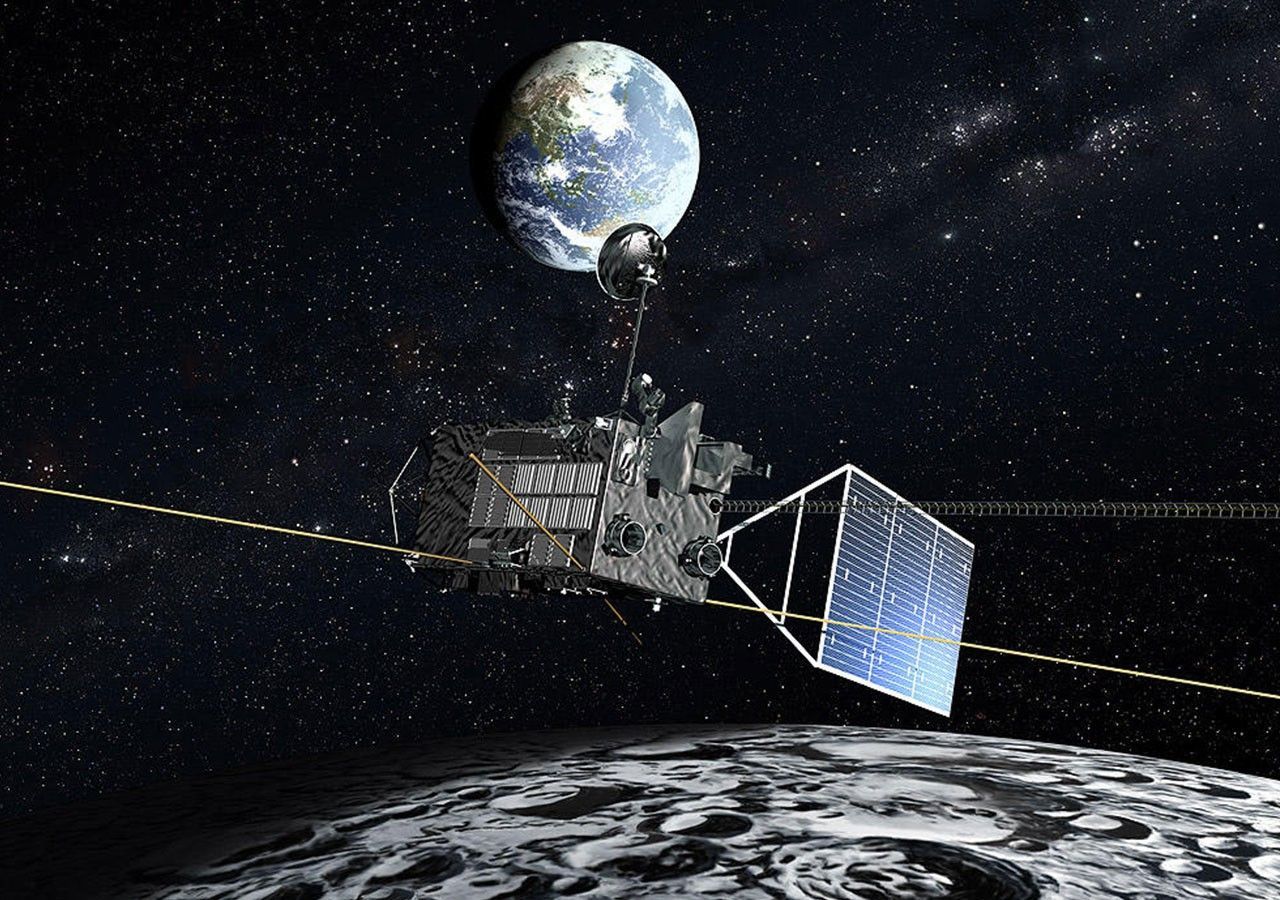
The mission comprised the Kaguya main orbiter and two small subsatellites, Okina and Ouna. Together they supported global topographic, mineralogical, geological, gravitational, magnetic, plasma, and radio-science observations of the Moon. High-definition television cameras also returned detailed imagery of the lunar surface and Earth above the lunar horizon.
Kaguya was launched from Tanegashima Space Center aboard an H-IIA launch vehicle at 01:31:01 UT on September 14, 2007. The mission entered lunar orbit in October 2007, completed its primary observations in 2008, and ended when the main orbiter was deliberately impacted on the Moon on June 10, 2009.
The spacecraft had originally been scheduled for launch in 2003, but the mission was delayed until 2007 following problems associated with the H-II launch vehicle program. After launch, SELENE received the name Kaguya through a public naming process. The name refers to Kaguya-hime, the lunar princess in the Japanese tale The Tale of the Bamboo Cutter.
After separation from the H-IIA, Kaguya performed a series of Earth-orbit and trajectory-correction maneuvers. It entered an initial polar lunar orbit of approximately 101 by 11,741 km on October 3, 2007. Further maneuvers progressively lowered the orbit toward the approximately 100 km polar observation orbit used for the main science program.
The relay satellite Okina was released on October 9, 2007, followed by the VRAD satellite Ouna on October 12. Kaguya reached its operational near-circular polar orbit by October 19, and normal orbital operations began on October 20. Deployment of major instruments, including the magnetometer boom and radar sounder antennas, continued through the end of October. The nominal science phase began on December 21, 2007.
By the end of the nominal mission in October 2008, Kaguya had observed more than 95 percent of the lunar surface. The mission was extended, and the spacecraft continued observations from progressively lower orbits. A reaction-wheel problem shortened the planned extended phase. Kaguya's orbital altitude was lowered to about 50 km from February 1, 2009, and its perilune was reduced to approximately 10-30 km from April 16.
Okina impacted the Moon on February 12, 2009. The Kaguya main orbiter continued operating until June 10, 2009, when it was deliberately directed into the lunar surface at 18:25 UT near 65.5 degrees south latitude and 80.4 degrees east longitude. The primary mission chronology and final impact are documented by JAXA ISAS and NASA Science.
Design
Main spacecraft
The Kaguya main orbiter had a box-shaped spacecraft bus measuring approximately 2.1 m by 2.1 m by 4.8 m. A single solar-array wing supplied electrical power, while a 1.3 m high-gain antenna supported communications with Earth. A 12 m magnetometer boom and long antennas for the Lunar Radar Sounder extended away from the main spacecraft during science operations.
The complete launch stack, including the main orbiter, propellant, Okina, and Ouna, had a mass of about 2,900 kg. The main orbiter itself had a mass of approximately 1,984 kg according to published mission descriptions.
Power and communications
The solar array covered approximately 22 square metres and used gallium-arsenide/germanium cells capable of producing up to about 3,486 W. Electrical energy was stored in four 50 V, 35 Ah nickel-hydrogen batteries.
Kaguya communicated through S-band and X-band systems. Its high-gain antenna supported an X-band downlink of up to 10 Mbit/s to a 60 m ground antenna. The spacecraft also carried S-band communications equipment and approximately 10 GB of onboard data-recording capacity.
Propulsion and attitude control
The propulsion module used a 500 N bipropellant main engine burning nitrogen tetroxide and hydrazine. Twelve 20 N bipropellant thrusters provided orbit-maintenance and attitude-control functions, while eight 1 N monopropellant thrusters supported roll control.
The main orbiter was three-axis stabilized. Its attitude-control system used Sun sensors, inertial measurement units, star trackers, reaction wheels, and thrusters. This arrangement supported accurate pointing of imaging, spectroscopy, radar, altimetry, and other scientific instruments.
Scientific instruments
The Kaguya mission used a broad instrument suite to examine lunar composition, mineralogy, topography, subsurface structure, magnetic fields, particles, plasma, gravity, and the surrounding space environment. The mission's scientific and observation systems included:
- X-ray Spectrometer: measured elemental composition using lunar X-ray fluorescence.
- Gamma-ray Spectrometer: measured gamma-ray spectra to investigate elemental abundances.
- Multiband Imager: mapped mineral distribution using visible and near-infrared imaging.
- Spectral Profiler: measured continuous visible and near-infrared spectra of the lunar surface.
- Terrain Camera: obtained high-resolution stereo images for terrain mapping.
- Lunar Radar Sounder: investigated subsurface structures in the lunar crust.
- Laser Altimeter: measured spacecraft-to-surface range for global topographic mapping.
- Lunar Magnetometer: measured magnetic fields around the Moon and lunar crustal magnetization.
- Charged Particle Spectrometer: measured charged particles and radiation around the Moon.
- Plasma Energy Angle and Composition Experiment: investigated low-energy electrons and ions.
- Radio Science Experiment: used radio propagation measurements to investigate the lunar environment.
- Upper Atmosphere and Plasma Imager: observed Earth's magnetosphere and ionosphere from lunar distance.
- RSAT: used four-way Doppler measurements through the relay satellite to improve knowledge of the lunar far-side gravity field.
- VRAD: used differential very-long-baseline interferometry to determine precise subsatellite orbits and support gravity measurements.
- High Definition Television: recorded high-definition images and video of Earth and the Moon.
The Laser Altimeter operated at a wavelength of 1,064 nm and had a ranging accuracy of about 5 m. Its planned operating range was 50-150 km. JAXA described the instrument as a means of producing a global, accurate lunar topographic map. Detailed instrument information is available from the JAXA Kaguya LALT page.
Mission elements
Okina relay satellite
Okina, originally designated Rstar, was the mission's relay satellite. It was a small spin-stabilized spacecraft of approximately 50 kg. Its role was to relay radio signals between Earth and the main orbiter when Kaguya passed behind the Moon, enabling four-way Doppler measurements of the lunar far-side gravity field. After release, Okina occupied an elliptical polar orbit of roughly 115 by 2,399 km. It impacted the Moon on February 12, 2009.
Ouna VRAD satellite
Ouna, originally designated Vstar, was the VRAD subsatellite. It was similar in size and mass to Okina and was also spin-stabilized. Its radio sources supported differential very-long-baseline interferometry from Earth, allowing precise orbit determination for gravity-field studies. After release, it operated in an elliptical polar orbit of roughly 127 by 795 km.
Operational history
Kaguya's principal science program surveyed the Moon from a near-polar orbit at approximately 100 km altitude. The mission gathered data on elemental abundance, minerals, topography, geology, gravity, magnetic fields, charged particles, plasma, and the lunar space environment.
The Terrain Camera and Laser Altimeter contributed to detailed global mapping of lunar topography. By April 2008, the laser altimeter had accumulated sufficient observations for a global topographic model. The mission also provided improved measurements of gravity variations on both the near and far sides of the Moon through coordinated Doppler and VLBI observations involving the main orbiter and the subsatellites.
Kaguya's high-definition television system recorded high-definition images of the Moon in October 2007. On November 7, it recorded Earth rising above the lunar horizon, producing the first such high-definition footage from lunar orbit. The mission also made the first optical observation of the permanently shadowed interior of Shackleton Crater near the lunar south pole.
The combination of laser altimetry, stereo imaging, spectroscopy, radar sounding, gravity measurements, and plasma observations made Kaguya a broad lunar geoscience mission rather than a single-purpose mapping spacecraft. Its data were intended both to improve understanding of lunar origin and evolution and to support future lunar exploration technology.
Specifications (Kaguya main orbiter)
General characteristics
- Type: unmanned lunar orbiter
- Program designation: SELENE, Selenological and Engineering Explorer
- Mission organization: Japan Aerospace Exploration Agency
- Launch date: September 14, 2007 at 01:31:01 UT
- Launch vehicle: H-IIA
- Launch site: Tanegashima Space Center, Japan
- Main orbiter dimensions: approximately 2.1 m by 2.1 m by 4.8 m
- Main orbiter mass: approximately 1,984 kg
- Total launch mass: approximately 2,900 kg including the main orbiter, propellant, and two subsatellites
- Attitude control: three-axis stabilized
- Nominal observation orbit: approximately 100 km circular polar orbit
- Orbital inclination: approximately 90 degrees
Power and communications
- Solar-array area: approximately 22 square metres
- Maximum solar-array output: approximately 3,486 W
- Battery system: four 50 V, 35 Ah nickel-hydrogen batteries
- Communications: S-band and X-band
- Maximum X-band downlink rate: approximately 10 Mbit/s
- Onboard data storage: approximately 10 GB
Propulsion
- Main engine thrust: 500 N
- Main-engine propellants: nitrogen tetroxide and hydrazine
- Orbit and attitude thrusters: twelve 20 N bipropellant thrusters
- Roll-control thrusters: eight 1 N monopropellant thrusters
Related equipment
Japan's earlier Hiten mission, launched in 1990, conducted multiple lunar flybys and released the Hagoromo probe near the Moon. Hiten primarily demonstrated technology for later lunar missions, while Kaguya used a dedicated lunar-orbiting spacecraft and a substantially broader scientific instrument suite for systematic global observations.
 Argentina
 Armenia
 Australia
 Austria
 Austria-Hungary
 Belgium
 Brazil
 United Kingdom
 United States
 Brunei
 Bulgaria
 Canada
 Chile
Chile China
China Colonial America
 Colombia
 Confederate States
 Croatia
 Czech
Czech Denmark
 Egypt
Egypt Finland
 France
 Georgia
 Germany
 German Imperial
 Greece
 Holland
 Hungary
 India
India Indonesia
 Iran
Iran Iraq
Iraq Ireland
 Israel
 Italy
Italy Japan (1940)
 Jordan
 Kingdom of Italy
 Malaysia
 Mexico
 Myanmar
 Nazi Germany
 Netherlands
 New Zealand
 North Korea
 Norway
 Pakistan
 Peru
Peru Philippines
 Poland
 Portugal
 Prussia
 Romania
 Russia
 Saudi Arabia
 Serbia
 Singapore
 Slovakia
 Slovenia
 South Africa
 South Korea
 Soviet Union
 Spain
Spain Sweden
 Switzerland
 Syria
Syria Taiwan
 Thailand
 Turkey
 UAE
UAE Ukraine
 Vietnam
 Yugoslavia