History
The SpaceX Starlink ground station is terrestrial communications infrastructure that connects the Starlink satellite network with the conventional internet. It receives data from Starlink satellites, transfers that traffic to high-capacity terrestrial networks, and sends return traffic back toward satellites serving user terminals.
Ground stations, also described as gateways or earth stations, form the terrestrial part of the Starlink architecture. They are normally positioned where reliable electrical power and high-capacity fiber connections are available, allowing satellite traffic to enter or leave the global internet.
Later Starlink satellites use inter-satellite laser links that can relay data between spacecraft before it reaches a ground gateway. This reduces the requirement for every satellite handling user traffic to maintain a direct connection with a nearby ground station, although terrestrial gateways remain necessary for access to conventional internet infrastructure.
Development and deployment
By May 2020, Starlink ground infrastructure was represented in United States earth-station authorization filings. The ground network subsequently expanded internationally as Starlink service reached additional regions and required terrestrial gateways with suitable fiber connectivity, power, regulatory approval, and geographic coverage.
Ground stations are distributed so that satellites can reach suitable terrestrial gateways while serving moving coverage areas. Facilities are commonly placed near major fiber routes and may be located in rural or semi-rural areas where sufficient land is available and radio-frequency interference can be limited.
Design
Network role
A Starlink ground station acts as a gateway between satellites in low Earth orbit and terrestrial internet infrastructure. In a basic connection path, a user's Starlink terminal sends data to a satellite. The satellite transfers the traffic to an available ground station, which passes it through a high-speed fiber connection toward the destination network. Return data follows the reverse path through the gateway and satellite network to the user terminal.
The constant movement of Starlink satellites requires connections to be handed between spacecraft as they pass through different areas of coverage. The distributed ground network provides terrestrial connection points for this changing satellite geometry. Inter-satellite laser links can also move traffic between satellites before it is delivered to a suitable gateway.
Antennas and site layout
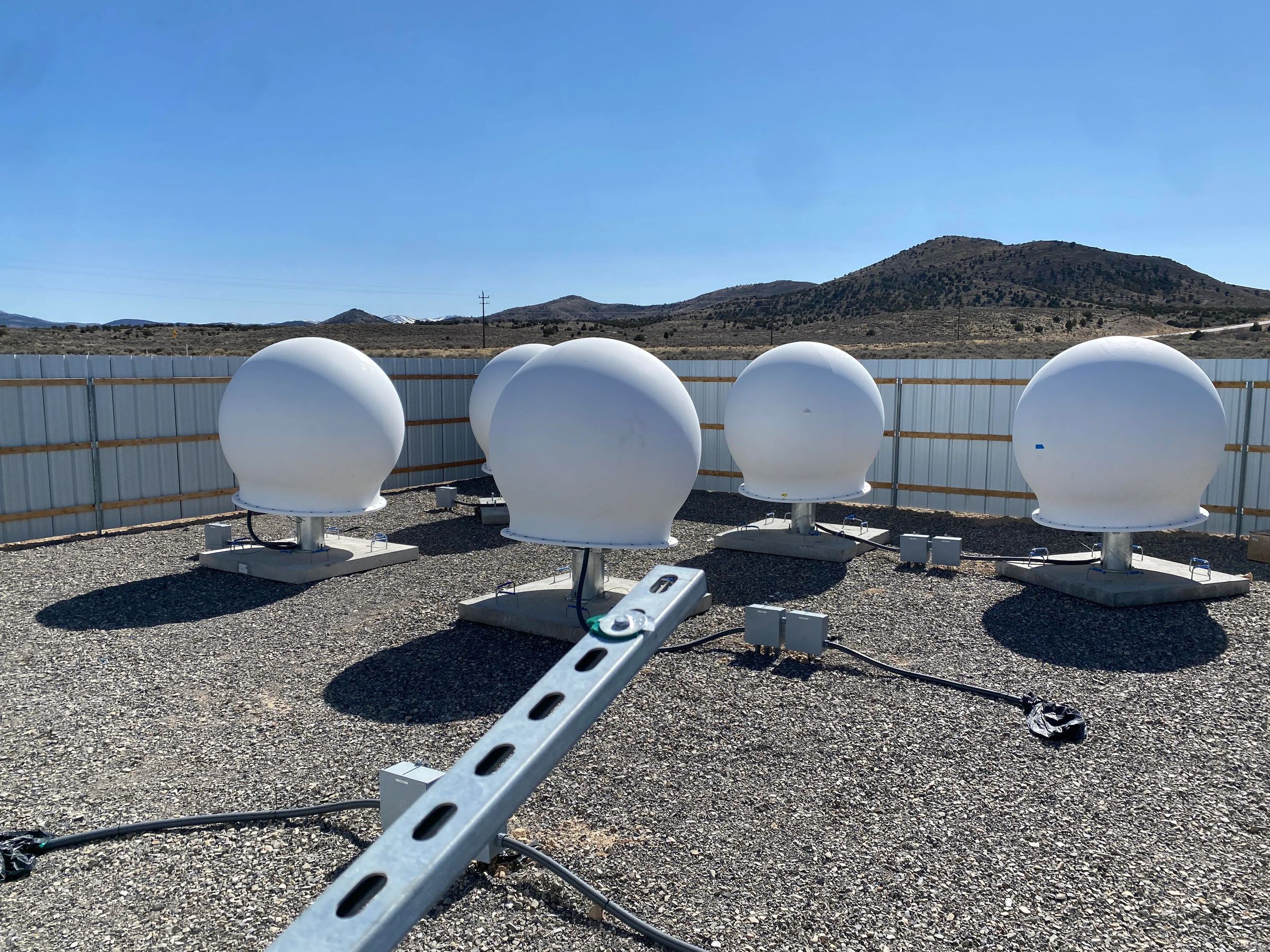
A typical Starlink ground station contains multiple antennas. At many sites the antennas are protected by white radomes, which shield the equipment from rain, snow, and wind while allowing radio signals to pass through. Individual radomes can be approximately 4.6 m across, and several may be installed at one site so that different satellites can be supported as the constellation moves overhead.
The antenna equipment is accompanied by networking, electrical, cooling, and other support systems. Ground facilities require high-bandwidth terrestrial connectivity, normally through fiber-optic infrastructure linking the site with the wider internet.
Power supply
Ground stations require a stable electrical supply for antennas, networking equipment, cooling, and associated systems. Sites can use backup generators or battery systems to maintain service during disruptions to normal power. The Starlink facility at Wola Krobowska in Poland included a generator as part of its supporting infrastructure.
Operational history
On the evening of 23 September 2026, a fire damaged infrastructure at a Starlink ground station in Wola Krobowska in Poland's Masovian Voivodeship. The fire began in an electrical distribution cabinet connected to the station's antennas, and the site's power generator was also damaged.
Investigators found a bottle containing flammable liquid near the burned distribution cabinet. Polish police and the Internal Security Agency investigated the incident, with deliberate arson and possible sabotage treated as working hypotheses. At that stage, authorities had not announced a suspect and had not officially attributed the incident to Russia.
The Wola Krobowska installation formed part of Starlink infrastructure serving Central and Eastern Europe and was operated by the Polish state telecommunications company Exatel. Polish authorities stated that damage to the facility could have disrupted internet connectivity used by institutions in the region, including Ukrainian military users.
Specifications (Starlink ground station)
General characteristics
- Type: Terrestrial satellite communications gateway
- Primary function: Transfer of data between Starlink satellites and terrestrial internet infrastructure
- Terrestrial backhaul: High-capacity fiber-optic connection
- Antenna arrangement: Multiple satellite communications antennas may be installed at one site
- Antenna protection: Radomes are used at many facilities to protect antennas from weather
- Radome size: Individual structures can be approximately 4.6 m across
- Power: Stable electrical supply with backup generators or battery systems possible
Network operation
- Satellite connection: Exchanges traffic with Starlink satellites passing within suitable communication geometry
- Internet connection: Routes satellite traffic into and out of terrestrial internet networks
- Network resilience: Inter-satellite laser links can route traffic between Starlink satellites before it reaches a terrestrial gateway
 Argentina
 Armenia
 Australia
 Austria
 Austria-Hungary
 Belgium
 Brazil
 United Kingdom
 United States
 Brunei
 Bulgaria
 Canada
 Chile
Chile China
China Colonial America
 Colombia
 Confederate States
 Croatia
 Czech
Czech Denmark
 Egypt
Egypt Finland
 France
 Georgia
 Germany
 German Imperial
 Greece
 Holland
 Hungary
 India
India Indonesia
 Iran
Iran Iraq
Iraq Ireland
 Israel
 Italy
Italy Japan
Japan Japan (1940)
 Jordan
 Kingdom of Italy
 Malaysia
 Mexico
 Myanmar
 Nazi Germany
 Netherlands
 New Zealand
 North Korea
 Norway
 Pakistan
 Peru
Peru Philippines
 Poland
 Portugal
 Prussia
 Romania
 Russia
 Saudi Arabia
 Serbia
 Singapore
 Slovakia
 Slovenia
 South Africa
 South Korea
 Soviet Union
 Spain
Spain Sweden
 Switzerland
 Syria
Syria Taiwan
 Thailand
 Turkey
 UAE
UAE Ukraine
 Vietnam
 Yugoslavia