
History
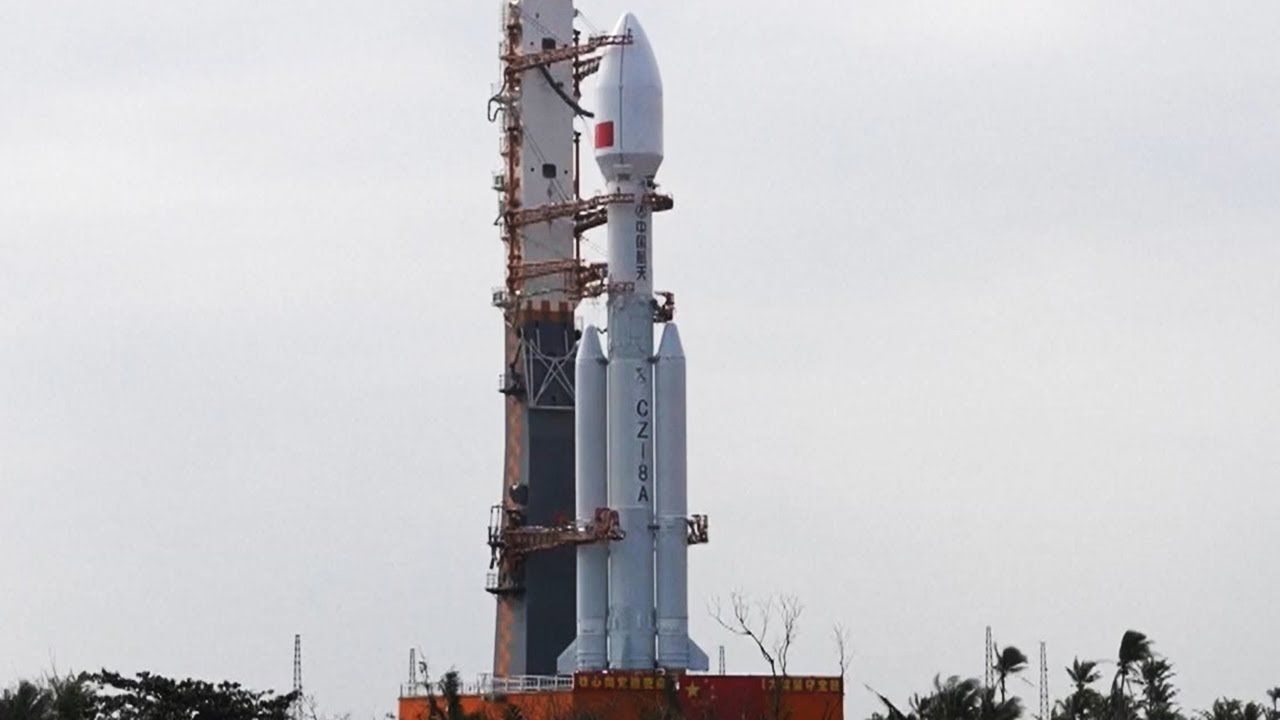
The Long March 8A is a Chinese two-stage orbital launch vehicle developed by the China Academy of Launch Vehicle Technology as an upgraded member of the Long March 8 family. It entered flight service on 11 February 2025 and is designed to carry larger payloads than the original Long March 8.
The principal changes include a larger second stage, higher-thrust upper-stage engines, and support for a payload fairing up to 5.2 m in diameter. The vehicle is capable of placing up to 7,000 kg into a 700 km Sun-synchronous orbit.
The Long March 8A made its first successful launch from Wenchang Space Launch Site on 11 February 2025, carrying the second group of satellites for China's Guowang communications constellation. By September 2026, available flight records listed 11 successful Long March 8A missions and no failures.
Development
The Long March 8A was developed from the Long March 8 configuration to increase payload capacity. Its major redesign is the upper stage, whose diameter was increased to 3.35 m to match the main core. The stage uses liquid hydrogen and liquid oxygen and is powered by two YF-75H engines, upgraded versions of the YF-75D. Each YF-75H produces approximately 10 tonnes-force of thrust, with increased turbopump speed among the measures used to raise engine performance.
The larger upper stage and revised propulsion system raised the vehicle's stated payload capability to 9,800 kg to low Earth orbit, 7,000 kg to a 700 km Sun-synchronous orbit, and 3,500 kg to geostationary transfer orbit. A 5.2 m diameter payload fairing is available for larger spacecraft or multi-satellite payloads.
Flight service
The first Long March 8A launch took place on 11 February 2025. The vehicle subsequently supported repeated constellation deployment missions from Wenchang. Recorded missions during 2025 and 2026 included Guowang and SatNet batches as well as SpaceSail spacecraft. Launch records through 23 September 2026 showed 11 successful flights.
Design
The Long March 8A is a two-stage launch vehicle with two strap-on boosters. It has an overall length of approximately 50.5 m, a core diameter of 3.35 m, and a launch mass of about 371 tonnes. Published figures place liftoff thrust at approximately 4.8 to 4.9 MN.
Upper stage
The second stage has a diameter of 3.35 m and burns liquid hydrogen and liquid oxygen. It is fitted with two YF-75H engines. The YF-75H is an uprated development of the YF-75D and produces approximately 10 tonnes-force of thrust per engine.
Payload accommodation
The Long March 8A can use a payload fairing with a diameter of 5.2 m. Its greater internal volume supports large spacecraft and multi-satellite payloads associated with constellation deployment missions.
Operational history
The Long March 8A entered operational flight service with its successful maiden launch on 11 February 2025 from Wenchang Space Launch Site. Its early manifest concentrated heavily on deployment of large communications-satellite constellations.
During 2026, recorded missions included SatNet LEO Group 18 on 13 January, SatNet LEO Group 20 on 12 March, SpaceSail Polar Group 14 on 5 July, SatNet LEO Group 23 on 4 August, and SatNet LEO Group 26 on 23 September. The September mission carried a batch of nine low-Earth-orbit communications satellites.
Flight databases current through September 2026 listed 11 launches, all successful. The Long March 8A remained active at that time.
Specifications (Long March 8A)
General characteristics
- Type: Two-stage orbital launch vehicle
- Stages: 2
- Strap-on boosters: 2
- Length: approximately 50.5 m
- Core diameter: 3.35 m
- Maximum stated fairing diameter: 5.2 m
- Launch mass: approximately 371 tonnes
- Liftoff thrust: approximately 4.8 to 4.9 MN
Upper-stage propulsion
- Propellants: Liquid hydrogen and liquid oxygen
- Engines: 2 YF-75H
- Thrust per YF-75H: approximately 10 tonnes-force
Performance
- Payload to low Earth orbit: up to 9,800 kg
- Payload to 700 km Sun-synchronous orbit: up to 7,000 kg
- Payload to geostationary transfer orbit: up to 3,500 kg
 Argentina
 Armenia
 Australia
 Austria
 Austria-Hungary
 Belgium
 Brazil
 United Kingdom
 United States
 Brunei
 Bulgaria
 Canada
 Chile
Chile Colonial America
 Colombia
 Confederate States
 Croatia
 Czech
Czech Denmark
 Egypt
Egypt Finland
 France
 Georgia
 Germany
 German Imperial
 Greece
 Holland
 Hungary
 India
India Indonesia
 Iran
Iran Iraq
Iraq Ireland
 Israel
 Italy
Italy Japan
Japan Japan (1940)
 Jordan
 Kingdom of Italy
 Malaysia
 Mexico
 Myanmar
 Nazi Germany
 Netherlands
 New Zealand
 North Korea
 Norway
 Pakistan
 Peru
Peru Philippines
 Poland
 Portugal
 Prussia
 Romania
 Russia
 Saudi Arabia
 Serbia
 Singapore
 Slovakia
 Slovenia
 South Africa
 South Korea
 Soviet Union
 Spain
Spain Sweden
 Switzerland
 Syria
Syria Taiwan
 Thailand
 Turkey
 UAE
UAE Ukraine
 Vietnam
 Yugoslavia