
History
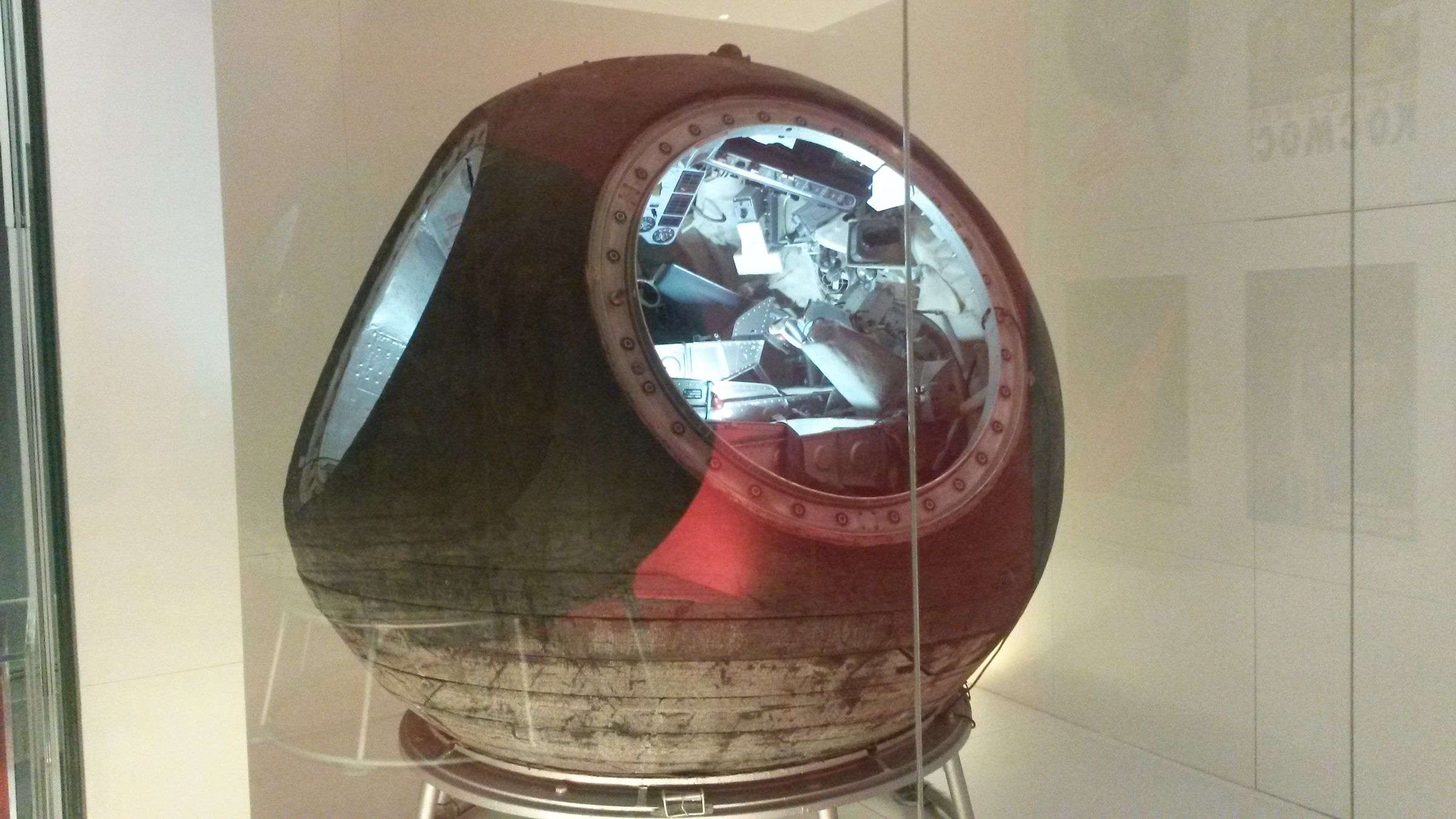
Voskhod 1 was the seventh crewed Soviet space flight. Launched on 12 October 1964 from NIIP-5 (Baikonur), Site 1, it was the first human spaceflight to carry more than one crew member into orbit and the first to carry either an engineer or a physician into outer space. The flight lasted just over 24 hours.
The mission originated when Soviet Premier Nikita Khrushchev, having learned of United States plans for the two-seat Gemini spacecraft, ordered chief designer Sergei Korolev to convert the one-seat Vostok into a vehicle capable of carrying three cosmonauts. The spacecraft had originally been designed for two crew members. Development was formally approved by the Soviet government on 13 April 1964.
The original prime crew of Boris Volynov, Georgi Katys, and Boris Yegorov was rejected three days before the scheduled launch date. Katys was reportedly removed after the KGB discovered that his father had been shot during the 1937 Great Purge; Volynov was removed due to his part-Jewish background. The final crew comprised Vladimir Komarov (commander), Konstantin Feoktistov (flight engineer), and Boris Yegorov (medical specialist). Feoktistov, a design engineer for the Vostok, Voskhod, and Soyuz programs, became the only Soviet spacecraft designer to make a spaceflight. Yegorov was selected through his father's Politburo connections. The cosmonauts received only three to four months of training.
An unmanned full dress rehearsal was conducted on 6 October 1964; the spacecraft was publicly designated Kosmos-47. The crewed spacecraft lifted off at 07:30 on 12 October. During the flight, Khrushchev spoke with the crew by radio from his dacha in Crimea; shortly afterward he was removed from power. The crew landed on 13 October in the Kustanai region and was greeted by Leonid Brezhnev and Alexei Kosygin in their first public appearance as Soviet leaders. Within the space program the mission was privately called "a circus" because of the crew selection process, the cramped conditions, and the extreme risk of the flight. As part of its payload, Voskhod 1 carried a ribbon from a Communist banner of the Paris Commune of 1871 into orbit.
Design
Voskhod 1 was a modified Vostok spacecraft. The single ejection seat was removed and replaced with three crew couches arranged at a 90-degree angle to the original Vostok cosmonaut's position, each fitted with a suspension system to absorb launch and landing shock. Because the couches could not function as ejection seats, the capsule provided no means of crew escape once the payload shroud was jettisoned approximately three minutes after liftoff. A backup solid-fuel retrorocket was mounted on top of the descent module to deorbit the spacecraft in case the primary retrorocket failed. The parachute system was increased from one to two parachutes, and a small cluster of solid rockets was attached to the parachute lines to soften the landing, since the crew had to land inside the capsule rather than ejecting. The modifications added nearly 600 kg to the spacecraft, necessitating a change to the third stage of the 11A57 launch vehicle from the Block Ye to the more powerful Block I. There was neither room nor payload capacity for spacesuits; the cosmonauts wore only training suits. A parachute drop test on 6 September 1964 ended in a crash when the parachute hatch failed to open; the controlling electrical circuit was subsequently redesigned with component redundancies. A second drop test on 5 October 1964 was successful.
Specifications
- Spacecraft designation: Voskhod, 3KV No. 3
- Call sign: Rubin (Ruby)
- Spacecraft length: 5 m
- Spacecraft diameter: 2.43 m
- Spacecraft mass: 5,320 kg (11,730 lb); one account gives 5.7 t for the flight article
- Descent module mass: 2.9 t
- Flight duration: 1 day, 00 h, 17 min, 3 s
- Orbital parameters: 177.5 × 408 km, inclination 65°, in one account and 178 × 336 km, inclination 64.7°, in another
- Orbital period: 89.6 min
- Launch vehicle: 11A57 (Voskhod)
- Launch site: NIIP-5 (Baikonur), Site 1
- Landing site: Kustanai region
 Argentina
 Armenia
 Australia
 Austria
 Austria-Hungary
 Belgium
 Brazil
 United Kingdom
 United States
 Brunei
 Bulgaria
 Canada
 Chile
 China
 Colonial America
 Colombia
 Confederate States
 Croatia
 Czech
 Denmark
 Egypt
 Finland
 France
 Georgia
 Germany
 German Imperial
 Greece
 Holland
 Hungary
 India
 Indonesia
 Iran
 Iraq
 Ireland
 Israel
 Italy
 Japan
 Japan (1940)
 Jordan
 Kingdom of Italy
 Malaysia
 Mexico
 Myanmar
 Nazi Germany
 Netherlands
 New Zealand
 North Korea
 Norway
 Pakistan
 Peru
 Philippines
 Poland
 Portugal
 Prussia
 Romania

 Russia
 Saudi Arabia
 Serbia
 Singapore
 Slovakia
 Slovenia
 South Africa
 South Korea
 Spain
 Sweden
 Switzerland
 Syria
 Taiwan
 Thailand
 Turkey
 UAE
 Ukraine
 Vietnam
 Yugoslavia