
History
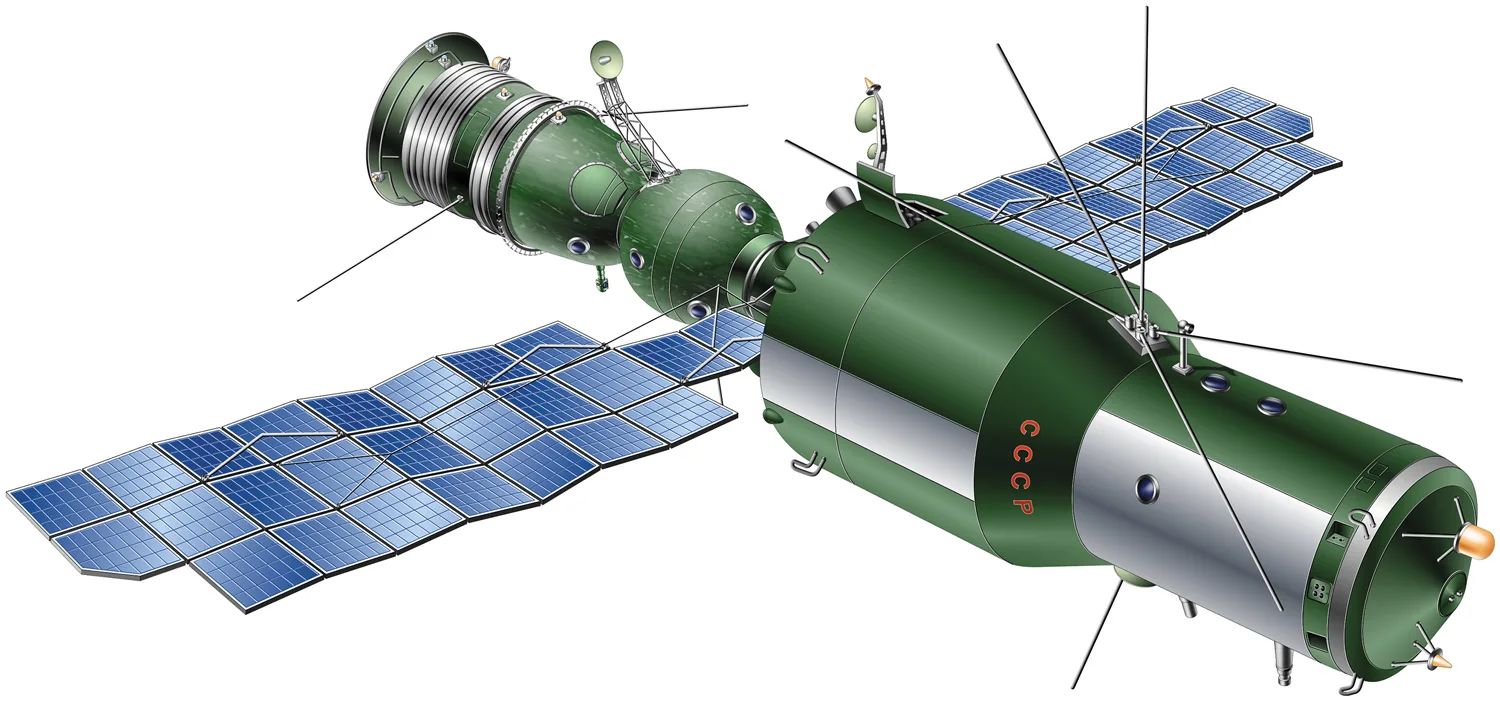
Salyut 5, internally designated Almaz OPS-3, was the third and final crewed military reconnaissance station launched under the Soviet Almaz program. It was publicly presented as part of the Salyut series, while its primary role was military Earth observation from low Earth orbit.
The station was launched on 22 June 1976 by a Proton-K rocket from Site 81/23 at Baikonur. Two Soyuz crews successfully occupied Salyut 5, a third crew failed to dock, and a fourth planned expedition was never launched. The station was deorbited on 8 August 1977 and broke up during atmospheric reentry.
Salyut 5 was developed within the Almaz program associated with Vladimir Chelomey's design organization, then known as TsKBM. The broader program had begun in the early 1960s as a Soviet crewed military reconnaissance effort. Three Almaz orbital stations ultimately flew under Salyut designations: Salyut 2 as OPS-1, Salyut 3 as OPS-2, and Salyut 5 as OPS-3.
Development and launch
The Almaz concept combined a crewed orbital station with reconnaissance equipment and provisions for returning selected data or materials to Earth. Early plans also included dedicated VA crew-return vehicles and TKS transport spacecraft, but the first flown stations instead received crews in modified Soyuz spacecraft. Salyut 5 represented the last of this first generation of crewed Almaz stations.
OPS-3 was launched at 18:04 UTC on 22 June 1976. RussianSpaceWeb identifies the vehicle as OPS No. 0103 and 11F71 and gives the launch vehicle as UR-500K No. 290-02, the Proton-K. The station received the international designator 1976-057A and satellite catalog number 08911. A detailed account of the launch and program history is available from RussianSpaceWeb.
Crewed expeditions
Soyuz 21 launched on 6 July 1976 with commander Boris Volynov and flight engineer Vitali Zholobov. The spacecraft reached Salyut 5 and the crew began the first expedition. Their work included military experiments, scientific research, microgravity studies, and solar observations. The mission had been expected to last longer, but the crew reported an unpleasant odor and headaches. Officials suspected contamination of the station atmosphere, possibly involving propellant-related fumes, and the crew returned to Earth on 24 August 1976.
Soyuz 23 launched on 14 October 1976 with Vyacheslav Zudov and Valery Rozhdestvensky. During rendezvous, the Igla automated system received erroneous motion information and used maneuvering propellant while attempting to correct the perceived problem. By the time the crew took manual control, insufficient propellant remained for another docking attempt. Soyuz 23 returned on 16 October without reaching the station.
Soyuz 24 launched on 7 February 1977 with Viktor Gorbatko and Yury Glazkov. The crew checked the station after the earlier atmosphere concerns and carried out an experiment demonstrating replacement of the cabin air. They also performed scientific work and completed repairs. The crew departed on 25 February 1977.
Salyut 5 carried a small KSI return capsule for bringing reconnaissance data and materials back to Earth. The supplied sources disagree on the exact release date of the capsule after the Soyuz 24 expedition: RussianSpaceWeb gives 26 February 1977, while Astronautix gives 22 February. Both sources identify the returned payload as film or mission data, so the capsule's use is clear even though the date differs.
End of the mission
A further crewed expedition was prepared, but it was not flown. RussianSpaceWeb reports that the available Soyuz spacecraft assigned to the program had already been used and that another vehicle could not be ready before Salyut 5 exhausted the propellant needed for continued operations. Other summaries likewise describe low remaining propulsion or attitude-control propellant as a factor in ending the mission.
Salyut 5 was deorbited on 8 August 1977 and disintegrated during reentry. RussianSpaceWeb and the Salyut 5 reference summary report a flight duration of 412 days, while Astronautix reports 409 days. The 412-day figure is used here because it is independently repeated by two of the supplied sources. The station completed thousands of Earth orbits before disposal.
Design
Salyut 5 was an Almaz Orbital Piloted Station, or OPS, built around a large pressurized cylindrical spacecraft body. The station had one docking port for visiting Soyuz spacecraft and used two laterally mounted solar arrays for electrical power. Its maximum body diameter was about 4.15 m.
Published dimensions differ between the supplied references. RussianSpaceWeb gives an OPS-3 length of 11.61 m, while the Salyut 5 reference summary and KeepTrack list approximately 14.5 to 14.55 m. The difference likely reflects differing definitions of the measured configuration, so both figures are retained rather than treated as directly interchangeable.
The station's reported launch mass is approximately 18.9 to 19.0 tonnes. KeepTrack lists a dry mass of 16,000 kg and a launch mass of 18,900 kg. The Salyut 5 reference summary gives a launch mass of 19,000 kg. KeepTrack's catalog entry for the spacecraft is available at KeepTrack.
Crew arrangement and docking
The successful visiting expeditions each carried two cosmonauts in Soyuz 7K-T spacecraft. Salyut 5 had a single docking port, so only one visiting spacecraft could be attached at a time. Although earlier Almaz concepts considered other crew-transport arrangements, the flown OPS-3 station operated with Soyuz crews.
Reconnaissance and research equipment
Salyut 5 carried the Agat camera for observing Earth as part of its reconnaissance mission. It also supported scientific and technical experiments. The German Kristall furnace was used for crystal-growth experiments, and the crews performed solar observations and microgravity research alongside military tasks.
A KSI return capsule allowed selected material to be sent back to Earth without returning the whole station or requiring the crew to carry all data in Soyuz. This feature was particularly relevant to film-based reconnaissance, because exposed film could be recovered for processing on the ground.
Pressurized volume
The supplied references give different internal-volume figures. The Salyut 5 reference summary lists 100 m³ of pressurized volume, while the broader Almaz program summary gives 47.5 m³ of habitable volume for the OPS design. Because pressurized volume and habitable volume can be defined differently, these figures are not combined into a single value.
Operational history
Salyut 5 was occupied by the Soyuz 21 and Soyuz 24 crews for a combined period of 67 days according to the Salyut 5 reference summary. Soyuz 23 attempted to reach the station but failed to dock. The two successful expeditions demonstrated crewed operation of the Almaz reconnaissance station, including Earth observation, maintenance, scientific experiments, and recovery of mission material by return capsule.
The station's short operational life also exposed practical limits of a crewed reconnaissance platform. Crew support, environmental-control issues, transport availability, and finite station propellant all constrained the program. After Salyut 5, the Soviet military did not continue with another crewed Almaz OPS flight. The broader Almaz program later produced uncrewed radar spacecraft derived from the same development line.
Operators
- Soviet Union: Salyut 5 was flown as a Soviet military Almaz reconnaissance station. TsKBM was the design organization associated with the program, while KeepTrack lists TSKBM as operator and ZiKh as manufacturer.
Specifications (Salyut 5 / Almaz OPS-3)
General characteristics
- Designation: Salyut 5; Almaz OPS-3; OPS No. 0103; 11F71
- Launch date: 22 June 1976
- Launch vehicle: Proton-K / UR-500K No. 290-02
- Launch site: Baikonur, Site 81/23
- Launch mass: approximately 18,900-19,000 kg
- Dry mass: 16,000 kg according to KeepTrack
- Maximum diameter: approximately 4.15 m
- Length: 11.61 m in RussianSpaceWeb; approximately 14.5-14.55 m in other supplied references
- Pressurized volume: 100 m³ in the Salyut 5 reference summary; the broader Almaz OPS description separately lists 47.5 m³ of habitable volume
- Docking ports: one
- Visiting crew size: two cosmonauts on each successful expedition
Orbital data
- International designator: 1976-057A
- Satellite catalog number: 08911
- Orbit: low Earth orbit
- Inclination: approximately 51.6 degrees
- Orbital period: about 89 minutes during the mission; KeepTrack lists 88.15 minutes near decay
- Reported mission orbit: approximately 223 x 269 km in the Salyut 5 reference summary
- Near-decay orbit: approximately 189 x 192 km in KeepTrack
- Reentry: 8 August 1977
Mission equipment
- Earth-observation system: Agat camera
- Data return: KSI return capsule
- Scientific equipment: included the Kristall crystal-growth furnace and instruments used for solar and microgravity research
Related equipment
- Salyut 2 / OPS-1: first Almaz OPS station launched under a Salyut designation; it failed shortly after reaching orbit.
- Salyut 3 / OPS-2: second flown Almaz military station and the immediate predecessor to Salyut 5.
- OPS-4: planned successor with additional systems, but it was not flown after the crewed Almaz program was cancelled.
- Almaz-T: later uncrewed radar reconnaissance spacecraft derived from the Almaz development line.
For a station-specific summary, see the Salyut 5 reference. For a broader description of the Almaz family and its later derivatives, see the supplied Almaz program reference. A separate mission summary is also available from Astronautix.
 Argentina
 Armenia
 Australia
 Austria
 Austria-Hungary
 Belgium
 Brazil
 United Kingdom
 United States
 Brunei
 Bulgaria
 Canada
 Chile
Chile China
China Colonial America
 Colombia
 Confederate States
 Croatia
 Czech
Czech Denmark
 Egypt
Egypt Finland
 France
 Georgia
 Germany
 German Imperial
 Greece
 Holland
 Hungary
 India
India Indonesia
 Iran
Iran Iraq
Iraq Ireland
 Israel
 Italy
Italy Japan
Japan Japan (1940)
 Jordan
 Kingdom of Italy
 Malaysia
 Mexico
 Myanmar
 Nazi Germany
 Netherlands
 New Zealand
 North Korea
 Norway
 Pakistan
 Peru
Peru Philippines
 Poland
 Portugal
 Prussia
 Romania
 Russia
 Saudi Arabia
 Serbia
 Singapore
 Slovakia
 Slovenia
 South Africa
 South Korea
 Spain
Spain Sweden
 Switzerland
 Syria
Syria Taiwan
 Thailand
 Turkey
 UAE
UAE Ukraine
 Vietnam
 Yugoslavia