
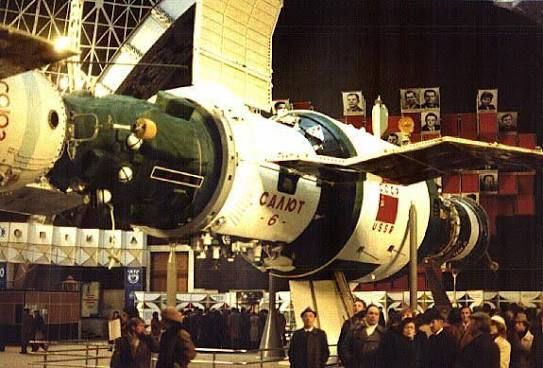
History
Salyut 6, also designated DOS-5, was a Soviet civilian orbital space station and the first of the second-generation Salyut stations. It was launched from Baikonur on 29 September 1977 by a Proton-K rocket. The station introduced two docking ports into routine Soviet station operations, allowing a resident crew to remain aboard while another Soyuz spacecraft or a Progress resupply vehicle was docked.
The two-port arrangement changed the practical limits of long-duration operations. Crews could exchange Soyuz return vehicles, Progress spacecraft could deliver supplies and propellant, and visiting expeditions could arrive without forcing the resident crew to leave. Salyut 6 consequently became a major testbed for long-duration habitation, automatic resupply, international Intercosmos missions, scientific observation, and maintenance in orbit.
Salyut 6 supported crewed operations from 1977 to 1981. After the last resident expedition, the large Kosmos 1267 transport spacecraft docked with the station. Salyut 6 was deorbited on 29 July 1982 and burned up in Earth's atmosphere, ending almost five years in orbit.
Development
The DOS family combined an Almaz-derived station hull with systems developed from the Soviet Soyuz program. According to the Astronautix chronology, work on the improved DOS-5 design was authorized in December 1973. The design adopted a second docking port at the aft end so that crew rotation and unmanned resupply could be supported. Gunter's Space Page identifies NPO Energia as the contractor for the DOS station.
Salyut 6 was launched on 29 September 1977 at 06:50 UTC from Baikonur Site 81/24. Its first attempted crewed visit, Soyuz 25 in October 1977, failed to dock. The first resident crew, Yuri Romanenko and Georgy Grechko, reached the station aboard Soyuz 26 in December 1977. Their 96-day expedition exceeded the previous long-duration record set aboard Skylab.
Progress 1 arrived in January 1978, making Salyut 6 the first station to be resupplied by the new uncrewed Progress cargo spacecraft. The rear docking port incorporated propellant-transfer plumbing, so Progress vehicles could deliver fuel as well as food, water, equipment, and other consumables. Twelve Progress spacecraft ultimately visited the station.
In March 1978, Soyuz 28 brought Aleksei Gubarev and Czechoslovak cosmonaut Vladimír Remek to Salyut 6. Remek became the first person from a country other than the Soviet Union or the United States to travel in space. Further Intercosmos expeditions brought cosmonauts from Poland, East Germany, Hungary, Vietnam, Cuba, Mongolia, and Romania to the station.
Long-duration operations expanded through 1978 and 1979. Vladimir Kovalyonok and Aleksandr Ivanchenkov spent about 140 days aboard during the second resident expedition. Vladimir Lyakhov and Valery Ryumin then remained for about 175 days in 1979. After Soyuz 33 failed to dock because of a propulsion problem, Soyuz 34 was launched without a crew to provide Lyakhov and Ryumin with a replacement return spacecraft.
During the 1979 expedition, the KRT-10 radio telescope was delivered and deployed at the rear of the station. The antenna later interfered with the docking area and was removed during a spacewalk by Lyakhov and Ryumin on 15 August 1979. Salyut 6 also supported testing of the new Soyuz-T spacecraft, including the uncrewed Soyuz T-1 and the crewed Soyuz T-2.
The longest Salyut 6 resident expedition began in April 1980, when Leonid Popov and Valery Ryumin arrived aboard Soyuz 35. Their stay lasted about 185 days. A three-person Soyuz T-3 mission later in 1980 carried Leonid Kizim, Oleg Makarov, and Gennady Strekalov to conduct repair and preventive work on the station.
The final resident crew, Vladimir Kovalyonok and Viktor Savinykh, arrived aboard Soyuz T-4 in March 1981 and remained for about 75 days. Soyuz 39 and Soyuz 40 brought the final short-duration Intercosmos crews. After the resident crew departed, Kosmos 1267, a TKS-derived transport logistics spacecraft, docked automatically to Salyut 6 on 19 June 1981. The successful docking demonstrated techniques that later supported larger modular space stations.
Following the launch of Salyut 7 in April 1982, Salyut 6 was retired. The Salyut 6 technical record gives its reentry date as 29 July 1982. Astronautix records that the combined Salyut 6 and Kosmos 1267 complex was commanded into reentry over the Pacific using the attached transport spacecraft's propulsion system.
Design
Salyut 6 retained the general cylindrical DOS layout but was redesigned around long-duration logistics. Its most important structural change was the addition of an aft docking port. This made it possible to have two spacecraft docked at once and gave Progress vehicles access to refueling lines at the rear of the station.
Compartments and habitability
The station contained a forward transfer compartment, a main working and living compartment, and a rear transfer and propulsion section. The Salyut layout reference describes the forward transfer compartment as about 2 m in diameter and 3 m long, with an inward-opening side hatch that allowed the compartment to serve as an airlock. Two spacesuits were stored there for extravehicular activity.
The main working compartment was formed from cylindrical sections joined by a conical transition. Equipment was arranged around the walls, leaving a central working area. The station provided designated sleeping berths, food storage, hot and cold water, a toilet, a shower, exercise equipment, and systems for recovering water from the cabin atmosphere. Soundproofing was improved compared with earlier Soviet stations. The pressurized volume was about 90 m³.
Salyut 6 had numerous portholes for visual observation, photography, and instrument use. Two scientific airlocks allowed equipment to be exposed to space or discarded without depressurizing the main living volume.
Docking and propulsion
The forward and aft docking ports allowed two spacecraft to be attached simultaneously. Soyuz spacecraft could use either port, while Progress vehicles needed the aft port because that interface contained the lines required to transfer propellant to the station. On several occasions, resident crews moved a Soyuz from the aft port to the forward port so that the rear interface would be available for an arriving Progress spacecraft.
The added aft port required a different propulsion arrangement from the earlier DOS stations. Two main engine nozzles were mounted on either side of the rear docking interface, each producing about 2.9 kN of thrust. The main engines and attitude-control thrusters used a unified nitrogen tetroxide and UDMH propellant system supplied from common pressurized tanks. The propulsion system suffered a serious malfunction during the second resident period in 1978. Thereafter, visiting spacecraft were used for major orbital adjustments, while the station retained attitude-control capability.
Power and control systems
Electrical power came from three steerable solar arrays. The Salyut 6 technical data reports about 51 m² of solar-cell area and a peak output of roughly 4 kW, while Astronautix lists an average electrical output of about 2 kW. The arrays had an overall span of about 17 m.
Navigation and orientation systems included the Delta semi-automatic computer for orbit information and the Kaskad attitude-control system. Salyut 6 also used gyrodynes for orientation control, building on equipment tested on earlier Salyut stations.
Scientific equipment
The principal astronomical instrument was the BST-1M multispectral telescope. It used a 1.5 m mirror for infrared, ultraviolet, and submillimeter observations and operated under cryogenic conditions of about 4 K. The telescope was used when the station was on Earth's night side.
Earth observation was supported by the MKF-6M multispectral camera. It photographed an area of about 165 by 220 km in six spectral bands and could achieve a reported ground resolution of about 20 m. The KATE-140 stereoscopic camera provided broader topographic coverage in visible and infrared wavelengths, with a reported resolution of about 50 m.
The station later received the KRT-10 radio observatory, which used a deployable 10 m directional antenna and radiometers for astronomical and meteorological observations. Additional equipment supported biological experiments, materials processing, radiation studies, and Earth-resources research.
Operational history
Salyut 6 was operated as a sequence of resident expeditions separated by uncrewed periods rather than as one continuously inhabited station. Resident crews remained aboard for progressively long missions while shorter visiting crews arrived in separate Soyuz spacecraft. A visiting crew could return in the older Soyuz already docked to the station, leaving the newer spacecraft for the resident crew and extending the time before their return vehicle reached its service limit.
The station received six resident crews as classified in the mission summary, including the Soyuz T-3 repair mission, and ten short-duration visiting crews. The longest stay was approximately 185 days. The program also included three spacewalks from Salyut 6, covering inspection of docking equipment, retrieval of external experiments, and removal of the KRT-10 antenna.
Progress operations were equally important to the station's role. Twelve Progress cargo craft delivered more than 20 tonnes of supplies, equipment, and propellant. The combination of two docking ports, regular cargo flights, and exchangeable Soyuz return vehicles established an operating pattern later developed further on Salyut 7 and Mir.
International missions were conducted through the Intercosmos program. Visiting cosmonauts from Czechoslovakia, Poland, East Germany, Hungary, Vietnam, Cuba, Mongolia, and Romania flew to Salyut 6 with Soviet commanders. These missions made the station an important platform for the Soviet Union's international human-spaceflight program during the late 1970s and early 1980s.
Operators
- Soviet Union: Operated Salyut 6 as a civilian DOS-series orbital station from its 1977 launch until its 1982 deorbit. Soviet crews conducted long-duration expeditions, maintenance, scientific work, and joint Intercosmos missions with visiting international cosmonauts.
Specifications (Salyut 6 / DOS-5)
General characteristics
- Type: Civilian crewed orbital space station.
- Manufacturer/contractor: NPO Energia.
- Launch date: 29 September 1977.
- Launch vehicle: Proton-K.
- Launch site: Baikonur Site 81/24.
- Launch mass: 19,824 kg.
- Maximum diameter: 4.15 m.
- Solar-array span: About 17 m.
- Pressurized volume: About 90 m³.
- Crew capacity: 3.
- Docking ports: 2, forward and aft.
Orbit and mission
- Orbital inclination: About 51.66 degrees.
- Reported orbit: Approximately 219 km periapsis and 275 km apoapsis in the station statistics.
- Orbital period: About 89.1 minutes.
- Time in orbit: About 1,764 days.
- Reentry: 29 July 1982.
Propulsion and power
- Main propulsion: Two engines of about 2.9 kN each, approximately 5.8 kN total thrust.
- Propellants: Nitrogen tetroxide and UDMH.
- Electrical power: Three steerable solar arrays, about 51 m² total area.
- Power output: Roughly 4 kW peak; Astronautix reports about 2 kW average.
Selected scientific equipment
- BST-1M: 1.5 m cryogenic multispectral telescope for infrared, ultraviolet, and submillimeter astronomy.
- MKF-6M: Six-band multispectral Earth-observation camera.
- KATE-140: Stereoscopic topographic mapping camera for visible and infrared imaging.
- KRT-10: Deployable 10 m radio telescope delivered during the station's operational life.
Related equipment
- Salyut 4: Earlier DOS station whose power, navigation, thermal-control, and other systems influenced Salyut 6.
- Salyut 7: Successor second-generation DOS station that continued the two-port, long-duration operating concept.
- Mir and Zvezda: The Salyut programme history traces the DOS line forward to the Mir core module and the Zvezda service module of the International Space Station.
 Argentina
 Armenia
 Australia
 Austria
 Austria-Hungary
 Belgium
 Brazil
 United Kingdom
 United States
 Brunei
 Bulgaria
 Canada
 Chile
Chile China
China Colonial America
 Colombia
 Confederate States
 Croatia
 Czech
Czech Denmark
 Egypt
Egypt Finland
 France
 Georgia
 Germany
 German Imperial
 Greece
 Holland
 Hungary
 India
India Indonesia
 Iran
Iran Iraq
Iraq Ireland
 Israel
 Italy
Italy Japan
Japan Japan (1940)
 Jordan
 Kingdom of Italy
 Malaysia
 Mexico
 Myanmar
 Nazi Germany
 Netherlands
 New Zealand
 North Korea
 Norway
 Pakistan
 Peru
Peru Philippines
 Poland
 Portugal
 Prussia
 Romania
 Russia
 Saudi Arabia
 Serbia
 Singapore
 Slovakia
 Slovenia
 South Africa
 South Korea
 Spain
Spain Sweden
 Switzerland
 Syria
Syria Taiwan
 Thailand
 Turkey
 UAE
UAE Ukraine
 Vietnam
 Yugoslavia