
History
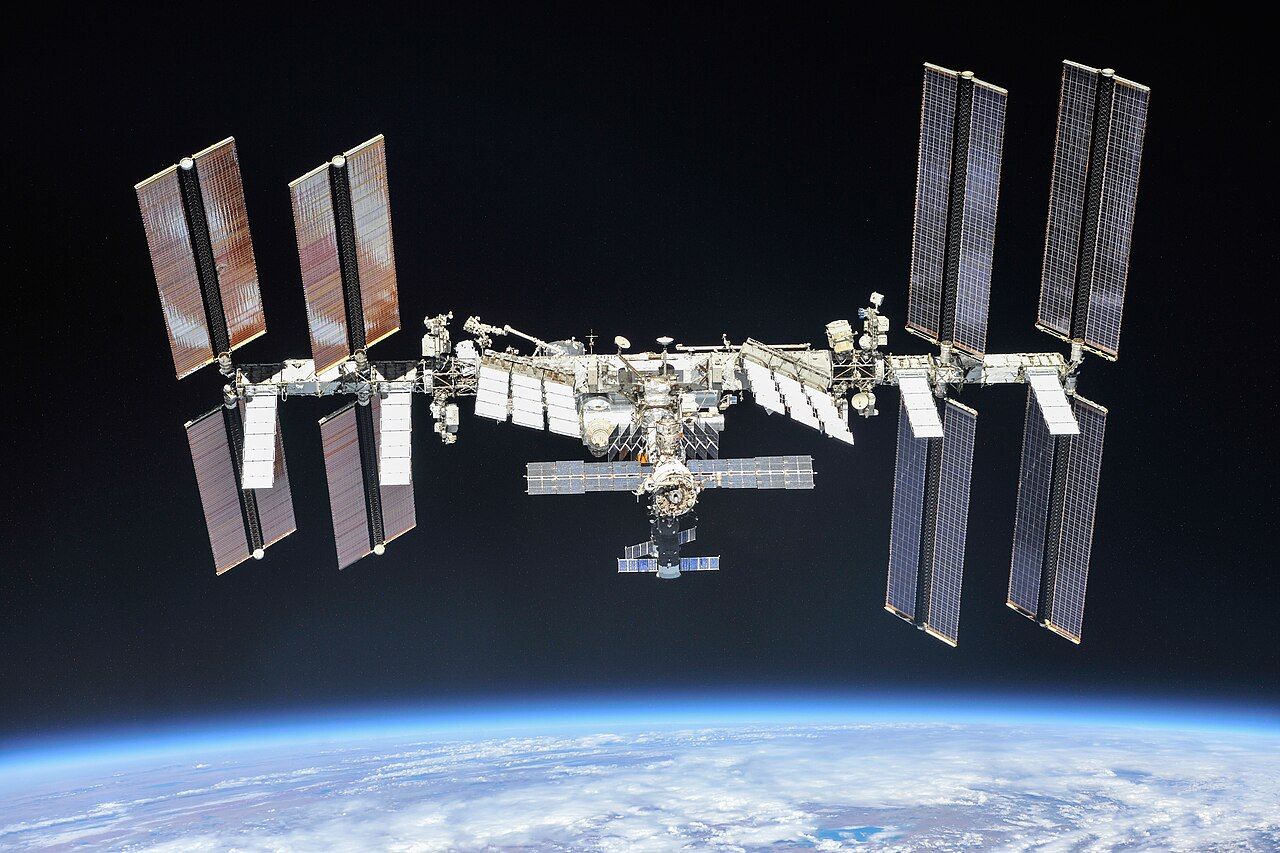
The International Space Station (ISS) is a multinational crewed space station and research laboratory in low Earth orbit. It combines the Russian Orbital Segment with the United States Orbital Segment, which includes contributions from the United States, Europe, Japan, and Canada.
The station grew from earlier American Space Station Freedom and Soviet Mir-2 plans. Its first orbital element, the Russian-built Zarya module, was launched on 20 November 1998, and continuous human occupation began with Expedition 1 on 2 November 2000.
The ISS is operated through a partnership involving NASA, Roscosmos, ESA, JAXA, and the Canadian Space Agency. It supports long-duration human spaceflight, microgravity research, Earth observation, astronomy, technology demonstrations, education, and preparation for future exploration missions.
Development and international partnership
NASA began formal work toward a permanently crewed station after President Ronald Reagan directed the agency in 1984 to develop one within a decade. The American project, later named Space Station Freedom, was redesigned repeatedly as costs rose and international participation expanded. Europe, Japan, and Canada joined the program with laboratory, robotics, and other hardware contributions.
Russia entered the partnership in 1993 after the United States and Russia agreed to combine their separate station plans. The resulting ISS incorporated hardware and concepts from Space Station Freedom and Mir-2. On 29 January 1998, representatives of the United States, Russia, Japan, Canada, and participating ESA countries signed an updated Intergovernmental Agreement establishing the cooperative framework for design, development, operation, and use of the station. NASA provides a detailed account of this development in its ISS historical overview.
Assembly in orbit
Zarya launched from Baikonur Cosmodrome on 20 November 1998 and initially supplied propulsion, attitude control, communications, electrical power, and storage. Space Shuttle Endeavour delivered the U.S.-built Unity connecting node in December 1998, linking the first Russian and American elements.
The Russian Zvezda service module arrived in July 2000 and provided living quarters and life-support capability. Expedition 1 launched on 31 October 2000 and docked two days later, beginning uninterrupted human occupancy of the station.
Assembly continued through Russian launch vehicles and the U.S. Space Shuttle fleet. The Destiny laboratory, Quest airlock, Canadarm2 robotic arm, truss sections, solar arrays, Harmony node, Columbus laboratory, Japanese Kibō complex, Tranquility node, Cupola, Rassvet, and Leonardo Permanent Multipurpose Module were added during the 2000s and early 2010s. Construction slowed after the loss of Space Shuttle Columbia in 2003 and resumed after shuttle flights returned.
Later additions included the commercial Bigelow Expandable Activity Module, International Docking Adapters, the Bishop airlock, the Russian Nauka laboratory module, and the Prichal docking module. Prichal, installed in November 2021, is identified by NASA as the most recent station module. NASA summarizes the current configuration and principal dimensions in its ISS facts and figures.
Design
The ISS is a modular orbital complex divided into two principal sections. The Russian Orbital Segment contains modules developed for Russian operations, while the United States Orbital Segment incorporates American, European, Japanese, and Canadian elements. A long Integrated Truss Structure carries large solar arrays, radiators, external payloads, and support equipment.
Pressurized modules
The Russian segment includes Zarya, Zvezda, Poisk, Rassvet, Nauka, and Prichal. Zvezda provides command, control, living, and life-support functions for the Russian segment. Nauka adds laboratory capacity, while Prichal provides multiple docking ports.
The U.S.-led segment includes Unity, Destiny, Harmony, Tranquility, Quest, Leonardo, and the Cupola, together with ESA's Columbus laboratory and Japan's Kibō laboratory complex. Harmony acts as a central connection point for the U.S., European, and Japanese laboratory modules and also contains crew sleeping quarters. Tranquility contains environmental-control and life-support equipment, exercise hardware, and sanitation facilities. The Cupola provides seven windows for Earth observation, robotics, and docking support.
Destiny is the principal U.S. laboratory, Columbus is ESA's main laboratory contribution, and Kibō is Japan's research facility. Kibō includes a pressurized laboratory, an exposed facility for experiments in the external space environment, storage areas, and a robotic arm.
External structure, power, and robotics
The Integrated Truss Structure is about 94 m long and supports the station's main solar arrays and thermal radiators. NASA lists the station as 109 m end-to-end, with a solar-array span of 73 m. The station also uses International Space Station Roll-Out Solar Arrays to augment its original solar power system.
Canadarm2, a 17 m robotic arm, is used to move modules, handle external payloads, support maintenance, and transport spacewalking astronauts. Dextre, a more specialized robotic manipulator, performs external servicing tasks that can reduce the need for astronaut spacewalks.
Docking, logistics, and life support
The ISS supports multiple visiting spacecraft at the same time. Crewed transportation has included Soyuz and Crew Dragon, while the Space Shuttle served the station until 2011. Cargo vehicles have included Progress, Dragon, Cygnus, European ATV spacecraft, Japanese HTV vehicles, and later HTV-X.
The station provides a controlled Earth-like atmosphere inside its pressurized modules and uses regenerative life-support systems to manage oxygen and water. NASA states that the Water Recovery System reduces dependence on water delivered from Earth by 65 percent. Crew members exercise for at least two hours per day to reduce muscle and bone loss caused by microgravity.
Operational history
The ISS has been continuously occupied since 2 November 2000. Crews generally remain aboard for several months, conducting scientific research while maintaining and upgrading the station. The laboratory supports work in medicine, biology, materials science, fluid physics, combustion, Earth science, astronomy, space weather, and technology development.
The station also serves as a testbed for long-duration human spaceflight. Its low Earth orbit environment allows crews to study the effects of microgravity and radiation on people and equipment while retaining regular access to cargo, replacement hardware, and ground support.
Research facilities and external payload sites have supported instruments such as the Alpha Magnetic Spectrometer, Earth-observation sensors, and astronomical experiments. The station has also been used for education, amateur radio contacts, cultural activities, and commercial missions.
On 12 August 2026, the ISS was photographed transiting across the Sun during a solar eclipse. A composite image showed the station's silhouette at eight positions across the solar disk while the Moon partially covered the Sun from the photographer's viewpoint. The event demonstrated the station's rapid apparent motion across the sky as it orbited Earth at roughly 7.7 km/s.
Operators
- NASA: United States partner responsible for major U.S. segment elements and overall participation in station operations and research.
- Roscosmos: Russian partner responsible for the Russian Orbital Segment and associated spacecraft operations.
- ESA: European partner contributing the Columbus laboratory and other station hardware and operations. ESA describes the partnership and station configuration in its ISS overview.
- JAXA: Japanese partner responsible for the Kibō laboratory complex and related research operations.
- CSA: Canadian partner responsible for major robotic systems including Canadarm2 and Dextre.
Specifications (International Space Station)
General characteristics
- Type: Modular crewed orbital space station and research laboratory
- Orbit: Low Earth orbit
- Orbital inclination: 51.64 degrees
- Typical altitude: About 400 km above Earth
- Orbital speed: About 7.67 km/s (27,600 km/h)
- Orbital period: About 93 minutes
- Orbits per day: About 15.5 to 16
- Overall length: 109 m
- Truss length: 94 m
- Solar array span: 73 m
- Pressurized module length: 67 m along the major axis
- Pressurized volume: 1,005 m3
- Habitable volume: 388 m3, excluding visiting vehicles
- Mass: About 420,000 kg; NASA lists 419,725 kg in its facts and figures
- Nominal crew: Seven, with higher temporary occupancy possible during handovers
Configuration
- Main sections: Russian Orbital Segment and United States Orbital Segment
- Major laboratories: Destiny, Columbus, Kibō, and Nauka
- Primary structural backbone: Integrated Truss Structure
- Robotic systems: Canadarm2, Dextre, Kibō robotic arm, and European Robotic Arm
- Docking and berthing capacity: Up to eight spacecraft connected at once according to NASA
Related equipment
- Space Station Freedom: Earlier U.S. station program whose designs and international partnerships contributed to the ISS.
- Mir-2: Planned Soviet and Russian station program whose concepts and hardware influenced the Russian segment of the ISS.
- Mir: Soviet and Russian modular space station that provided operational experience used during the transition to ISS cooperation.
 Argentina
 Armenia
 Australia
 Austria
 Austria-Hungary
 Belgium
 Brazil
 United Kingdom
 Brunei
 Bulgaria
 Canada
 Chile
Chile China
China Colonial America
 Colombia
 Confederate States
 Croatia
 Czech
Czech Denmark
 Egypt
Egypt Finland
 France
 Georgia
 Germany
 German Imperial
 Greece
 Holland
 Hungary
 India
India Indonesia
 Iran
Iran Iraq
Iraq Ireland
 Israel
 Italy
Italy Japan
Japan Japan (1940)
 Jordan
 Kingdom of Italy
 Malaysia
 Mexico
 Myanmar
 Nazi Germany
 Netherlands
 New Zealand
 North Korea
 Norway
 Pakistan
 Peru
Peru Philippines
 Poland
 Portugal
 Prussia
 Romania
 Russia
 Saudi Arabia
 Serbia
 Singapore
 Slovakia
 Slovenia
 South Africa
 South Korea
 Soviet Union
 Spain
Spain Sweden
 Switzerland
 Syria
Syria Taiwan
 Thailand
 Turkey
 UAE
UAE Ukraine
 Vietnam
 Yugoslavia