
History
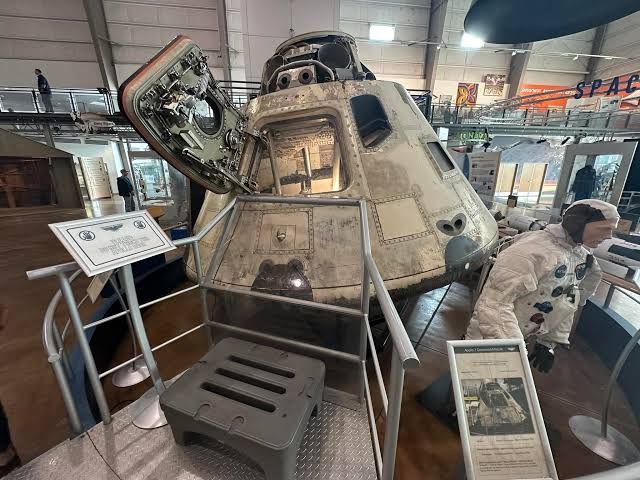
The Apollo 7 Command Module (CSM-101) was the first spacecraft of the Apollo program to carry a crew into orbit. It launched on October 11, 1968, from Launch Complex 34 at Cape Kennedy Air Force Station, Florida, aboard a Saturn IB rocket (SA-205). The mission was the first crewed flight following the Apollo 1 cabin fire of January 27, 1967, which had killed three astronauts during a launch rehearsal test and suspended all crewed Apollo flights for 21 months.
The crew consisted of Commander Walter M. “Wally” Schirra, Command Module Pilot Donn F. Eisele, and Lunar Module Pilot R. Walter Cunningham. Although Cunningham held the LMP designation, Apollo 7 did not carry a Lunar Module. The spacecraft was a Block II command and service module, a redesign of the Block I version used on Apollo 1, with improved safety features including a cabin atmosphere of 60 percent oxygen and 40 percent nitrogen at launch (replaced with lower-pressure pure oxygen within four hours after ascent) and an outward-opening hatch.
The mission’s principal objective was to verify that the redesigned command and service module was habitable and reliable for the duration of a lunar mission, and to demonstrate that the Service Module’s main engine and the Command Module’s guidance systems could perform an orbital rendezvous and a precision reentry. During the first two days, the crew used the empty S-IVB upper stage of their booster as a rendezvous target, performing a simulated docking on day 1 and a series of maneuvers on day 2 that brought the Command Module to within 70 feet (approximately 21 m) of the stage. Over the mission the crew performed eight test firings of the Service Propulsion System, the longest lasting 67 seconds and raising the spacecraft to an altitude of approximately 450 km (280 mi). The crew also made seven live television broadcasts, the first from an American spacecraft, and photographed Hurricane Gladys and Typhoon Gloria.
All three astronauts developed severe head colds during the flight, which complicated reentry planning due to concerns about pressure changes in the eardrums while wearing suit helmets. The mission was nonetheless rated a complete technical success; NASA program manager General Sam Phillips assessed it as a “101 percent” success. The spacecraft completed 163 orbits over 10 days and 20 hours, splashing down in the Atlantic Ocean near Bermuda on October 22, 1968.
None of the three crew members flew in space again after Apollo 7. The Command Module was displayed in the 1969 presidential inauguration parade, transferred to the Smithsonian Institution in 1970, and loaned to the National Museum of Science and Technology in Ottawa, Canada, before returning to the United States in 2004. It is currently on loan to the Frontiers of Flight Museum at Love Field in Dallas, Texas.
Specifications
The Apollo 7 Command Module was manufactured by North American Rockwell (Space Division, Downey, California). It was a conical pressure vessel with a maximum diameter of 391.16 cm (154 in) at its base. The National Air and Space Museum records the height of the Apollo 7 artifact as 322.58 cm (127 in); a separate technical reference gives 3.65 m.
The structure was a double-wall design. The outer shell consisted of brazed stainless steel honeycomb between stainless steel sheets, serving as thermal protection against solar radiation and atmospheric reentry heating. The crew compartment inner shell was aluminum honeycomb between aluminum alloy sheets. An epoxy-resin ablative heat shield covered the base, with a thickness ranging from 1.8 to 6.9 cm. The crew compartment provided approximately 6.17 m³ of internal volume.
The Command Module was divided into three compartments. The forward section housed three main parachutes (25.4 m diameter), two drogue parachutes, and pilot mortar chutes for Earth landing. The central crew compartment held three astronaut couches, five windows, and the controls, displays, and navigation equipment used by the astronauts. The aft compartment contained propellant tanks, twelve 420 N nitrogen tetroxide/monomethylhydrazine reaction control thrusters, navigation and guidance equipment, and electrical systems. Five silver/zinc-oxide batteries provided power after separation from the Service Module: three for reentry and post-landing operations, and two for vehicle separation and parachute deployment.
The attached Service Module was a cylinder 3.9 m in diameter and 7.6 m long, with a gimbal-mounted re-startable 91,000 N hypergolic liquid propellant engine, three hydrogen-oxygen fuel cell stacks providing 28 V, two cryogenic oxygen tanks, two cryogenic hydrogen tanks, and four banks of four 450 N reaction control thrusters.
After S-IVB separation, the spacecraft’s initial orbit was 228×282 km; propellant venting from the spent stage raised it to 232×309 km. The orbital inclination was 31.63°.
 Argentina
 Armenia
 Australia
 Austria
 Austria-Hungary
 Belgium
 Brazil
 United Kingdom
 Brunei
 Bulgaria
 Canada
 Chile
Chile China
China Colonial America
 Colombia
 Confederate States
 Croatia
 Czech
Czech Denmark
 Egypt
Egypt Finland
 France
 Georgia
 Germany
 German Imperial
 Greece
 Holland
 Hungary
 India
India Indonesia
 Iran
Iran Iraq
Iraq Ireland
 Israel
 Italy
Italy Japan
Japan Japan (1940)
 Jordan
 Kingdom of Italy
 Malaysia
 Mexico
 Myanmar
 Nazi Germany
 Netherlands
 New Zealand
 North Korea
 Norway
 Pakistan
 Peru
Peru Philippines
 Poland
 Portugal
 Prussia
 Romania
 Russia
 Saudi Arabia
 Serbia
 Singapore
 Slovakia
 Slovenia
 South Africa
 South Korea
 Soviet Union
 Spain
Spain Sweden
 Switzerland
 Syria
Syria Taiwan
 Thailand
 Turkey
 UAE
UAE Ukraine
 Vietnam
 Yugoslavia