
History
The Antares launch vehicle was developed by Orbital Sciences Corporation with financial support from NASA under the Commercial Orbital Transportation Services (COTS) program, for which a $171 million contract was awarded in February 2008. Originally designated Taurus II, the vehicle was renamed Antares on December 12, 2011. Since 2018, it has been manufactured by Northrop Grumman Space Systems.
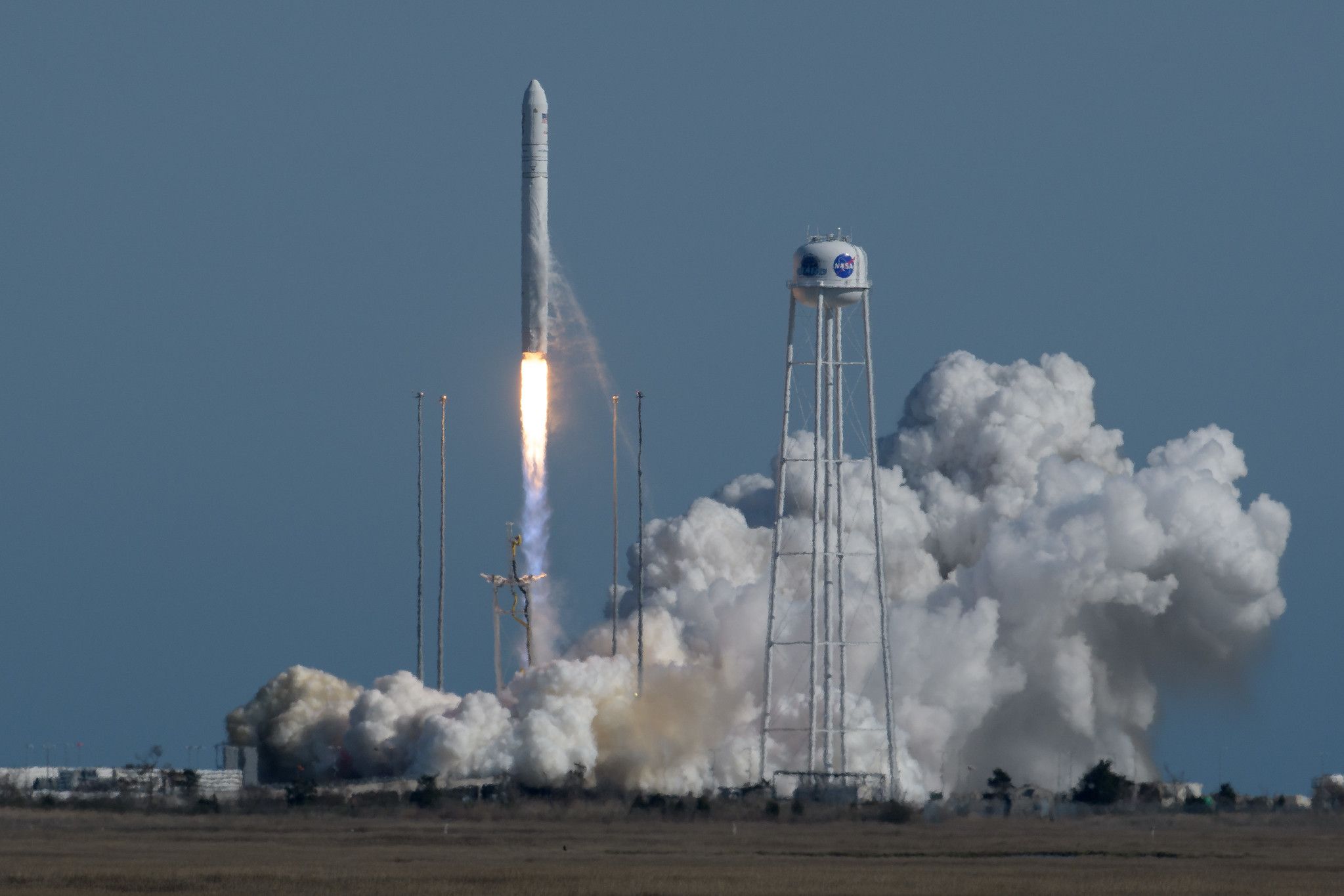
Antares made its first flight on April 21, 2013, launching the Antares A-ONE mission with a Cygnus mass simulator from Launch Pad 0A at the Mid-Atlantic Regional Spaceport (MARS) in Virginia. On September 18, 2013, it successfully launched the Orb-D1 Cygnus spacecraft, the first Cygnus mission to rendezvous with the International Space Station (ISS). After completing the COTS demonstration flights, Antares and Cygnus were awarded Commercial Resupply Services contracts covering 25 ISS cargo missions.
The Antares 130 vehicle suffered a catastrophic explosion a few seconds after liftoff during the Cygnus Orb-3 mission in October 2014, suspending flight operations. On October 17, 2016, the upgraded Antares 230 returned to flight from NASA's Wallops Flight Facility in Virginia, launching the S.S. Alan Poindexter Cygnus spacecraft to the ISS; the spacecraft arrived at the station six days later to deliver food, supplies, and science experiments. Antares flew 12 additional missions before standing down again for a redesign. In total, Northrop Grumman has flown 18 Antares missions.
The Antares 230+ took its last flight in August 2023. After Russia's 2022 invasion of Ukraine ended access to the Ukrainian and Russian first-stage suppliers, Northrop Grumman announced the Antares 300 series, with a new first stage developed by Firefly Aerospace using composite structures and seven Miranda engines.
Design
Antares is a two-stage expendable launch vehicle incorporating both liquid and solid propulsion. The first stage is liquid-fueled, burning RP-1 (kerosene) and liquid oxygen. The second stage is a solid-fuel motor from the Castor 30 family, derived from the Castor 120 used on the Minotaur-C and ultimately from the Peacekeeper ICBM first stage. An optional third stage is offered but has never been used, as the Cygnus spacecraft incorporates its own service module for orbital maneuvers.
The vehicle's configuration is indicated by a three-digit number: the first digit identifies the first stage, the second the second stage, and the third the third stage. The 100 series used two AJ-26 engines (based on the Soviet NK-33) and a Castor 30A second stage; the 200 series uses two Russian RD-181 engines and a Castor 30B second stage; the 300 series uses seven Miranda engines and a Castor 30XL second stage. A "+" suffix denotes performance upgrades to the Antares 230 variant. The 100 and 200 series first stages were built by the Ukrainian companies Pivdenne and Pivdenmash; the 300 series first stage is built by Firefly Aerospace in Texas. The launch system uses Northrop Grumman's MACH avionics and is launched from the Wallops Flight Facility in Virginia.
Specifications
The Antares 330 provides up to 10,500 kg to a low-Earth orbit space station transfer orbit. Its 3.9-meter-diameter fairing with a removable pop-top nose cone accommodates the Cygnus cargo spacecraft. The Antares 330 is planned to support up to three commercial resupply missions to the ISS.
 Argentina
 Armenia
 Australia
 Austria
 Austria-Hungary
 Belgium
 Brazil
 United Kingdom
 Brunei
 Bulgaria
 Canada
 Chile
 China
 Colonial America
 Colombia
 Confederate States
 Croatia
 Czech
 Denmark
 Egypt
 Finland
 France
 Georgia
 Germany
 German Imperial
 Greece
 Holland
 Hungary
 India
 Indonesia
 Iran
 Iraq
 Ireland
 Israel
 Italy
 Japan
 Japan (1940)
 Jordan
 Kingdom of Italy
 Malaysia
 Mexico
 Myanmar
 Nazi Germany
 Netherlands
 New Zealand
 North Korea
 Norway
 Pakistan
 Peru
 Philippines
 Poland
 Portugal
 Prussia
 Romania

 Russia
 Saudi Arabia
 Serbia
 Singapore
 Slovakia
 Slovenia
 South Africa
 South Korea
 Soviet Union
 Spain
 Sweden
 Switzerland
 Syria
 Taiwan
 Thailand
 Turkey
 UAE
 Ukraine
 Vietnam
 Yugoslavia