History
Schiaparelli originated from the ESA Aurora programme, which aimed to develop building blocks toward human space exploration. In 2005 the ESA Council approved 650 million euros for a Mars rover and static lander. The architecture evolved into a two-launch strategy: the first mission (ExoMars 2016) would carry the Trace Gas Orbiter and a technology demonstrator lander; the second would deliver the full science rover. The entry, descent and landing demonstrator module was named Schiaparelli in November 2013 in honour of the Italian astronomer Giovanni Schiaparelli (1835–1910), who made notable observations of Martian surface features. The module was built in Italy by Thales Alenia Space under ESA contract as part of the joint ESA–Roscosmos ExoMars programme.
Schiaparelli was launched attached to the ExoMars Trace Gas Orbiter on a Proton-M rocket from the Baikonur Cosmodrome in Kazakhstan on 14 March 2016. After a seven-month cruise, the two vehicles separated on 16 October 2016. Schiaparelli then coasted ballistically in low-power hibernation mode for three days before being activated for atmospheric entry.
On 19 October 2016 Schiaparelli entered the Martian atmosphere at an altitude of 122.5 km and a velocity of approximately 21,000 km/h. The heat shield, parachute, radar altimeter, and thruster system all activated as designed. However, shortly after parachute deployment the inertial measurement unit (IMU) saturated because the parachute produced oscillation rates higher than the unit could report. The guidance, navigation and control software integrated the saturation threshold as a constant rotation rate, accumulating an attitude estimation error of about 165 degrees. When the radar altimeter began providing slant-range data, projecting those ranges through the corrupted attitude yielded a negative altitude reading. The onboard failure logic, which assumed any radar–inertial disagreement indicated a radar fault, forced the radar into the navigation loop without challenging the attitude estimate. The software then entered terminal descent, jettisoned the back shell and parachute, and ignited the thrusters. Because the shutdown criterion compared estimated energy against a threshold and the large negative altitude immediately satisfied that condition, the thrusters cut off after approximately three seconds instead of the planned thirty. The module switched to surface mode while still at an altitude of about 3.7 km, then free-fell for roughly 34 seconds. The signal was lost 43 seconds before the scheduled touchdown time, and Schiaparelli impacted the surface of Meridiani Planum at an estimated 150 m/s (approximately 540 km/h), 37 seconds early. Early preliminary estimates after the event placed the impact speed at about 300 km/h (83 m/s); the inquiry's reconstruction yielded the higher figure.
The crash site, approximately 5.4 km west of the aim point and well within the landing ellipse, was imaged by NASA's Mars Reconnaissance Orbiter. High-resolution imagery resolved a 2.4 m impact scar, the 12 m parachute with the back shell still attached about 0.9 km to the south, and the front heat shield about 1.4 km to the east. ESA officials declared the mission a partial success because the real-time telemetry had validated atmospheric entry, parachute deployment and inflation, front shield jettison, radar altimeter operation, and back shell separation, even though the retro-propelled descent to the two-metre drop point and the final touchdown were not demonstrated.
The ESA anomaly inquiry board, chaired by Inspector General Toni Tolker-Nielsen with members from CNES, DLR, NASA/JPL, and three universities, published its findings in May 2017. The board identified four root causes: insufficiently conservative modelling of parachute dynamics, inadequate persistence time of the IMU saturation flag combined with inadequate handling of saturation by the guidance software, insufficient failure detection, isolation and recovery design robustness, and a mishap in the management of subcontractors and hardware acceptance. The board found no IMU malfunction; post-flight testing showed the unit performed nominally and the high rates it reported were real. The report stated that if the saturation flag persistence time had been 15 milliseconds as believed at acceptance rather than the longer value actually present, the landing would probably have succeeded. Sixteen recommendations were issued, including the suggestion that onboard software should check that altitude cannot be negative.
The Schiaparelli failure delayed the ExoMars rover mission, which had already slipped from 2018 to 2020 to 2022. In March 2022 ESA's Council suspended the ExoMars cooperation with Roscosmos following Russia's invasion of Ukraine, which removed the Russian-built descent module and landing platform. The Rosalind Franklin rover mission has been restructured around a US launch vehicle and a new European landing platform, with launch now planned for no earlier than 2028.
Design
The Schiaparelli module used a 70-degree sphere-cone front heat shield with a 600 mm nose radius and a 47-degree truncated conical back shell. The aeroshell shape was selected as the lowest-risk option, based on the extensive heritage from NASA's Viking landers and previous European experience including the NetLander project. Both shields were covered with Norcoat Liège ablative thermal protection tiles bonded with silicone adhesive. The 2.4 m module diameter was reduced from the 3.4 m diameter originally planned for the full ExoMars landing platform configuration that would have also carried the rover.
The parachute system comprised a 12 m nylon disk-gap-band canopy with 22.4% geometric porosity, scaled from the Huygens probe's second-stage parachute. It was deployed by a mortar at supersonic speed and was designed to decelerate the module from up to Mach 2.1 (nominally Mach 1.95 ± 0.15 at 3σ) to a subsonic speed compatible with surface platform separation. The design maximum load limit was 75 kN. Final functional and structural qualification of the parachute was conducted at NASA's Ames National Full-Scale Analog Complex.
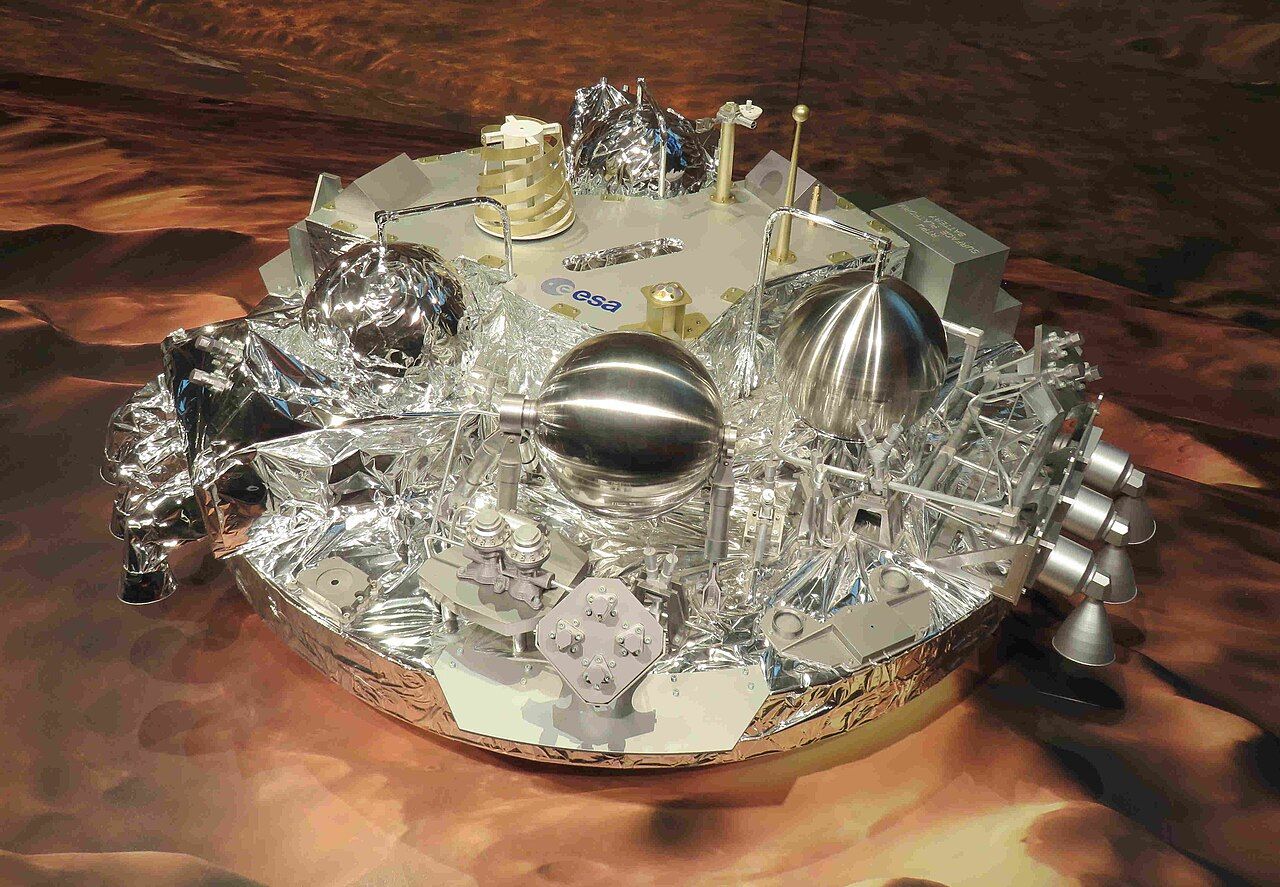
The reaction control system used three clusters of three hydrazine monopropellant pulse engines (400 N each), fed from three 17.5-litre propellant tanks with diaphragms for propellant management and pressurised by a 15.6-litre helium tank. Nozzles were canted 18 degrees from nadir, with the outer pair of each cluster tilted an additional 13 degrees for roll control. The system was designed to fire for approximately 30 seconds during terminal descent to reduce speed below 7 km/h at 2 m above the surface.
The Surface Platform incorporated a crushable structure of aluminium honeycomb (crushing strength 0.17 MPa) beneath the baseplate to absorb the final free-fall drop of approximately 1.8 m after engine cutoff. The maximum expected quasi-static axial deceleration at touchdown was approximately 48 g. Crushable structure was selected over landing legs or airbags as the simplest solution for the mission's short surface lifetime.
The avionics architecture was single-string with no redundancy, a decision made during development under programme financial constraints and a fixed launch window. The primary computer, the Central Terminal and Power Unit (CTPU), was built around an Atmel AT697F Leon2-FT radiation-hardened processor with 4 GB of mass memory. Electrical power was provided by non-rechargeable lithium-ion primary batteries; a radioisotope thermoelectric generator option was studied in cooperation with Roscosmos but not adopted because the few-sol surface mission did not require it.
Schiaparelli carried a payload of approximately 15.2 kg. The DREAMS surface package (Dust Characterisation, Risk Assessment, and Environment Analyser on the Martian Surface) comprised six sensors to measure wind, humidity, pressure, temperature, solar irradiance, and atmospheric electric fields, and was planned to operate for 2 to 8 sols. COMARS+ measured heat flux on the back shield during entry. AMELIA used the spacecraft's engineering sensors to reconstruct entry and descent conditions. The DeCa descent camera was designed to acquire 15 images of the Martian terrain during the final descent. The INRRI passive laser retroreflector array, contributed by the Italian Space Agency, was intended to enable future laser ranging of the lander by orbiters.
Specifications
- Entry mass: 577 kg (576.3 kg as-flown); 280 kg at landing
- Diameter: 2.4 m with front shield; 1.65 m without
- Height: 1.8 m
- Front shield: 70-degree sphere-cone, Norcoat Liège thermal protection system
- Back shell: 47-degree conical, Norcoat Liège thermal protection system
- Structure: aluminium honeycomb sandwich with carbon fibre reinforced polymer (CFRP) skins
- Parachute: 12 m disk-gap-band, 22.4% geometric porosity
- Propulsion: 9 hydrazine pulse engines (3 clusters of 3), 400 N each
- Radar altimeter: 35.76 GHz, four-beam Doppler
- Power: primary lithium-ion batteries (non-rechargeable)
- Communications: UHF transceiver, 8 kbps real-time telemetry rate
- Crushable structure: aluminium honeycomb, 0.17 MPa crushing strength
- Landing site: Meridiani Planum, 2.05°S 6.10°W, −1.45 km elevation
- Landing ellipse (3σ): 110 × 24 km
- Design terrain capability: rocks up to 40 cm and slopes up to 12.5°; other published mission references give 38 cm and 19°
- Heat shield peak temperature during entry: approximately 1500 °C
 Argentina
 Armenia
 Australia
 Austria
 Austria-Hungary
 Belgium
 Brazil
 United Kingdom
 United States
 Brunei
 Bulgaria
 Canada
 Chile
 China
 Colonial America
 Colombia
 Confederate States
 Croatia
 Czech
 Denmark
 Egypt
 Finland
 France
 Georgia
 Germany
 German Imperial
 Greece
 Holland
 Hungary
 India
 Indonesia
 Iran
 Iraq
 Ireland
 Israel
 Italy
 Japan
 Japan (1940)
 Jordan
 Kingdom of Italy
 Malaysia
 Mexico
 Myanmar
 Nazi Germany
 Netherlands
 New Zealand
 North Korea
 Norway
 Pakistan
 Peru
 Philippines
 Poland
 Portugal
 Prussia
 Romania

 Russia
 Saudi Arabia
 Serbia
 Singapore
 Slovakia
 Slovenia
 South Africa
 South Korea
 Soviet Union
 Spain
 Sweden
 Switzerland
 Syria
 Taiwan
 Thailand
 Turkey
 UAE
 Ukraine
 Vietnam
 Yugoslavia