History
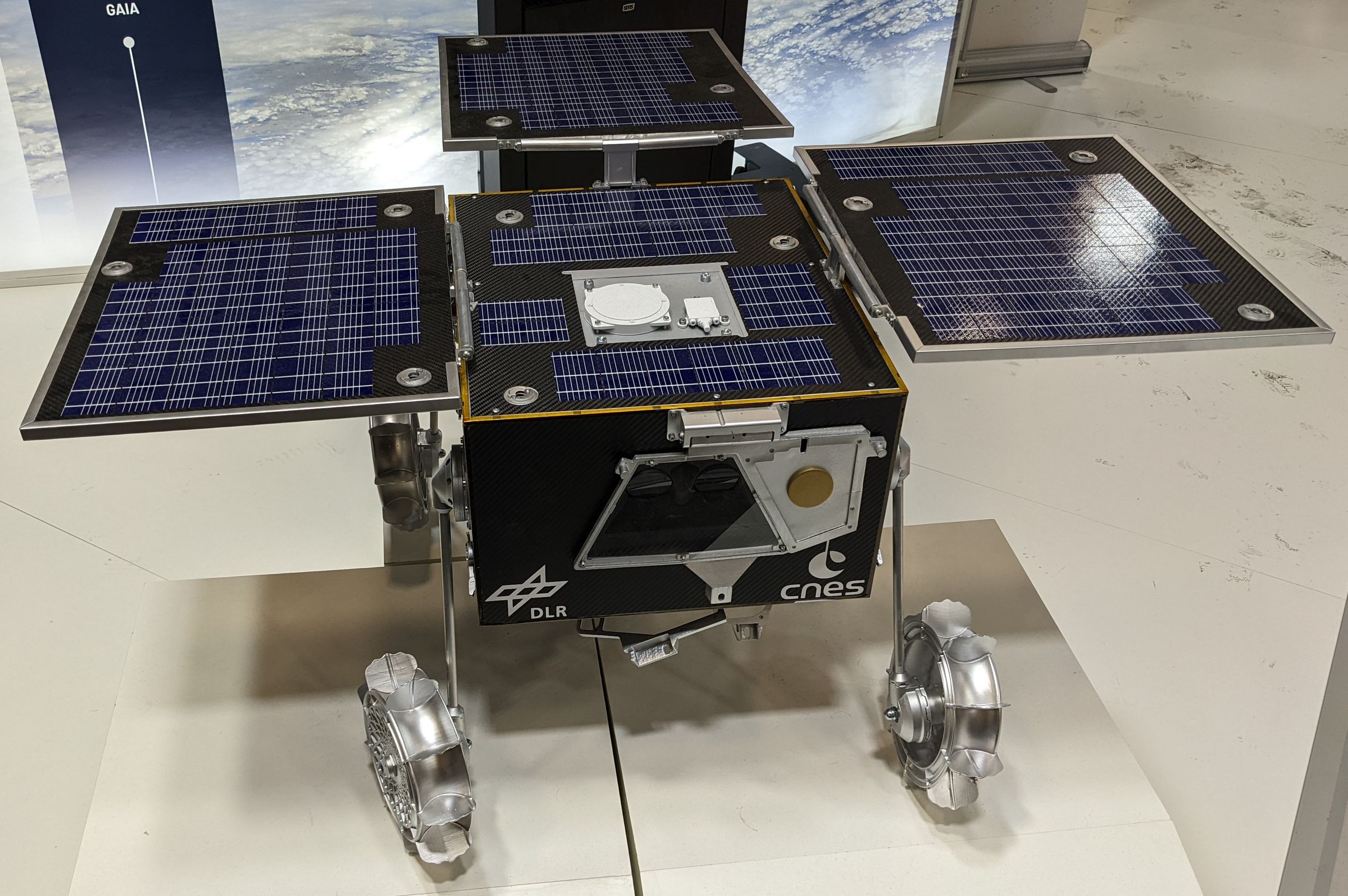
The Idefix rover was developed jointly by the German Aerospace Center (DLR) and the French space agency CNES for the Japanese MMX (Martian Moons eXploration) mission. DLR constructed the rover's carbon-fibre body and chassis in Bremen; in November 2022 the structure was delivered to CNES in Toulouse for integration of the remaining systems. The rover was completed in June 2023 and was named Idefix, after Idéfix (Dogmatix), Obelix's dog in the Asterix comics. The name was announced at the 2023 Paris Air Show to connect the rover with the name of France's first satellite, Astérix (1965).
In 2024 the completed rover was sent to Japan for integration with the MMX spacecraft. MMX was launched on 19 October 2026 aboard an H3 rocket from the Tanegashima Space Center. The spacecraft is scheduled to reach Mars in summer 2027, after which it will study Phobos and Deimos from orbit before releasing Idefix toward the surface of Phobos in late 2028 or early 2029. Idefix will then begin its surface exploration period, after which the MMX spacecraft will itself land on Phobos, collect at least 10 grams of surface material, and return a sample capsule to Earth in 2031.
Design
Idefix is a small, solar-powered rover designed for the extremely low surface gravity (0.0030 to 0.0068 m/s²) and wide temperature swings (more than 200 °C over a roughly seven-hour day–night cycle) of Phobos. The carbon-fibre-reinforced structure was developed by DLR's Institute of Lightweight Systems. Because of long signal travel times to Earth, the rover must perform some tasks autonomously; all commands and telemetry are relayed through the MMX spacecraft and JAXA's Sagamihara ground segment, and direct Earth–rover transmission is not possible. Spacecraft–rover contact occurs twice per Earth day.
Locomotion
The locomotion system (LOCO), developed by DLR's Institute of Robotics and Mechatronics, is the first wheeled locomotion system designed for operation at such low gravity. The rover has four individually actuated wheels, each weighing 190 g and carrying nine blades (grousers) suitable for both hard and sandy terrain. The wheels use a mesh-like structure produced by topology optimisation. LOCO provides four modes of operation: driving, alignment, uprighting, and passthrough. After landing, the system rights the rover from any orientation. Both DLR and CNES developed autonomous navigation software, although initially the rover will traverse following driving plans received from Earth. The expected traverse speed is approximately 1 mm per second.
Deployment
MMX will release Idefix from an altitude of 40 to 100 metres above Phobos into a landing area approximately 100 m in diameter. Rather than using a powered descent, the rover will fall freely and may bounce multiple times before coming to rest. It must then autonomously right itself, deploy its solar panels, and begin operations; failure to complete this sequence would prevent the rover from generating sufficient power to warm its computer and instruments. Deployment is planned only after roughly 18 months of Phobos observations by the MMX orbiter, so that the landing site can be selected from acquired data. Both Idefix and the MMX lander target a shared region of about 300 × 300 m, with the rover's landing zone separated from the spacecraft's to prevent the MMX landing from interfering with or damaging the rover's solar panels.
Specifications
Idefix's body measures 231 × 376 × 415 mm. Four solar panels, each 415 × 363 mm (total collecting area 0.36 m²), are designed to produce at least 60 watt-hours per Phobos sol (approximately 7 hours). The rover is designed for a minimum of 100 days of surface operations. Its mass is recorded as 23.47 kg in detailed technical data and as 25 kg in broader mission documentation; the configuration basis for the difference is not specified. The scientific instruments (cameras, radiometer, and Raman spectrometer) together account for 2.44 kg of the total mass.
Instruments
- RAX Raman spectrometer – developed by DLR, INTA/UVA, and JAXA/UTOPS/Rikkyo. Compact (81 × 98 × 125 mm) and weighing less than 1.4 kg, RAX uses a green Nd:YAG laser for excitation and operates in the 535–680 nm spectral range to detect a wide variety of minerals and identify both primary and altered mineral phases. It can analyse a 50 μm area and includes a verification target (a deuteriated polyethylene terephthalate pellet).
- miniRAD radiometer – a forward-mounted infrared radiometer with six thermophile sensors (45° field of view) for measuring radiative flux, surface temperature, and thermophysical properties. It observes targets at 25–150 cm distance. Its design has heritage from the Rosetta MUPUS thermal mapper, the MASCOT radiometer, and the InSight radiometer.
- WheelCams – a pair of downward-facing panchromatic microcameras on the rover's underside, built around 2048 × 2048 CASPEX (CMV4000) sensors with optics tilted approximately 3° to place the focal plane near the ground. They achieve ~100 μm/pixel at ~30 cm standoff and retain sharp focus from roughly 20–50 cm. Co-located LEDs (four white sources and three narrow-band emitters at 590, 720, and 880 nm) compensate for permanent shadow under the rover deck. Imagery is used to extract regolith particle size and shape down to ~200 μm, detect cohesive clumping, and infer bulk mechanical properties (friction angle, cohesion, shear strength, density, bearing capacity) from wheel sinkage, slip, and trench geometry.
- Navigation cameras – two cameras mounted on the top of the front panel (combined mass 526 g), each equipped with white LEDs for night-time observation. They use CASPEX 2048 × 2048 detectors with RGGB Bayer filters and 5.5 μm pixel pitch. The design is shared with the Rashid 1 lunar rover; the detectors were developed by 3DPLUS and CNES, and the wide-angle lenses by Lambda-X.
Operators
Idefix is operated from two control centres: DLR's Microgravity User Support Center (MUSC) in Cologne, Germany, and CNES in Toulouse, France. During the cruise phase to Mars, the centres take turns executing flight events, conducting system checks and instrument calibrations, and planning command sequences; a software update of the rover is also scheduled during the flight. During surface operations on Phobos, the two centres function in parallel with weekly role exchanges, one serving as prime centre executing current operations while the other plans subsequent seven-day activity sequences.
Related equipment
Idefix builds on experience from earlier small-body landers: the German-French MASCOT rover, which touched down on asteroid Ryugu aboard JAXA's Hayabusa2 in 2018, and ESA's Philae lander on the Rosetta mission. Unlike MASCOT, which moved by hopping, Idefix is designed to drive on wheels across a surface in extremely low gravity. Two additional small rovers have been proposed for ESA's Ramses mission to an asteroid but have not yet been selected.
 Argentina
 Armenia
 Australia
 Austria
 Austria-Hungary
 Belgium
 Brazil
 United Kingdom
 United States
 Brunei
 Bulgaria
 Canada
 Chile
 China
 Colonial America
 Colombia
 Confederate States
 Croatia
 Czech
 Denmark
 Egypt
 Finland
 France
 Georgia
 Germany
 German Imperial
 Greece
 Holland
 Hungary
 India
 Indonesia
 Iran
 Iraq
 Ireland
 Israel
 Italy
 Japan
 Japan (1940)
 Jordan
 Kingdom of Italy
 Malaysia
 Mexico
 Myanmar
 Nazi Germany
 Netherlands
 New Zealand
 North Korea
 Norway
 Pakistan
 Peru
 Philippines
 Poland
 Portugal
 Prussia
 Romania

 Russia
 Saudi Arabia
 Serbia
 Singapore
 Slovakia
 Slovenia
 South Africa
 South Korea
 Soviet Union
 Spain
 Sweden
 Switzerland
 Syria
 Taiwan
 Thailand
 Turkey
 UAE
 Ukraine
 Vietnam
 Yugoslavia