
History
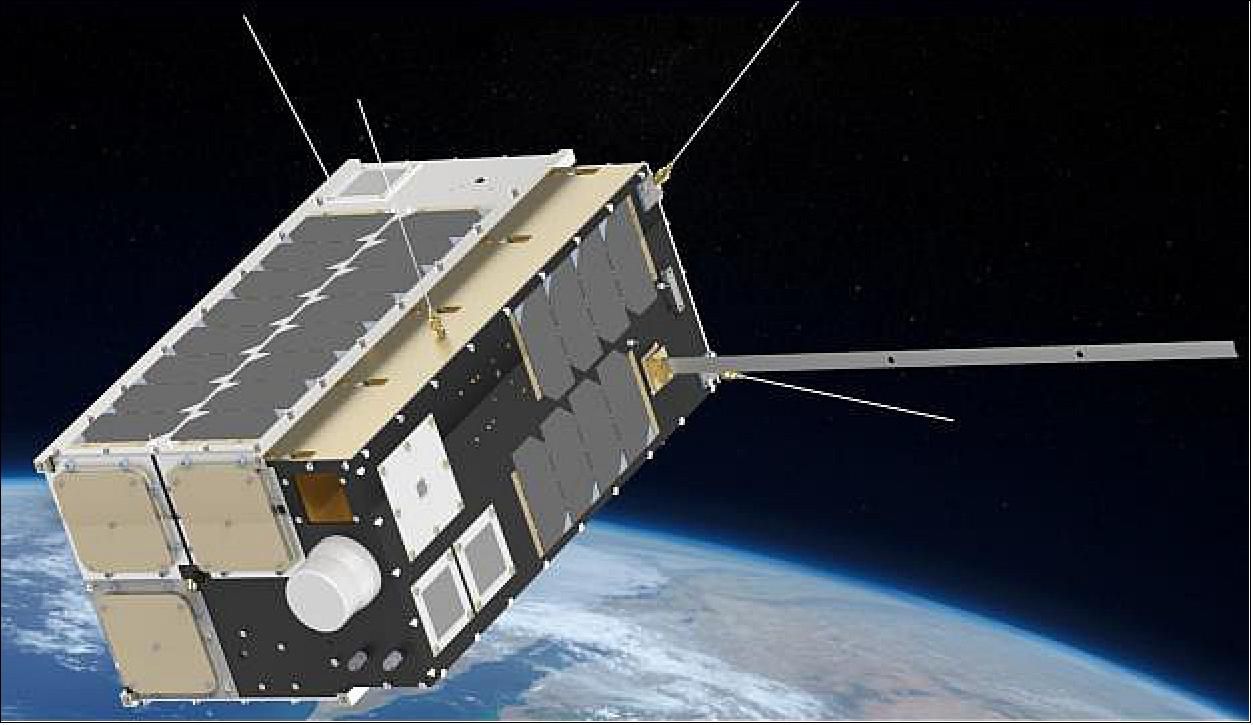
HawkEye 360, a Virginia-based company, is developing a space-based civil global intelligence network that uses radio frequency (RF) technology for signals intelligence (SIGINT) and transportation monitoring across air, land, and sea. The constellation of small satellites, designated Hawk, operates in low Earth orbit and collects information on specific radio signals worldwide to provide high-precision RF mapping and analytics.
The pathfinder constellation of three satellites was planned for launch in late 2017 and delayed to early 2018. The first Hawk satellites reached orbit in 2018 aboard a Falcon 9 rocket on the Spaceflight Industries SSO-A multi-satellite mission. In March 2019 the first operational cluster of three improved satellites was ordered, followed by an order for twelve more in September 2019. By October 2026, HawkEye 360 had sent nearly 50 satellites to low Earth orbit.
Three additional Hawk satellites were launched to orbit; the subject record records the date as 21 October while the launch report states 23 October 2026. The mission, designated "We're Not Hawking Around," lifted off aboard a Rocket Lab Electron rocket from the company's New Zealand launch site. Rocket Lab, a California-based company, described the flight as its 98th launch and its 19th of 2026. A prior Hawk launch had taken place two days earlier on SpaceX's Bandwagon-5 rideshare mission.
HawkEye 360 provides the collected data to the U.S. government and its allies. The company describes its space-based collection, proprietary signal processing, and AI-powered analytics as transforming knowledge of the RF spectrum into a strategic advantage.
Specifications
The Hawk constellation encompasses multiple satellite variants with differing bus and payload configurations.
Pathfinder (first three satellites, 2018)
The pathfinder satellites use the Nemo-V1 bus with the Comet-1 propulsion system. Their mass is 13 kg and they are powered by solar cells and batteries. The bus was provided by Deep Space Industries in partnership with the UTIAS Space Flight Laboratory (SFL) in Toronto; GomSpace supplied the flight-proven software-defined radio platforms and antennas as the payload. Their orbital parameters are approximately 577 × 590 km at 97.77° inclination.
Clusters 15 and later (enhanced versions)
Beginning with cluster 15, the satellites are enhanced versions with improved capabilities. They use the Defiant bus with water thrusters for propulsion, have a mass of 30 kg and a design lifetime of 3 years, and are powered by solar cells and batteries. The bus is provided by SFL Missions and the payload by HawkEye 360. The October 2026 mission targeted a deployment altitude of 520 km in low Earth orbit.
Operating in clusters of three, the satellites collect signal data from across the RF spectrum for maritime tracking, GNSS jamming detection, radar monitoring, communications mapping, and space defense.
 Argentina
 Armenia
 Australia
 Austria
 Austria-Hungary
 Belgium
 Brazil
 United Kingdom
 Brunei
 Bulgaria
 Canada
 Chile
 China
 Colonial America
 Colombia
 Confederate States
 Croatia
 Czech
 Denmark
 Egypt
 Finland
 France
 Georgia
 Germany
 German Imperial
 Greece
 Holland
 Hungary
 India
 Indonesia
 Iran
 Iraq
 Ireland
 Israel
 Italy
 Japan
 Japan (1940)
 Jordan
 Kingdom of Italy
 Malaysia
 Mexico
 Myanmar
 Nazi Germany
 Netherlands
 New Zealand
 North Korea
 Norway
 Pakistan
 Peru
 Philippines
 Poland
 Portugal
 Prussia
 Romania

 Russia
 Saudi Arabia
 Serbia
 Singapore
 Slovakia
 Slovenia
 South Africa
 South Korea
 Soviet Union
 Spain
 Sweden
 Switzerland
 Syria
 Taiwan
 Thailand
 Turkey
 UAE
 Ukraine
 Vietnam
 Yugoslavia