History
On 30 November 2017, ESA signed a contract with Thales Alenia Space and ELV for the engineering and preliminary development of Space Rider, covering detailed mission and system design up to the Critical Design Review. On 9 December 2020, ESA signed contracts with Thales Alenia Space Italy, Avio, Altec, and Telespazio for development of the space and ground segments. In October 2021, ESA issued an Announcement of Opportunity inviting organisations to fly payloads on Space Rider's first return flight and future missions. In June 2023, the programme advanced to Phase D, marking the transition to full-scale manufacturing and testing.
The descent and landing qualification campaign began in 2025, with earlier tests demonstrating parafoil deployment and autonomous capabilities. Thermal protection testing also took place during this period, exposing heat-shield materials to temperatures around 1,600 °C in plasma wind tunnel trials. In April 2026, the first full-size test model was completed at the Italian Aerospace Research Centre (CIRA) in Capua; it had been built at Romania's National Institute for Aerospace Research (INCAS) in Craiova before being shipped to Italy. A drop test attempt in May 2026 was aborted when a sensor flagged an issue during preparations, before the model was released.
On 6 October 2026, the full-scale Space Rider test model was released from a helicopter at an altitude of approximately 3 km over the Salto di Quirra military range in Sardinia, Italy. The initial drogue parachute deployed successfully and began slowing the vehicle's descent, but the main parafoil detached during deployment, leaving the prototype unable to slow its descent before crashing into the ground. All components were subsequently recovered. On 22 October 2026, ESA's Director of Space Transportation Géraldine Naja confirmed that an independent investigation was ongoing to determine the root cause and inform the next steps. Naja described the incident as unfortunate but noted that testing and validation is part of the development of a space system, and expressed confidence that the setback would not damage the remaining schedule or qualification activities.
Design
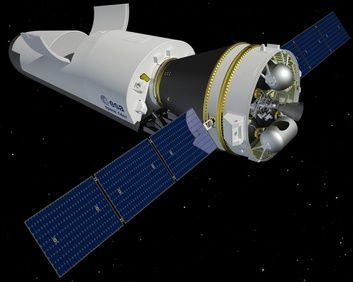
Space Rider consists of two main components: the AVUM Orbital Module (AOM) and the Re-entry Module (RM). The AOM, managed by Avio, is a modified version of the Vega-C upper stage that provides power, attitude control, and orbital manoeuvrability. After delivering the re-entry boost, the AOM separates and performs a deorbiting burn for its own disposal through destructive atmospheric re-entry. The RM, managed by Thales Alenia Space, is of IXV heritage and employs a wingless, lifting-body design. It returns to Earth by gliding under a steerable parafoil to a runway landing, a method not used by any other operational spacecraft.
The RM's Multi-Purpose Cargo Bay (MPCB) provides a controlled environment with power, thermal regulation, data handling, and telemetry for payloads that can be exposed to the space environment or kept enclosed. The spacecraft's avionics host the Guidance, Navigation and Control algorithms that steer the parafoil, adapting to wind conditions including gusts to guide the vehicle to a soft landing. Two winches pull the parafoil's steering lines, fully controlled by the onboard computer with no human involvement.
Specifications
Space Rider's key design parameters are summarised below.
- Payload capacity: up to 600 kg
- MPCB internal volume: 1.2 m³ (1,200 L)
- MPCB main door: 1,200 mm × 718 mm
- MPCB lateral doors (late-access/early-retrieval): 575 mm × 262 mm (two)
- Re-entry module length: 4.6 m
- Re-entry module mass: 3,000 kg; the parafoil is designed to support 2,950 kg during descent
- Parafoil dimensions: 27 m × 10 m
- Parafoil deployment altitude: approximately 6 km
- Orbital period: approximately 90 minutes
- Mission duration: at least two months in low Earth orbit
- Reusability: up to six flights with on-ground maintenance between flights
- Landing accuracy: within 150 m
- Power: 600 W
- Microgravity capability: as low as 5 × 10⁻⁶ g
- Downlink: up to 2 GB per day at 2 Mbit/s
- Uplink: 600 KB per orbit at 4 kbit/s
Program Status
Following the failed drop test of 6 October 2026, an independent investigation board is determining the root cause of the parafoil detachment. ESA does not currently expect the setback to delay the programme, as the remaining qualification activities are not on the critical path; the schedule will be reviewed once the investigation is complete. ESA is targeting the first half of 2028 for Space Rider's inaugural orbital flight aboard a Vega-C rocket from Europe's spaceport in Kourou, French Guiana.
Operators and Partners
Space Rider is developed by ESA with Thales Alenia Space Italy and Avio as co-prime contractors. Telespazio manages Orbital Control from the Fucino Space Centre in Italy, while ALTEC operates Landing Control and the Payloads Ground Control Centre in Turin. The drop test range at Salto di Quirra in Sardinia is operated by Italy's Ministry of Defense. The designated mission baseline landing site is the island of Santa Maria of the Azores; Kourou is designated for low-inclination orbits.
 Argentina
 Armenia
 Australia
 Austria
 Austria-Hungary
 Belgium
 Brazil
 United Kingdom
 United States
 Brunei
 Bulgaria
 Canada
 Chile
 China
 Colonial America
 Colombia
 Confederate States
 Croatia
 Czech
 Denmark
 Egypt
 Finland
 France
 Georgia
 Germany
 German Imperial
 Greece
 Holland
 Hungary
 India
 Indonesia
 Iran
 Iraq
 Ireland
 Israel
 Italy
 Japan
 Japan (1940)
 Jordan
 Kingdom of Italy
 Malaysia
 Mexico
 Myanmar
 Nazi Germany
 Netherlands
 New Zealand
 North Korea
 Norway
 Pakistan
 Peru
 Philippines
 Poland
 Portugal
 Prussia
 Romania

 Russia
 Saudi Arabia
 Serbia
 Singapore
 Slovakia
 Slovenia
 South Africa
 South Korea
 Soviet Union
 Spain
 Sweden
 Switzerland
 Syria
 Taiwan
 Thailand
 Turkey
 UAE
 Ukraine
 Vietnam
 Yugoslavia